

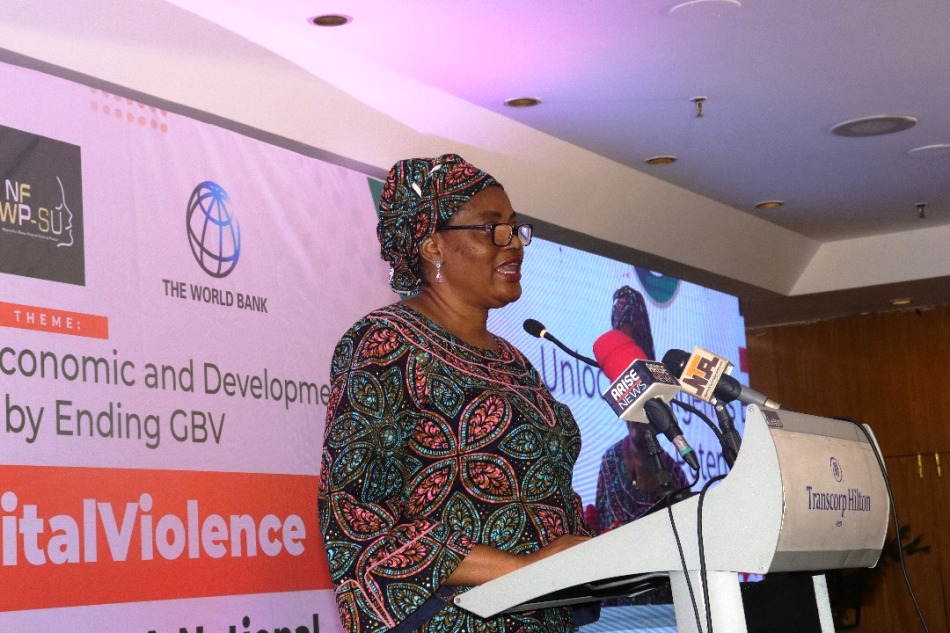
The Federal Ministry of Women Affairs and Social Development, in partnership with the World Bank Group Nigeria, today convened a high-level National Dialogue on Ending Gender-Based Violence (GBV) in Abuja and Lagos, bringing together government leaders, development partners, private sector actors, civil society, traditional and faith leaders, and the media to strengthen national action against all forms of violence targeting women and girls. This brings to an end the 2025, 16 Days of Activism anchored by the Ministry.
Honourable Minister of Women Affairs and Social Development, Hajiya Imaan Suleiman-Ibrahim, fsi, in her keynote address stated that Violence is no longer confined to physical spaces but now follows women into the privacy of their thoughts.
The Minister who was ably represented by the Permanent Secretary, Mrs. Esuabana Nko Asanye, stressed that Nigerians must unite with renewed determination to eliminate violence in all its forms—offline, in homes and workplaces, and online.
“Too many women wake up every day with fear sitting beside them, fear stalking them online, and fear limiting their potential,” she said, adding that no nation can become great when half its population is forced to live with that level of anxiety.
She described gender-based violence as a leadership, societal and national development problem, emphasizing its enormous economic and human cost.
“Every year, we lose trillions of naira—funds that should build schools, equip hospitals, and create jobs—because violence continues to silence productivity and drain potentials.”
The Minister highlighted alarming statistics, noting that 31% of Nigerian women aged 15–49 have experienced physical violence, while one in four girls has suffered sexual violence before adulthood adding that technology-facilitated abuse, has risen by over 45% in four years.
The Honourable Minister reaffirmed the Federal Government’s commitment under President Bola Ahmed Tinubu’s Renewed Hope Agenda to adopt evidence-driven, survivor-centered solutions.
She announced progress including:
Domestication of the VAPP Act in 35 states and the FCT
Strengthening of the National Strategy to End GBV
Near-universal domestication of the Child Rights Act
Expansion of the Protect Her and Health Safeguard Initiatives
Launch of the Digital Harmony Programme
Scale-up of the Nigeria for Women Programme (NFWP) to boost women’s economic independence
Operationalization of the National GBV Data Situation Room, providing real-time analytics for policy and accountability.
“Because every decision that affects women’s lives must be based on truth, not assumptions,” the Minister stressed.
She urged all sectors to escalate their actions:
“Let this Dialogue be remembered as the day we chose compassion over indifference, courage over silence, and accountability over excuses.”
In his keynote remarks, Mr. Mathew Verghis, World Bank Country Director for Nigeria, called GBV one of the most severe barriers to Africa’s economic and human development.
“GBV depresses productivity, limits women’s labour force participation, strains health and justice systems, and weakens the effectiveness of public investments,” Verghis said.
He reaffirmed that the World Bank’s 2024–2030 Gender Strategy places ending all forms of GBV as a core development objective, describing Nigeria as one of the 16 fast-track countries receiving technical and strategic support.
“Let this gathering be more than a ceremony. Let it be a pledge—that every girl can walk to school without fear and every woman can pursue her ambitions without harassment.”
Earlier, the Director of Women Development, Mrs. Blessing Anunike, who delivered the welcome address, emphasized the Ministry’s commitment to coordinated national action.
“The fight against gender-based violence is a fight for the soul of our nation,” she said.
She applauded the partnership with the World Bank, describing it as a catalyst for evidence-based programming, survivor-driven policies, and national capacity strengthening.
As the Dialogue ends, stakeholders collectively agreed to accelerate national reforms, including:
Strengthening survivor support systems and safe spaces
Enforcing faster prosecution and standardized GBV response protocols
Scaling data reporting through the GBV Situation Room
Expanding awareness and prevention at community and family levels
Enforcing stricter penalties for cyberbullying, blackmail, and online exploitation
Scaling women-focused financing and reintegration programs
The Dialogue served not only as a policy platform, but also as a national charge to sustain action beyond the 16 Days of Activism.
Signed
Ahmed Lawan Danbazau
mnipr
Head, Press and Public Relations Department