


The Federal Government has launched the Renewed Hope Campus Transport Scheme with the deployment of 240 solar powered electric tricycles to 12 federal universities, marking a major intervention to ease transportation challenges and promote clean, affordable mobility for students.
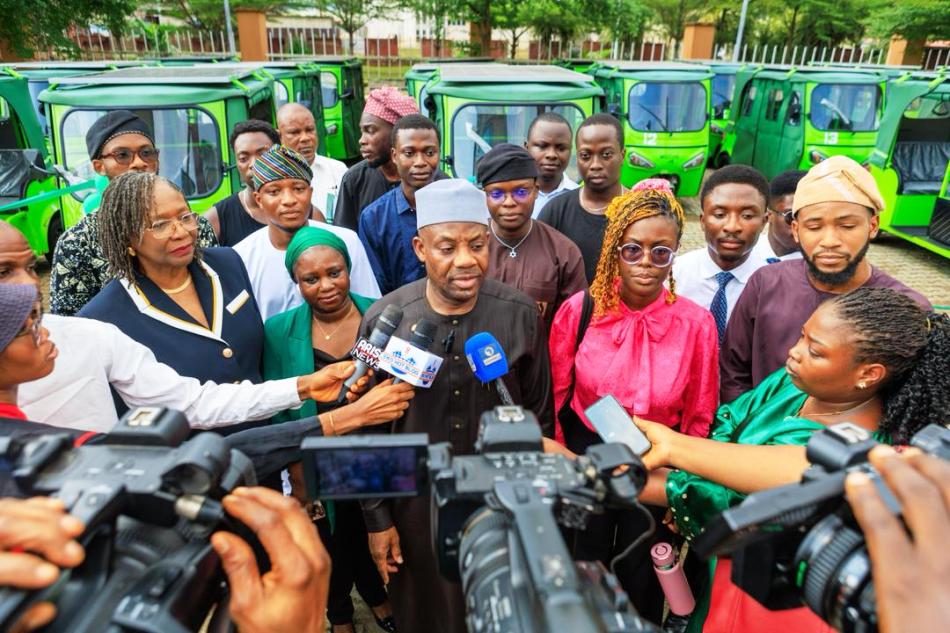
The Honourable Minister of Education, Dr Maruf Tunji Alausa FAMedS CON, inaugurated the initiative at the University of Lagos, UNILAG, describing it as a strategic response to rising transportation costs following fuel subsidy removal and exchange rate reforms. He noted that the scheme is a direct instruction from President Bola Ahmed Tinubu to develop innovative and sustainable mobility solutions for young people.
According to him, “Mr President directed that we design solutions that are innovative, sustainable and directly responsive to the needs of our young people. Today’s programme is the result of that directive.” He added that President Tinubu holds Nigerian youths in the highest esteem, stressing that the administration has funded education more than any in Nigeria’s history.
Implemented through TETFund, the programme deploys 20 electric tricycles and one solar powered charging station to each beneficiary university, equipped with solar panels, battery storage and inverters for reliable clean energy supply. Dr Alausa emphasised that the tricycles are donated directly to Student Union Governments, who will operate them at significantly reduced fares to ensure affordability while generating income for maintenance and expansion.
“These tricycles are for the students. They are not meant to be free, but should be provided at a very low cost to ensure sustainability and empower students with responsibility and leadership,” he said, urging student leaders to work with university management to guarantee equitable distribution and efficient operations.
The 12 universities selected under the first phase of the scheme cut across all six geopolitical zones including leading institutions in the South West such as the University of Lagos, Obafemi Awolowo University and the University of Ibadan; major universities in the South East including the University of Nigeria Nsukka, Nnamdi Azikiwe University and the Federal University of Technology Owerri; as well as those in the South South including the University of Benin, the University of Port Harcourt and the University of Uyo. Others include universities in the North Central including the University of Jos, the University of Ilorin, the University of Abuja and the Federal University of Technology Minna; the North East including Abubakar Tafawa Balewa University, the University of Maiduguri and Modibbo Adama University; and in the North West including Ahmadu Bello University and Bayero University Kano. The selection ensures broad national coverage and equity in the rollout of the scheme.
The initiative is projected to reduce transport expenses for students by more than 70 per cent, improve movement across campuses and enhance the overall learning experience. It also aligns with the Federal Government’s commitment to green innovation by promoting zero emission, solar powered mobility.
Dr Alausa announced that additional tricycles have been captured in the TETFund 2026 cycle to ensure nationwide expansion. He also highlighted complementary clean energy interventions under the Presidential CNG Initiative, through which about 2,000 university staff vehicles will be retrofitted with free CNG conversion kits.
“If you run your car on CNG, you will save up to 80 per cent of fuel costs compared to PMS. These conversions will be done for free. Mr President has already paid for that,” he said.
The Minister further revealed that procurement has been completed for an 11 megawatt solar mini grid to power UNILAG off grid, with construction expected to commence early next year.
In her remarks, the Vice Chancellor of UNILAG, Professor Folasade Tolulope Ogunsola, described the deployment as a significant boost to the university’s green mobility agenda. She noted that the university had earlier launched electric buses and commissioned additional units, enabling the campus to cut more than 120 metric tonnes of carbon dioxide emissions by the end of the year.
“Today is another milestone in our bid to maintain a clean, healthy campus environment. This transport scheme aligns with our drive for clean air,” she said, expressing appreciation to the Federal Government and IRS Green Energy for the timely delivery of the tricycles. She assured that the university would utilise the units judiciously.
Dr Alausa commended TETFund and the beneficiary universities for their cooperation and reaffirmed President Tinubu’s commitment that no student will be disadvantaged due to economic reforms. He described the scheme as “Renewed Hope in action. Practical, measurable and impactful.”
The Federal Ministry of Education reaffirmed the government’s commitment to supporting students as the Minister officially flagged off full operation of the electric tricycles across all beneficiary universities.
Signed
Boriowo Folasade
Director Press and Public Relations