

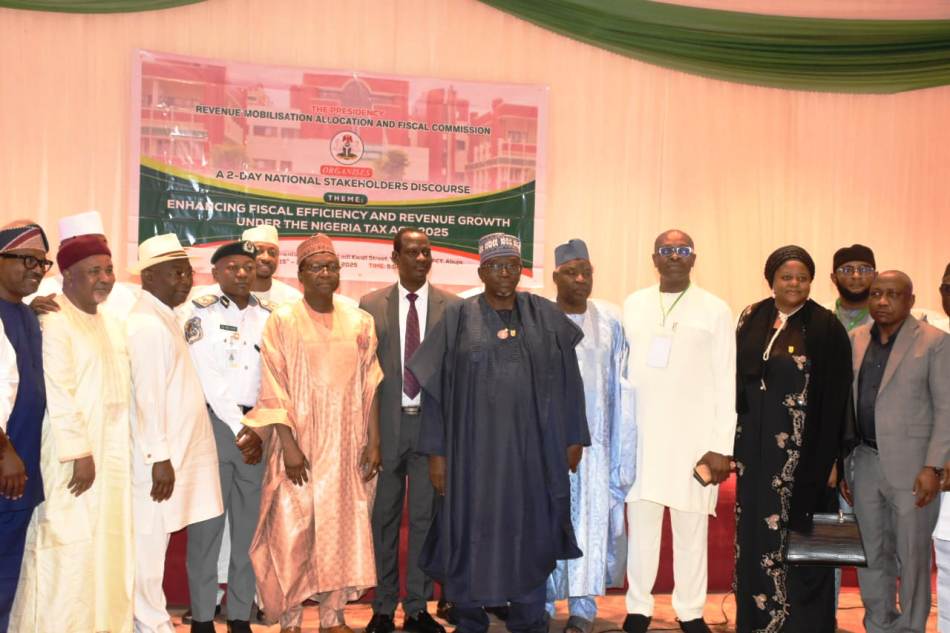
The Revenue Mobilisation Allocation and Fiscal Commission (RMAFC) has organised a 2-Day National Stakeholders’ Discourse on “Enhancing Fiscal Efficiency and Revenue Growth under the Nigeria Tax Act, 2025”, bringing together key government institutions, regulators, the private sector and development partners to strengthen collaboration and align strategies for the effective implementation of Nigeria’s new tax framework. The discourse held at the Abuja Continental Hotel is scheduled to last from Monday, 13th to Tuesday, 14th December 2025.
Declaring the occasion open, the Chairman, RMAFC, Dr. Mohammed Bello Shehu OFR described the engagement as both timely and necessary, considering the fact that the Nigeria Tax Act, 2025, will come into force on 1 January 2026.
“One critical but necessary fiscal matter that has elicited and continues to attract public discourse is the Nigeria Tax Act, 2025, which will come into effect on 1st January 2026,” the Chairman said . He explained that the Act followed extensive consultations and reforms by the Federal Government and represents a major step towards strengthening Nigeria’s fiscal architecture.
According to him, “the Nigeria Tax Act, 2025 has harmonised previously fragmented tax laws, reduced duplication and obsolete provisions, and enhanced the ease of doing business.”
He further stated that the Commission convened the Discourse in line with its constitutional mandate, stressing that “Paragraph 32(c) of Part I of the Third Schedule of the 1999 Constitution mandates the Commission to advise the Federal, State and Local Governments on fiscal efficiency and methods by which their revenue can be increased.”
Highlighting recent fiscal outcomes, the Chairman noted that, “The growth in Federation Account inflows reflects the impact of fiscal reforms, stronger audits, digital tracking and improved coordination among revenue agencies, which have expanded the revenue pool available for allocation to the three tiers of government.”
Delivering the Keynote Address, the Chairman of the Presidential Fiscal Policy and Tax Reforms Committee (PFTRC), Prof. Taiwo Oyedele described the Nigeria Tax Act, 2025 as a long-overdue but necessary reset of Nigeria’s tax system.
“This reform should have been done 20 years ago. The next best time is now.” Incremental fixing could no longer solve the problem; we needed a transformation.” He said.
Professor Oyedele explained that the reforms are designed to promote fairness, simplify compliance and support economic growth, noting that “we were taxing poverty and capital investments, and that is not the way to build a prosperous and inclusive economy.” According to him, the new tax framework is structured to protect low-income earners, support small businesses, simplify multiple tax laws, and create a more predictable environment that restores investor confidence.
He stressed that the success of the reforms must translate into tangible benefits for citizens, stating that, “When we say the economy is improving, it must mean something to households and businesses; macro gains must translate into micro outcomes.”
In his Welcome Address, the Chairman, Fiscal Efficiency and Budget Committee, RMAFC, Ambassador Desmond Akawor, described the discourse as a defining moment in Nigeria’s fiscal journey.
“The choices we make today will shape the stability, sustainability and resilience of Nigeria’s public finances for many years to come,” he said. He added that the Nigeria Tax Act, 2025 is aimed at modernising tax administration, strengthening compliance frameworks, closing revenue leakages, and expanding the revenue base across all tiers of government.
Goodwill messages at the opening ceremony reflected broad stakeholder alignment behind the reforms. The Governor of the Central Bank of Nigeria, Mr. Olayemi Cardoso, represented by the Deputy Governor, Mr. Philip Ikeazor said the reforms are designed to broaden the tax base, improve compliance and reduce dependence on oil revenues while strengthening transparency through modernised and digitalised tax administration.
The Comptroller-General of the Nigeria Customs Service, Bashir Adewale Adeniyi who was represented at the occasion noted that the reforms signal a more equitable tax environment. He said the measures are indicative of a fairer tax system where businesses can thrive while emphasizing the importance of inter-agency collaboration and technology-driven implementation.
The President of the Nigerian Association of Chambers of Commerce, Industry, Mines and Agriculture (NACCIMA), Engr. Jani Ibrahim, commended RMAFC for engaging the private sector, noting that “When tax policies are clear, predictable and business-friendly, enterprises are better positioned to invest, expand, create employment and contribute meaningfully to national revenue.”
From the industrial sector, the Permanent Secretary, Federal Ministry of Steel Development, Dr. Chris Osa Isokpunwu, described the Nigeria Tax Act, 2025 as a critical step towards modernising the tax system, strengthening compliance, reducing leakages, and promoting fairness and transparency. He highlighted the steel sector’s potential to expand Nigeria’s industrial tax base through value addition and increased production.
Speaking at the close of the opening ceremony, the Secretary to the Commission, Mr. Joseph Okechukwu Nwaze, emphasised the importance of sustained engagement beyond the Discourse, noting that the success of the Nigeria Tax Act, 2025 will depend on collective ownership, effective coordination and diligent implementation by all stakeholders across the three tiers of government.
Signed
Maryam Umar Yusuf, mnipr
Head, Information and Public Relations Unit
RMAFC