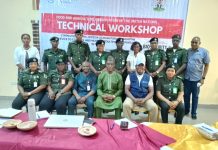



The Attorney-General of the Federation and Minister of Justice, Prince Lateef Fagbemi, SAN Thursday, cautioned that the nation’s cyberspace will not be secured by enforcement alone but by informed citizens, coordinated institutions, and principled leadership.
The National cascade program as envisioned by the JCTC according to him is more than a training but also a strategic intervention seeking to build the much-needed certified trainers, establish national cascade capacity, and embed sustainable prevention impact.
While assuring of government readiness to take deliberate steps towards strengthening institutional capacity within the cyber justice ecosystem, the AGF commended the Commonwealth Secretariat for the Cyber Fellowship program established to build a network of experts from Africa and the Caribbean to encourage cooperation, policy development and capacity building across the two regions.
Fagbemi stated this in Abuja at the National Cascade Leadership Training focused on Cybercrime Prevention.
At the retreat were Heads of Agencies, members of the Commonwealth Africa Cyber Fellows in Nigeria. Members of the Joint Case Team on cybercrimes (JCTC), ICT experts, and other stakeholders.
Represented by the Director, Administration of Criminal Justice Reforms, Mrs Leticia Ayoola- Daniels, the minister, who observed that cybercrimes and digital criminality has become a global threat, commended the organiser, the Joiint Case Team on Cybercrime (JCTC) and it’s supporting partners, the Commonwealth Secretariat and UK Foreign Commonwealth Development Office for depth of expertise in leadership facilitation and performance-based training, helping to translate vision into structured delivery and long-term impact.
“It is no longer news that cybercrimes are a global threat and increasingly complex at that, with losses estimated in trillions of dollars annually.
“It is imperative to note at this point that enforcement alone cannot address the challenge; prevention must be structured, messaging staying consistent, and capacity deliberately multiplied
“Ransomware attacks have increased exponentially in recent years; Online fraud schemes evolving with alarming sophistication; Young people are being drawn into digital criminality at earlier ages with the low barriers to entry; and Sextortion, identity theft, cryptocurrency-enabled laundering etc. continue to test our enforcement architecture.
“That empowerment has therefore materialized into a structured intervention aimed at deepening capacity and multiplying impact within the Joint Case Team on Cybercrimes.
“The Commonwealth Secretariat and UK Foreign, Commonwealth & Development Office (FCDO) are long-standing partners of the JCTC, particularly recounting the support for the Foundation Laying Retreat which preceded the formal launch and the signing of the Multilateral Memorandum of Understanding in April 2025. That was a defining moment for the JCTC, marking a mindset shift, forging trust, and moving from silos to shared mission in the fight against cybercrimes within the criminal justice sector and related stakeholders. That early investment is bearing fruit today.” Fagbemi said.
The Minister then thanked the support partner for awarding the fellowship to three Nigerians including a member of the Joint Case Team on Cybercrimes (JCTC), noting that it has translated into tangible benefit through the Ideas Incubator program for the wider inter-agency team.
In her remarks at the retreat, the Head, Joint Case Team on Cybercrime and Commonwealth Africa Cyber Fellow, Jamila Akaaga Ade said the work being done through the Cyber Fellowship is invaluable and so is the exchange within the network which in her words has recorded some wins, the most recent being the endorsement of the Africa Cyber Toolkit in Fiji by the Commonwealth Law Ministers Meeting.
She said: “This gathering is not accidental. It is intentional. It reflects a deliberate decision to pause from the urgency of case files, court schedules, intelligence reports, and inter-agency coordination, to strengthen the very foundation upon which all of that work rests, leadership, mindset, and cohesion.
“The Joint Case Team on Cybercrime was born out of necessity identified by the Honorable Attorney General of the Federation and Minister of Justice.
Cybercrime does not respect institutional boundaries. It does not wait for bureaucratic alignment. It evolves rapidly, crosses jurisdictions seamlessly, and exploits every gap in coordination.
“Our response, therefore, cannot be fragmented. It must be structured, disciplined, and united.
In a short speech, the senior research officer for the Commonwealth’s cyber capability programme, Dr Nkechi Amobi commended the Government of Nigeria and participating agencies for their continued commitment to strengthening the country’s response to cybercrime and protecting citizens in an increasingly digital society.
Other speakers at the retreat were Mr Akeem Lawal, Director ICT NAPTIP, Deputy Commissioner of Police, Dep Director NPF NCCC, Olufemi Akino la, Dr Muhammad Jiya. Chief Operating Officer, National Financial Intelligence Unit (NIFU) among others.
Signed
Hauwa Bala
Head, Information & PR