


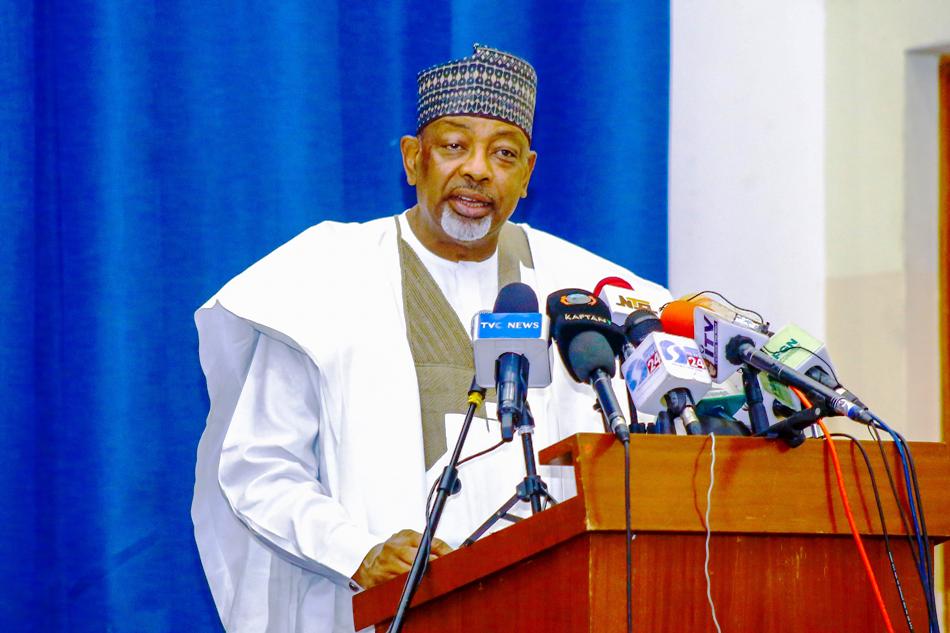
The Minister of Agriculture and Food Security, Sen Abubakar Kyari has revealed that the prices of essential food commodities have dropped by 50% nationwide, in fulfillment of President Bola Ahmed Tinubu’s mandate to achieve food security.
The Minister disclosed this during the Quarterly Citizens/Stakeholders Engagement Retreat on Agricultural Transformation, held at Yar’ Adua Centre in Abuja on Friday 6th March, 2026.
He said that since the present administration assumed office, food security has being a top priority, acknowledging the critical role the Ministry played in maintaining national stability and sovereignty.
Kyari pointed out that, “to achieve this, we focused on boosting local production and reducing our reliance on imports, with the ultimate goal of making affordable, nutritious food accessible to all Nigerians. Our efforts are starting to pay off, with a notable impact on food prices”.
“This is in contrast to previous years when food prices skyrocketed, way beyond what most Nigerians could afford. These efforts reflect our commitment to improving food security and the overall well-being of citizens. We are working to sustain this trend by addressing high input costs to ensure food remains accessible and affordable”. He emphasized.
The Minister further stated that, “our strategic focus on developing key value chains is positioning Nigeria as a major player in global agricultural market. We have prioritized and developed the rice, maize, wheat, millet, sorghum, yam, cocoa, kenaf, cowpea, cassava, soybeans, cotton, onion, FMAFS tomato, and oil palm value chains, thereby creating opportunities for millions of smallholder farmers and other stakeholders”.
“The provision of high-quality seeds, agrochemicals, safety kits, pest and disease management packs, coupled with capacity building initiatives undertaken in years 2024 and 2025 has significantly bolstered our agricultural value chains. These interventions have empowered farmers to boost productivity, reduce losses, and improve product quality, ultimately enhancing their livelihoods and contributing to a more robust agricultural sector. By enhancing their productivity, we have helped these farmers to transition from subsistence farming to thriving agribusinesses, contributing to national food security, employment generation, and economic growth”, the Minister added.
Speaking further, Kyari stated that in the last two years, the Federal Government has boosted agricultural productivity and food security through various initiatives. Key achievements include the distribution of over 1.9 million bags of fertilizers to nearly 1 million farmers, promoting sustainable soil management with 12,000 liters of organic fertilizers, and strengthening regulatory frameworks. We have made notable collaborations and partnerships with Russia, Turkiye, India, and Canada to enhance fertilizer production and technology transfer.
He added that, 109 fertilizer inspectors were trained and equipped, and over 329 industry stakeholders were trained on regulatory compliance. Efforts have been made to curb fake fertilizers from our markets through persecution of offenders. We have constructed a National Reference Laboratory and upgraded the National Fertilizer Management Platform to enhance fertilizer quality control, ensure regulatory compliance, and promote transparency in the fertilizer supply chain. Over 3,500 farmers were trained on organic fertilizers and soil management, promoting sustainable agriculture practices.
Kyari revealed that the 2025 Agricultural Performance survey carried out by the National Agricultural Extension and Research Liaison Services (NAERLS) in collaboration with Ministry, other relevant agencies, and NGOs highlighted steady growth in Nigeria’s agriculture, with rice, maize, sorghum, millet, cowpea, yam, and cassava all recording higher outputs compared to 2024. These production gains were driven by modest expansions in cultivated areas, improved farming practices, and resilience across major producing states, reinforcing food security and sustaining agro-industrial value chains.
He noted that the findings from the survey remain an essential tool for assessing the sector performance, guiding policy decisions, and advancing Nigeria’s food security agenda, adding that efforts have been made to create a conducive environment for agribusinesses to flourish nationwide amongst other things.
The Minister, therefore, called on stakeholders to prioritize agriculture as a key driver of economic growth, “our efforts are yielding results. While challenges persist, we are working tirelessly to overcome them. However, achieving these goals requires a collective effort, sustained energy, partnership, and alignment of our initiatives and resources. We will continue to collaborate with stakeholders, leveraging resources and expertise to drive growth and transformation in Nigeria’s agricultural sector. Together, let us build on our achievements and tackle the challenges ahead”.
In his remarks, the Minister of Information and National Orientation, Mohammed Idris. FNIPR said that the gathering reflects the governing philosophy of President Bola Ahmed Tinubu, which is rooted in transparency, participation and accountability, noting that governance must not operate in isolation from the people.
In his words, “it must be open, responsive and anchored on dialogue. Today’s engagement is therefore not just an event, it is a demonstration of this administration’s commitment to keeping Nigerians informed and involved”.
He noted that the Ministry of Information and National Orientation remains committed towards ensuring that Nigerians understand the direction and purpose of these reforms. “Our role is to bridge the gap between policy decisions and public awareness. Communication is not propaganda, it is accountability, it ensures that citizens are informed about government initiatives are given the opportunity to ask questions and provide feedback”, the Minister stressed.
Earlier, the Permanent Secretary, Federal Ministry of Agriculture and Food Security, Dr. Marcus Ogunbiyi stated that the gathering underscores a fundamental principle of governance that Agriculture and Food Security is not the responsibility of government alone, but a shared national endeavor that recognizes that farmers, processors, civil society, development partners, private actors, the media and the citizens are critical partners in shaping a resilient, productive and inclusive agrifood system.
He added that the primary goal of the engagement was to foster strong and enduring partnership aimed to strengthen open and transparent communication channels where recommendations are carefully considered, concerns are heard and questions addressed to ensure that policies and programmes are informed by practical insights, field experiences and technical expertise.
Eremah Anthonia (Mrs.)
Assistant Director
For: Head, Department of Information
6/3/2026