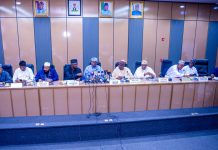



…………Unveils 2025 National Health Facility Survey.
…………Ensures Reforms Are Data- based Driven.
The Honourable Minister of State for Health and Social Welfare, Dr Iziaq Adekunle Salako has reaffirmed the unwavering commitment of President Bola Ahmed Tinubu’s administration to the health and well-being of every Nigerian, saying that through the Renewed Hope Agenda, the government has placed health at the centre of national development.
Dr. Salako made the assertion in Abuja during Ministerial Press briefing as part of activities marking the commemoration of 2026 World Health Day, which is observed globally on 7th of April yearly, to mark the anniversary of the establishment of the World Health Organisation (WHO) in 1948, to reflect on the health challenges confronting humanity and to renew collective commitment to improving the well-being of all people.
Elaborating the Highlights of this year’s theme “Together for Health: Stand with Science,” the Minister described it as both timely and profound as it calls on governments, scientists, health professionals, and communities to ensure that health policies and decisions are guided by evidence, research, and scientific collaboration.
He added that the theme also highlights the critical importance of science-driven health systems, emphasizing the need to rebuild trust in science and evidence-based policy making and ensure that health decisions are guided by data, knowledge, and collective responsibility, stressing that Science has always been the foundation of public health progress.
“From vaccines that prevent deadly diseases to innovations in diagnostics, various pharmaceuticals including precision medicines, and digital health systems, scientific discovery continues to save millions of lives each year. In Nigeria, our commitment is to ensure that policies and interventions are driven by credible data and evidence.”
Another highlights according to Salako is the importance of the One Health approach, which Nigeria has fully embraced in recognising the interconnectedness of human, animal health and environmental health, assuring that Federal Government will continue to strengthen collaboration between health, agriculture, environment, and research institutions to ensure that emerging health threats are detected early and addressed effectively.
The Minister said Nigeria has deeply appreciated the enduring partnership with the World Health Organisation which over the years supported the nation in strengthening disease surveillance and emergency response systems, expanding immunisation coverage, combating infectious diseases, improving maternal and child health, and building national health capacity, maintaining that the collaboration has helped to improve health outcomes for millions of Nigerians and remains a cornerstone of our public health progress.
Dr. Adekunle who said Nigeria’s health sector like many health system around the world, continues to face several longstanding structural challenges that require sustained and coordinated action, however, he stated these challenges are well recognised, and the Government of Nigeria remains firmly committed to addressing them through deliberate reforms, strategic investments, and strengthened partnerships under the Nigeria Health Sector Renewal Investment Initiative.
“We are clear in our vision for the country’s health sector: every Nigerian, regardless of income level, geographic location, or social status, should have access to quality healthcare services when they need them, without suffering financial hardship. Healthcare should not depend on a person’s ability to pay, but be accessible to all and available at the point of need as a fundamental right of citizenship” the Minister said.
He pointed out that in the last 3 years of the President Tinubu’s led administration, progress is being made as the Ministry continues to implement transformative reforms aimed at strengthening Nigeria’s health system and expanding access to quality healthcare for all Nigerians, reaffirming that Mr. President is firmly committed to building a more responsive, equitable, and resilient health system capable of meeting the health needs of both present and future generations.
According to Salako, the central to these reforms is the strengthening of primary healthcare as the foundation of the health system, with a focus on expanding coverage of essential health services and improving access to routine immunisation across communities, announcing that evidence shows that utilisation of primary healthcare services has increased significantly in recent years, rising from approximately 10 million visits in early 2024 to about 45 million visits by mid-2025, reflecting renewed public confidence in the system.
The State Minister further noted that immunisation which remains one of the most powerful tools available to protect children from preventable diseases has also recorded progress with over 14 millions girls (9 -14 years) have been reached with the HPV vaccine while the measles rubbela vaccine has reached over 102 million children 9months to 15 years representing about 99% coverage.
Shading more on the achievements, he explained , in order to address the high rate of maternal and newborn mortalities in the country, the Federal Ministry of Health and Social Welfare is implementing targeted programmes aimed at improving maternal and child health outcomes. “Through the Maternal Mortality Reduction Innovation Initiative, widely known as the MAMII, a targetted intervention based on scientific evidence, we are already seeing encouraging progress with maternal mortality reduction by about 17% in covered facilities.” He added.
On financial protection, Dr. Salako further said National Health Insurance Authority has been working closely with state governments and state health insurance agencies to expand health insurance coverage across Nigeria, announcing that more than 21.7 million Nigerians are now covered under various health insurance schemes representing almost 33% growth from late 2023, hoping that the number continues to grow steadily by expanding innovative programmes such as the Vulnerable Group Fund and community-based insurance initiatives.
He acknowledged that State Ministries of Health and sub-national resources are playing crucial roles in bringing healthcare services closer to communities and ensuring that national health policies translate into real and measurable improvements in the lives of citizens at the local level, describing the gesture as central to the success of our national health agenda.
Earlier in her welcome remarks, the Permanent Secretary Federal Ministry of Health and Social Welfare, Daju Kachollom S. mni described the event as a reminder that health is the foundation of national development, economic productivity, social stability and human dignity.
She added that it calls on all governments, institutions, communities and individuals to work together to build resilient health systems capable of responding to both present and emerging challenges, confirming that Ministry of Health has continued to pursue transformative reforms aimed at improving access to quality, affordable and equitable healthcare services.
“Working under the dynamic leadership of the Honorable Coordination Minister of Health and Social Welfare and the Minister of State for Health, we have strengthened primary healthcare systems, expanded health insurance coverage, advanced digital health initiatives and deepened partnerships across sectors to ensure that no Nigerian is left behind. Today’s press briefing provides an opportunity to highlight these achievements, outline ongoing priorities and reaffirm our commitment to the health, security and social welfare of all citizens.”
Daju Kachollom acknowledged the invaluable work played by the government partners, technical agencies, professional bodies, civil society organizations, media and the private sector who continue to collaborate with the Government of Nigeria in advancing national health priorities, stressing that the event provided opportunity to engage with the media, describing them as invaluable partners in public health communication whose role in shaping awareness, pampering with information and amplifying life-saving messages cannot be overstated.
Presenting goodwill message, from WHO, The country Director, Pavel Ursa said interventions have improved the survival of mothers and children, noting that investments in surveillance, laboratory systems and data have enhanced the country’s capacity to detect and respond to outbreaks from polio and measles to Lassa fever and cholera, attributing this to strong national leadership, dedicated health workers and sustained collaboration with partners.
He maintained that through science and solidarity, Nigeria can accelerate progress towards better health for all and contribute to a healthier, safer and more resilient future, warning that inequities and declining trust in science risk slowing the progress, saying that these challenges cannot be addressed in isolation, they require a shared commitment across sectors, discipline and commitment.
Speaking on behalf of development partners, Dr. Oluwatosin Kolade from UNFPA,said the occasion reminds that the remarkable gains achieved in global health from reductions in maternal and child mortality to advances in disease prevention and treatment have been made possible through science, evidence and collective action, stressing that at a time of increasing complex health challenges, stakeholders should reaffirm their shared commitment to science and evidence-informed decision-making as a foundation of sustainable health outcomes.
He urged Health Development Partners to renew their collective commitment to working together across government, partners, academia, civil society and communities to protect and promote health for all, noting that by standing firmly with science and by acting in solidarity, stronger, and more resilient health systems can be built and secure a healthier future for present and future generations.
After the launching of the 2025 National Health Facility Survey by the Dr. Salako, the Statistician-General of the Federation, Prince Adeyemi Adeniran, represented by Mr. David Babalola expressed Agency’s readiness to collaborate with ministries and agencies in providing evidence based data, disclosing that the 2025 National Health Facility Survey indicates 70% Public Health care facilities provide child delivery services, antinatal services are accessible.
Ado Bako
Assistant Director Information and Public Relations
8/4/2026