

The Federal Ministry of Agriculture and Food Security (FMAFS) has unveiled a comprehensive 10-Year Agrifood System Strategy and Action Plan that would be submitted to the Federal Executive Council for approval as part of efforts to align Nigeria’s food security agenda with the African Union’s CAADP Kampala Declaration (2026–2035) as well as revolutionizing the agricultural ecosystem.
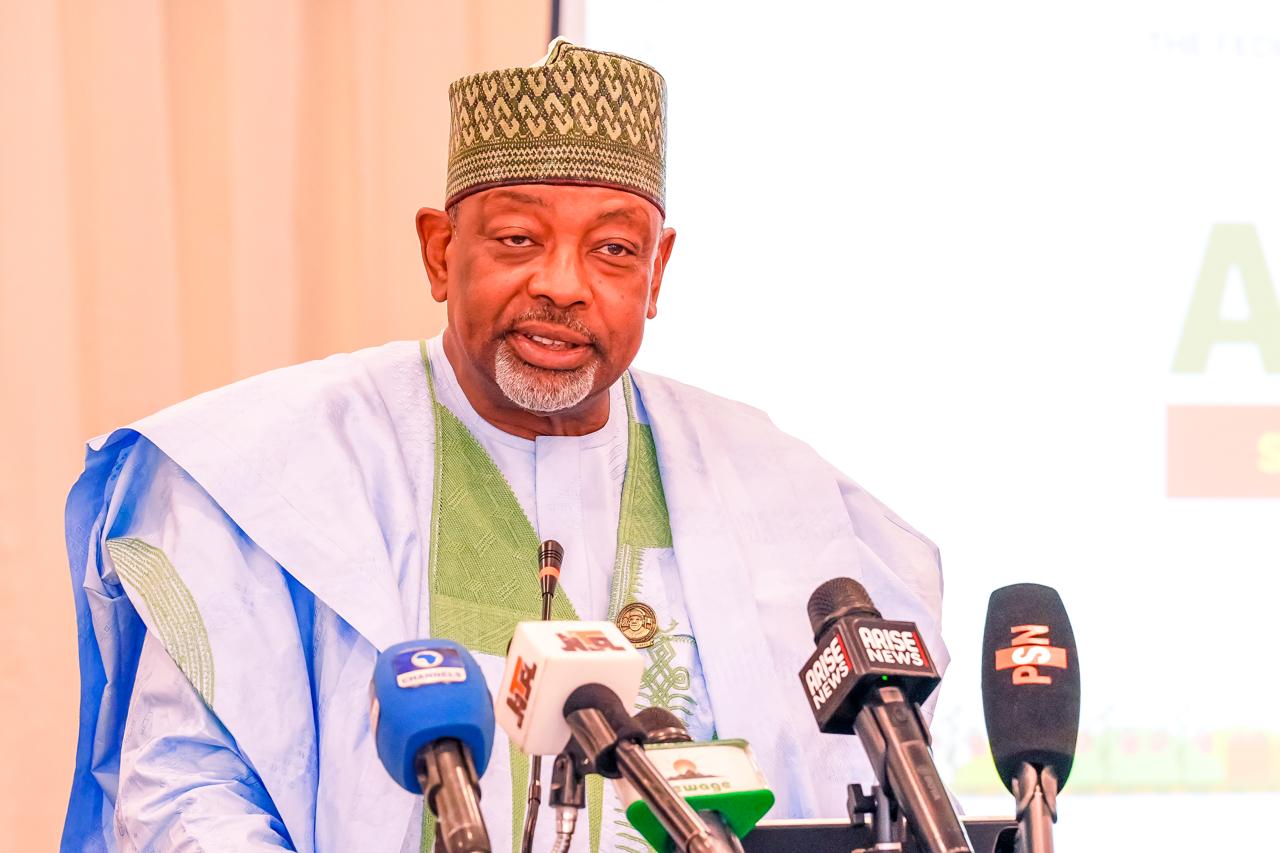
The Minister of Agriculture and Food Security, Sen. Abubakar Kyari, made this known during the Agrifood System Working Group Meeting held in Abuja on Thursday 23rd July, 2026.
Sen. Kyari revealed the directive that came from President Bola Ahmed Tinubu, GCFR, with a clear charge to move “beyond rhetoric, beyond pilot projects, and beyond fragmented interventions” and deliver a coherent, bankable, and implementable plan to transform Nigeria’s agrifood system, considers food security a national security imperative.
He said that “Governance is not merely one of six strategic objectives of the Kampala Declaration; it is the bedrock upon which all other pillars sustainable production, investment, food security, inclusivity, and resilience must stand.”
He noted that the Strategy was developed following extensive stakeholder consultations and validations across all six geopolitical zones and at the national level to ensure broad participation, inclusivity, and national ownership.
According to the Minister, Nigeria, as a dedicated Member State, is fully pledged to the Kampala Declaration adopted in Uganda in January 2025. Key targets include achieving a 2.45 per cent increase in agrifood output, tripling intra-African trade, reducing post-harvest losses by 50 per cent, mobilizing $100 billion in public and private investment, and reinvesting at least 15 per cent of agrifood GDP annually.
Sen. Kyari disclosed that the Strategy and Action Plan will be presented for adoption by the Working Group and subsequently forwarded to Federal Executive Council (FEC) for approval. This, he said, will ensure every Ministry, Department, and Agency aligns programmes and budgets with the unified vision.
Highlighting milestones under the Renewed Hope Agenda, the Minister highlighted that the administration has distributed over 10 million bags of fertiliser alongside a Guaranteed Price Model for 2 million smallholder farmers, adding that an additional 1.9 million bags of fertilizer have also been distributed to over one million farmers.
Other achievements include the distribution of over half a million bags of free fertilizer to over 120,000 farmers across 25 states and the FCT by NADF, also through its on-lending product has disbursed over 16 Billion to all value chains while also championing blended finance initiatives.
‘’Establishment of the Special Agro-Industrial Processing Zones (SAPZs), government-enabled, private-sector-led areas that bring infrastructure directly to farming communities, enabling farmers to process raw produce into packaged goods’’.
‘’In addition, the Renewed Hope Agricultural Mechanization Programme has deployed 2,000 tractors and other equipment to modernize farming practices, while the distribution of one million improved hybrid cocoa seedlings is repositioning Nigeria’s cocoa industry for greater global competitiveness’’.
Sen. Kyari revealed that the impact of these interventions is already evident, with essential food commodities recording price reductions of up to 50 per cent nationwide.
To drive implementation, he said, the Agrifood System Working Group whose membership cuts across public and private sectors, development partners, academia, farmers’ associations, and civil society, will meet biannually to review progress and proffer solutions.
The Minister also revealed that a Community of Practice meeting for State Commissioners overseeing agrifood systems will hold in September 2026 to strengthen coordination and drive domestication at the sub-national level.
“I enjoin all stakeholders to embrace governance as our collective responsibility. Let us strengthen inter-ministerial coordination and ensure that accountability is not an afterthought but a guiding principle,” Sen. Kyari urged.
“The time to act is now. Let us demonstrate the political will, the governance capacity, and the collective resolve to transform our agrifood systems and deliver the Nigeria we want,” he concluded.
In his remarks, the Minister of State for Agriculture and Food Security, Sen. Dr. Aliyu Sabi Abdullahi, stated that there is a need to provide robust and accurate data system in the agricultural ecosystem.
He commended the Agrifood System Working Group as a practical pathway to strengthen productivity, nutrition, and market access, and extended appreciation to His Excellency, President Bola Ahmed Tinubu, GCFR, for providing the enabling environment for the milestones being celebrated.
Speaking during the Ministerial Statements on Agrifood system Transformation, the Minister of Livestock Development, Alhaji Idi Mukhtar Maiha stated that ‘’the successful implementation of this Strategy will require adequate financing, innovative funding mechanisms, strong public-private partnerships, active participation of State Governments, and sustained support from our development partners’’.
He added that ‘’ we must ensure that resources are deployed efficiently, transparently, and in a manner that delivers measurable results’’.
In a welcome address, the Permanent Secretary in the Ministry, Dr. Marcus Ogunbiyi, stated that ‘’the Kampala Declaration provides a clear framework for coordinated action across the agrifood system, promoting investment, resilience, policy coherence, and mutual accountability. Nigeria’s agrifood system remains central to our national development objectives. It supports livelihoods, fuels rural economies, and offers significant opportunities for job creation and inclusive growth’’.
Dr. Ogunbiyi pointed out that ‘’the setting up of the Agrifood System Working Group to strengthen governance mechanisms holistically, addressing these interconnected issues and proffering lasting solutions toward food security for our people. This is why a collaborative approach is not just an option; it is an absolute imperative. We need the ingenuity of our researchers and academia to provide cutting-edge solutions’.
In attendance were Ministers of Budget and Economic Planning, Women Affairs, Livestock Development, Youth Development, Water Resources & Sanitation, Developmental Partners, among others.
Ezeaja Ikemefuna
Head, Department of Information
23/7/26