

The Federal Government has expressed its readiness to deepen collaboration with the United States private sector in livestock genetics, animal nutrition, technology and productivity as part of ongoing efforts to transform Nigeria’s livestock industry into a modern, productive and commercially viable sector.
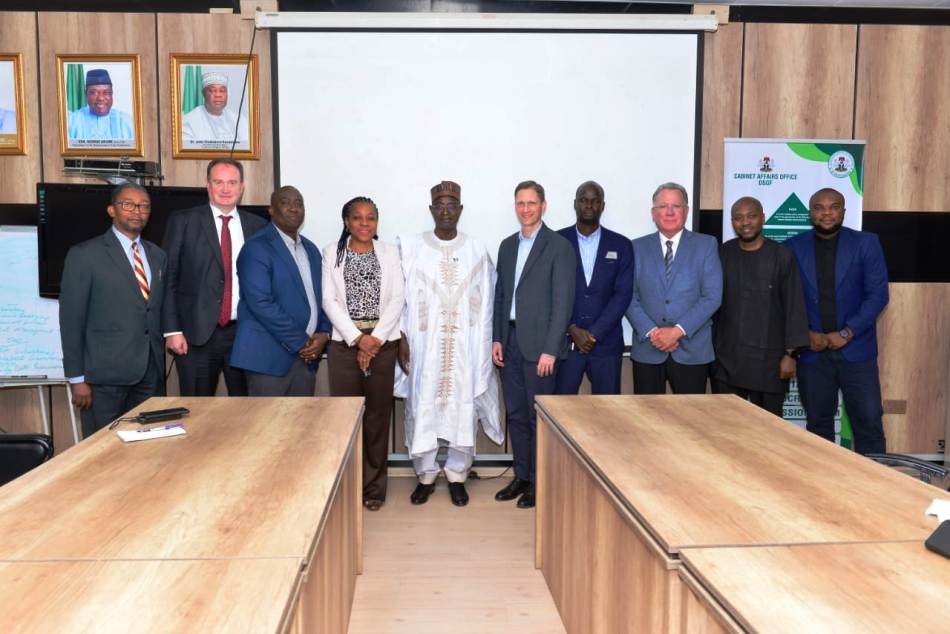
The Honourable Minister of Livestock Development, Hon. Idi Mukhtar Maiha, stated this on Friday, 11th July, 2026, in Abuja, when he received a delegation of American livestock companies and associations led by Mr. Christopher Beieleck, representing the United States Department of Agriculture (USDA), during a meeting with Directors of the Ministry and other stakeholders.
The Minister said , the engagement provided an important platform for the Ministry and the U.S. private sector to identify areas of mutual interest and develop practical partnerships capable of supporting the sustainable growth and development of Nigeria’s livestock industry.
He noted that, there was considerable alignment between the Ministry’s priorities and the solutions and expertise being offered by the visiting American companies, particularly in the areas of livestock genetics, feed and nutrition, poultry, dairy, ruminants and pig production.
According to him, the focus should now shift from broad discussions to concrete and actionable areas of collaboration, with clearly defined responsibilities, direct communication channels and measurable outcomes.
“Seeing you here today is the first level of getting to benefit from each other. We need to stay close together, ”the Minister said.
Stressing the importance of maintaining regular engagement and ensuring that the contacts established during the meeting translated into sustainable partnerships.
Maiha further explained that, the Federal Government was working to strengthen and reorganise livestock facilities and production systems across the country as part of efforts to establish a more coordinated, efficient and productive livestock industry.
He noted that Nigeria’s large population and expanding livestock market offered significant opportunities for investment, adding that the present period provided an opportunity for government and potential investors to clearly identify the respective contributions required to address existing challenges and unlock the sector’s enormous potential.
Earlier, Mr. Christopher Bielecki, representing the USDA, said the delegation’s visit was aimed at introducing leading American private-sector companies and livestock associations to Nigeria’s livestock sector and exploring opportunities for mutually beneficial partnerships.
He disclosed that the U.S. Government was also supporting Nigeria’s livestock sector through the Food for Progress programme, with an investment of approximately $25 million over five years, focusing on the poultry, aquaculture and animal feed value chains.
Beilecki said the participation of American private-sector companies in the engagement demonstrated their growing interest in Nigeria’s livestock industry and the investment opportunities available across the sector.
He emphasised that the objective of the partnership was not limited to supporting commercial businesses but also to contributing to the development of smallholder farmers and livestock producers through technology transfer, partnerships, training and capacity development.
A representative of STgenetics and Fast Genetics, Mr. Gregg BeVier, highlighted the companies’ expertise in livestock genetics, precision-farming technologies, sex-sorted semen and genetic testing.
He explained that, the application of advanced genetic technologies could enable Nigerian farmers to improve herd genetics, increase the number of productive female animals and make more informed breeding decisions.
BeVier also highlighted an artificial intelligence-based technology capable of monitoring animals and providing real-time information, including body temperature and movement patterns, which could assist farmers in identifying critical stages of the reproductive cycle and improving herd management.
He expressed interest in expanding the companies’ activities in Nigeria, including the provision of improved genetics, genetic testing and other livestock technologies.
He, however, stressed the importance of building local technical capacity, particularly in artificial insemination, noting that the expansion of modern breeding technologies would require a significant number of well-trained artificial insemination technicians across the country.
BeVier also called for stronger collaboration among government, private companies, research institutions and development partners to ensure that livestock data and interventions were properly captured, evaluated and replicated across states.
The meeting further , explored opportunities in dairy development, particularly the application of improved genetics and feed technologies to increase milk production and facilitate the transition of informal dairy producers into more organised and formal value chains.
Speaking on behalf of ADM (Archer Daniels Midland), the General Manager, Mrs. Ifunayan Aginam, said the company had been operating in Nigeria for about four years and had been supporting the livestock sector through feed additives, mineral and vitamin premixes, technical support, feed formulation and training.
She disclosed that ADM also operates a laboratory in Nigeria for the analysis of raw materials used by farmers and feed millers, thereby supporting improved feed quality and formulation.
Aginam, however, identified the scarcity of some essential raw materials as a major challenge confronting Nigeria’s feed industry, noting that several vitamins and minerals required for feed production were still imported.
She appealed to the Ministry to support efforts to address difficulties associated with obtaining the required End-User Certificate for the importation of essential feed ingredients, including dicalcium phosphate.
She explained that, adequate calcium and phosphate were critical to proper animal growth and development, particularly in poultry production.
The engagement also provided an opportunity for representatives of the U.S. Grains and Crop Council and other American livestock-sector organisations to highlight their interest in Nigeria’s poultry, aquaculture, dairy and beef industries.
A representative of the U.S. Grains and Crop Council said the organisation promotes the utilisation of U.S. corn, sorghum, barley, ethanol and corn co-products in livestock feed and expressed interest in supporting the development of efficient and sustainable feed systems in Nigeria.
The technical session also provided an opportunity for Directors from various departments of the Ministry to seek clarification on the level of Nigerian content envisaged in the proposed investments, particularly the potential for sourcing raw materials locally.
The Directors emphasised the need for prospective investors to establish stronger linkages with Nigerian universities, research institutes and other relevant institutions to promote research and development around locally available raw materials and technologies.
The Ministry also, stressed the importance of reducing excessive dependence on imported inputs by encouraging research collaborations that could identify, develop and commercialise locally available alternatives.
The discussions underscored the need to strengthen the relationship between government, the private sector, research institutions and development partners in order to promote local production, technology transfer, innovation and sustainable development across Nigeria’s livestock value chains.
Participants agreed on the need for continued engagement to develop practical areas of cooperation covering livestock genetics, breeding, genomics, animal health, diagnostics, feed and nutrition, research and development, trade finance, local content and private-sector investment.
The Minister reiterated the Ministry’s commitment to working with credible international and Nigerian private-sector partners to accelerate the transformation of the livestock sector and build a modern, productive and commercially viable industry capable of improving farmers’ livelihoods, creating jobs, strengthening food security and contributing significantly to Nigeria’s economic development.
Henrietta Okokon
Deputy Director, Information and Public Relations Department
11/8/26