


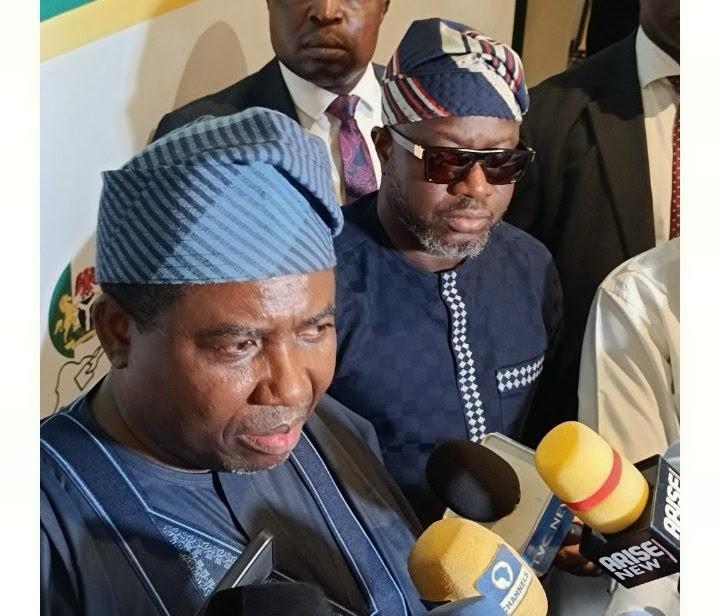
FIC REPORT (LAGOS STATE) – The Independent National Electoral Commission has begun a six-zone nationwide tour to assess its preparedness for the 2027 General Election, taking its zonal readiness exercise outside Abuja for the first time in more than two decades.
INEC Chairman, Prof. Joash Amupitan (SAN), launched the exercise on Monday at the Radisson Blu Hotel, Ikeja, Lagos, where he presided over the Southwest Zonal Interactive Meeting and Readiness Assessment.
The tour will take the Commission’s leadership to electoral officers across the country ahead of the presidential and National Assembly elections scheduled for January 16, 2027, and the governorship and state assembly elections on February 6, 2027.
Amupitan said the new approach was designed to bring the Commission’s leadership closer to its field operations.
“For more than two decades, zonal preparations were handled solely through headquarters directorates. This time, we are bringing the leadership directly to our electoral officers and administrative staff—the frontline guardians of Nigeria’s democracy,”he said.
He said electoral success would ultimately be determined at the grassroots rather than in Abuja.
“The true measure of electoral success is not determined in meeting rooms in Abuja. It is determined in the Local Government Areas, the Registration Area Centres, and the polling units, where our field officers handle the daily mechanics of this process,”he said.
Amupitan cited the recent Osun State governorship election as evidence of what the Commission could achieve when operational discipline, technical competence and administrative integrity were combined.
But he warned that the 2027 elections would present a significantly greater challenge, involving simultaneous polls across the 36 states and the Federal Capital Territory.
“Osun showed us what is possible when operational discipline, technical competence and administrative integrity converge,” Amupitan said. “But the 2027 General Election is a simultaneous exercise across 36 states and the Federal Capital Territory. It demands a far higher standard of performance than any single state election ever could.”
He identified voter apathy, declining public trust, and the spread of misinformation and disinformation as major threats to the elections.
According to him, the strongest response would be the professionalism and competence of INEC officials.
“The conduct and competence of our field staff remains our strongest defence against false narratives,”he said.
Amupitan disclosed that the Continuous Voter Registration exercise, conducted in three phases between August 2025 and July 2026, recorded 10,772,421 new registrants.
He said the figures were still undergoing verification through the Commission’s Automated Biometric Identification System.
The third phase introduced Nigeria’s first Online Registration Portal, while a new Printable Permanent Voter’s Card technology was deployed during the Osun election in accordance with Section 18(1) of the Electoral Act.
Amupitan said the national voter register was approaching 100 million, assuring eligible Nigerians that logistics would not prevent them from obtaining their cards.
“No eligible Nigerian will be disenfranchised because of logistical bottlenecks in PVC distribution”, “he said.
He also disclosed that INEC was strengthening its result-management systems, including the recently introduced eEC8A platform, to improve the traceability of results from polling units to the national collation centre.
On staff conduct, the chairman reiterated the Commission’s zero-tolerance policy towards partisan behaviour and administrative negligence, citing Section 26 of the Electoral Act, which requires electoral and election-related personnel to swear to an oath of neutrality.
In a development expected to boost staff morale, Amupitan said the Commission was finalising a new salary and welfare package for its employees, members and Resident Electoral Commissioners.
The package includes a new Consolidated Election Management Body Salary Structure, effective from January 1, 2026, as well as a 150 per cent increase in state-level overhead allocations from July 1, 2026.
Lagos State Resident Electoral Commissioner, Prof. Ayobami Salami, who hosted the first leg of the tour, said the state was honoured to lead the exercise.
He said credible elections depended on sustained preparation rather than activities on Election Day.
“Electoral credibility is built over time, through early preparation, competent personnel and effective coordination. It is not determined solely on Election Day,”Salami said.
Prof. Salami further stressed that the Southwest’s diversity required the assessment to go beyond routine checklists to examine logistics resilience, technological reliability and stakeholder engagement across the six states.
INEC’s Director of Planning and Monitoring, Mrs Helen Ajayi, said the assessment would cover logistics, ad hoc staff recruitment, technology, security, training, voter education and stakeholder engagement.
Mrs. Ajayu said the exercise would also identify operational bottlenecks early and reinforce compliance with the Commission’s code of conduct.
At a separate two-day Strategic Operational Workshop for Administrative Secretaries at the Marriott Hotel, Ikeja, Amupitan announced the development of a real-time election readiness tracker for monitoring preparations across the 36 states and the FCT.
He said INEC had historically lacked a uniform mechanism for monitoring the operational responsibilities of Administrative Secretaries.
The new system, based on a standardised Excel-based Administrative Secretary Master Operational Tracker Template, will be linked to the Commission’s Election Monitoring and Support Centre dashboard and Election Project Plan.
According to Amupitan, the tracker will give Resident Electoral Commissioners, Supervising National Commissioners, the Secretary to the Commission and headquarters officials real-time visibility into the distribution of electoral materials, ad hoc staff training and other aspects of state-level readiness.
The initiative, he said, would help the Commission replace “reactive panic with proactive management.”
The tracker is also expected to serve as a standard onboarding framework for future Administrative Secretaries.
Amupitan said Continuous Voter Registration was one of five operational areas being reviewed at the workshop, alongside logistics and material management, electoral technology, ad hoc staff optimisation and financial compliance.
He said the tracker was developed from lessons learnt during recent off-cycle elections, including Osun, and would be deployed nationwide during the six months preceding the 2027 elections.
The Secretary to the Commission, Mrs Rose Oriaran-Anthony, said the workshop was designed to ensure that the headquarters and all 36 states operated from a common Election Project Plan.
“Every state delegation is expected to leave here with a logistics risk register, an ad hoc recruitment and deployment plan, and a stakeholder engagement plan for the next three months—alongside the new tracker template,” she said.
The workshop was organised by the Office of the Secretary to the Commission with support from Development Alternatives Incorporated and the European Union’s Support to Democratic Governance in Nigeria programme.
It brought together National Commissioners, Resident Electoral Commissioners, the Director-General of The Electoral Institute, headquarters directors and Administrative Secretaries from the 36 states and the FCT.
Amupitan, while formally opening the national tour in Lagos, reminded INEC officials of the intense scrutiny that would accompany their preparations for the 2027 polls.
“The eyes of 200 million Nigerians—and the world—are fixed on us,”he said.
Sourced and Reported By:
IYEDEH Onowouzou David
ACIO&PRO
8/9/2026