

FIC REPORT (EKITI STATE) – The Ekiti State Government has strengthened disease surveillance, intensified public awareness and activated its emergency response structures following the confirmation of an Ebola case in the Federal Capital Territory.
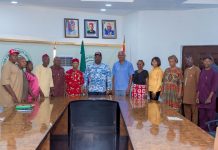
The Ekiti State Government set up a 30-man multi-ministerial committee as part of efforts at preventing as well as ensuring prompt diagnosis and managing possible identified cases of the dreaded ebola virus disease that is currently spreading across the West African sub region.
Speaking through the State government the State Commissioner for Health, Professor Olusola Fasuba who made this known in Ado Ekiti, explained that the government’s proactive stance was to prevent and control transmission of the disease to the state in view of the frightening 90% mortality rate of the current outbreak of the virus which has led to world-wide panic.
According to him, the committee comprised members from different relevant sectors including health, information, Police and other security agencies, road transport workers and women groups that would be able to track and refer suspected infected people for proper treatment as well as prevent further spread of the virus from the possibly infected persons.
Professor Fasuba disclosed that selected hospital wards in three General hospitals spread across the three senatorial districts of the state at Ode, Ifaki and Okemesi have been identified and set aside as case management centers to handle cases of possible spread of the infection to the state.
He assured that ambulance support would be provided for suspected infected persons from their respective locations and the premises would be properly decontaminated while surveillance measures would be intensified all over the state using a community-member approach.
The Commissioner added that it has become mandatory for people in the state to obtain death certificates from government health facilities for all deaths recorded in the state and all corpses awaiting burial, stressing that security agencies have been authorised to ensure proper screening of corpses entering or leaving the state.
Emphasizing that corpses would be properly screened before being admitted into mortuaries in the state, Fasuba assured that government would continue to strengthen Infection Prevention and Control Mechanism in all the Health facilities in the state, adding that safe and adequate disposal methods for waste and infected corpses would be adopted by the state.
While urging the people to be vigilant and report suspected cases of ebola to relevant authorities, Prof. Fasuba listed signs to watch out for to include vomiting with or without diarrhea and bleeding with or without dehydration adding that measures have adequately been put in place to contain the disease.
He added that radio jingles had been produced and were airing on two radio stations, while posters and other information, education and communication materials had been distributed to sensitise residents.
The Health Commissioner said laboratory personnel had been trained in Ebola sample collection, handling and transportation, while state and local government surveillance teams had received training on disease surveillance, active case search and emergency response.
Prof. Fasuba also disclosed that an Ebola Virus Disease Technical Working Group had been inaugurated to coordinate preparedness activities.
He disclosed that an emergency meeting of the technical working group was held on October 13 to assess the state’s preparedness level and accelerate outstanding response measures following reports of cases in Kenya.
Prof. Fasuba in his statement said airport officials and environmental health officers had been oriented on passenger screening and triage at the airport and other entry points.
He added that healthcare workers had undergone training in Ebola case management and infection prevention and control, while a simulation exercise had been conducted at the treatment centre of the Federal Teaching Hospital, Ido-Ekiti.
Explaining how the disease spreads, the government said Ebola could be transmitted through direct contact with the blood or other body fluids of an infected person showing symptoms or who had died from the disease, as well as through contaminated materials.
He noted that infected persons could not transmit the disease before symptoms appeared.
The Commissioner urged residents to remain vigilant and report anyone who developed a sudden fever, severe weakness, headache, vomiting, diarrhoea or unexplained bleeding, particularly if the person had travelled to countries affected by Ebola.
He advised anyone who suspected exposure to contact public health authorities immediately, even without symptoms.
Residents who developed symptoms after possible exposure were advised to avoid close contact with others and seek guidance from public health authorities before visiting a healthcare facility.
He also urged residents to maintain proper hand hygiene, avoid contact with the body fluids of suspected cases, cooperate with contact-tracing teams and refrain from spreading unverified information.
The government pledged to protect healthcare workers, patients and the wider public through continued surveillance and preparedness measures.
Residents were also advised to report suspected cases to the nearest general hospital or call designated responders.
Omotola Oluyemisi
AD (I&PR)
23/10/2026.