

ABUJA, NIGERIA — In a high-level strategic convergence in Abuja at the Federal Ministry of Environment, the Government of Nigeria identified a critical path toward transforming the Agro-Climatic Resilience in Semi-Arid Landscapes (ACReSAL) project from a time-bound initiative into a permanent pillar of national institutional architecture.
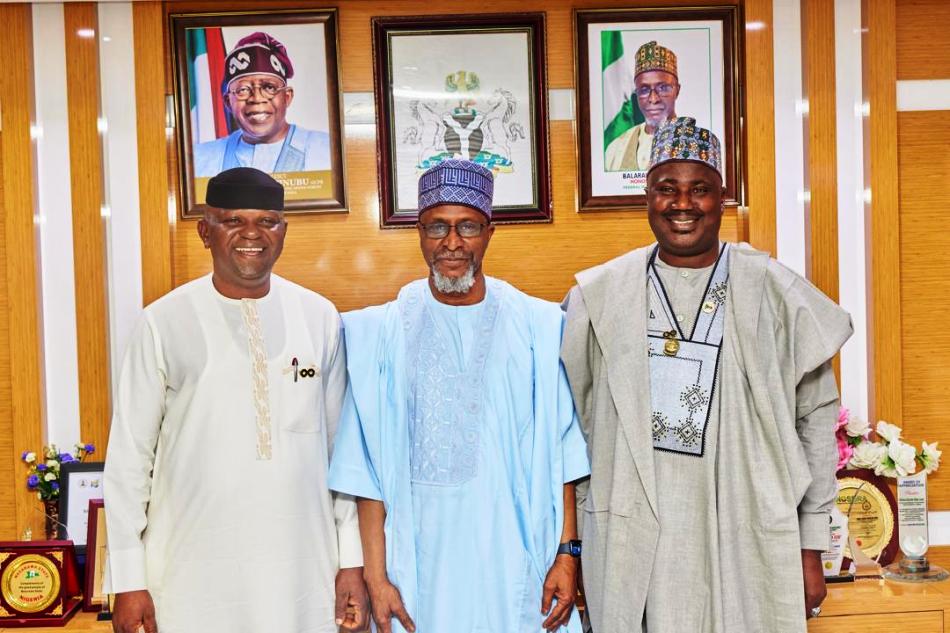
The meeting, which brought together the three leading cabinet members overseeing the project, reached a firm consensus on the urgent need to ensure that the monumental lessons in landscape restoration and community resilience are sustained beyond the project lifespan.
The Chairman of the ACReSAL Federal Steering Committee and Minister of Environment, Mallam Balarabe Abbas Lawal, emphasized that the “Knowledge Gain” harvested through ACReSAL’s implementation must become the permanent blueprint for Nigeria’s environmental stability.
This vision was reinforced by the Minister of Water Resources and Sanitation, Professor Joseph Utsev, who argued that institutionalization must be prioritized immediately through the creation of a robust “Federal Component” to provide oversight for all sustainability strategies.
Similarly, the Minister of State for Agriculture and Food Security, Senator Aliyu Sabi Abdullahi, highlighted the economic wisdom of this shift, noting that federal investment components in the states are remarkably cost-effective, providing a high impact return that justifies a permanent institutional presence at the grassroots.
A significant highlight of the meeting was the formal recognition that the World Bank has ranked ACReSAL as one of the best-performing projects within its entire Nigeria portfolio. This elite status sets a strong foundation for the upcoming Mid-Term Review (MTR), where the project’s achievements will be rigorously assessed against its Project Development Objectives (PDO) and Results Framework. The Ministers noted that the MTR serves as a critical junction to validate the project’s impact and refine its path toward meeting its ambitious land restoration targets.
To further bolster this momentum, the Ministers discussed an expanded engagement with the International Institute of Tropical Agriculture (IITA). This partnership is designed to technically empower Nigerian farmers by integrating IITA’s world-class research into the ACReSAL framework, specifically focusing on Climate-Smart Agriculture and resilience-building techniques. By bridging the gap between high-level research and local farm practice, the government aims to ensure that the productivity gains achieved under the project are both scientifically sound and practically sustainable.
Recognizing the project’s proven track record, the Ministers engaged in a vital discussion regarding Additional Financing (AF) for the project. This funding expansion has become an imperative to ensure that the project’s impact continues to grow.
They disclosed that additional financing will enable states to achieve even more results, scaling up restoration activities to reach more vulnerable communities and accelerating the achievement of Nigeria’s climate resilience targets.
The meeting concluded with a collective affirmation: ACReSAL has evolved beyond a project into a national standard for multi-sectoral success. By identifying the clear need for a permanent agency to drive the sustainability of project gains and the strategic push for additional financing, the Federal Government is working to ensure that Nigeria’s semi-arid landscapes remain resilient, productive and protected for years to come.
The MTR meeting is scheduled to hold in Kaduna, Kaduna State with stakeholders to include the 3 Ministers, all Commissioners and Permanent Secretaries of the 3 Ministeries of the 19 states and FCT, Abuja, the World Bank and all other relevant Stakeholders.
Jane Ozuruoke
For: Director, Press and Public Relations
Federal Ministry of Environment