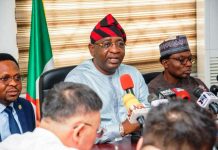

FIC Report (Lagos State) – The Federal Government has officially opened a new CCTV monitoring centre for the Third Mainland Bridge, marking a major step towards making one of Lagos’ busiest bridges safer and more secure.
The facility was commissioned by the Minister of Works, Engr. David Umahi, who said it is part of President Bola Tinubu’s wider plan to fix and protect key federal bridges across the country. The centre is equipped with high-definition cameras that monitor both the surface of the bridge and its underwater sections. It also comes with a surveillance boat and two Hilux vehicles to allow quick response to any emergency.
Umahi said that when the present administration took over in 2023, the Third Mainland Bridge, along with Carter and Iddo bridges, was in a very poor condition, with damaged road surfaces, faulty expansion joints and structural problems both above and below the water. He explained that after a detailed assessment, the government carried out a full rehabilitation of the bridge, including replacing the expansion joints and resurfacing the deck.
According to him, the quality of the work has made a clear difference. “The job is succeeding because it was done properly. Lagosians were very happy with the President for this beautiful work,” he said.
The minister explained that the new CCTV system will help tackle speeding, traffic blockages, vehicle fires and even suicide attempts on the bridge. With real-time monitoring, traffic officers will be able to spot problems quickly, while special lay-by areas on the bridge will allow enforcement without causing traffic jams. The Nigeria Police will be in charge of setting and enforcing speed limits, using the new cameras, patrol vehicles and boats provided for the project.
Umahi also revealed that the next phase of work, which will extend the bridge towards Falomo and Apongbon, is almost finished. He directed contractors to begin painting and marking the completed sections immediately so the area will look neat ahead of the extension’s commissioning before the end of January.
Beyond the bridge, the minister announced new standards for road construction nationwide. He said stone bases must now be laid wet, mixed with cement and compacted with pavers, while road shoulders will be built with concrete instead of asphalt to make them last longer.
He also disclosed that supervision within the Ministry of Works has been reshuffled, with senior officers now directly responsible for specific projects. He warned that any staff who fail to perform will be sanctioned, stressing that accountability will no longer be taken lightly.
On Lagos roads, Umahi ordered the immediate suspension of all concessions and allocations of federal road assets, saying there had been abuses in the past. Any future decisions, he said, must involve the Lagos State Government and be based on proper assessment of available spaces.
The minister also gave a seven-day deadline to illegal sand miners whose activities damaged one of the bridge’s piers, instructing them to remove their equipment and pay for repairs or face arrest.
Speaking on allegations surrounding the Lagos coastal highway, Umahi said the road’s alignment was changed only for technical reasons, to avoid damaging submarine cables belonging to MTN and other companies. He added that legal action would be taken against anyone spreading false claims about the project and urged the media to always verify information before publishing.
He reaffirmed the government’s commitment to building strong and safe infrastructure, saying the ongoing works reflect President Tinubu’s drive to improve Nigeria’s road network and boost national development.
Also speaking at the event, the Federal Controller of Works in Lagos, Engineer Olufemi Dare, said the new centre brings advanced technology that allows round-the-clock monitoring of the bridge, including its underwater parts. He noted that emergency teams can now respond to incidents within two to three minutes.
“This is just the first phase, but to the best of our knowledge, no other bridge in Nigeria has this level of surveillance and response system. It sets a new standard for bridge safety,” Dare said.
He added that the centre runs on renewable energy, with 240 solar panels powering the fully air-conditioned building. The facility is also supported by inverters, batteries, a 300kVA transformer, a standby generator, a borehole and a rooftop area for extra monitoring. As part of the wider project, 1,268 solar-powered streetlights have also been installed along the corridor.
Dare disclosed that the total cost of the project is N43.1 billion, out of which about N36.3 billion has already been paid. He said the government will return for a full commissioning once the bridge extension is completed.
Signed
Gloria Dawodu
CI&PRO
FIC Lagos