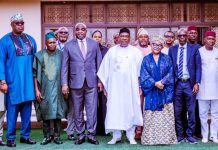



The Ministry of Foreign Affairs and the Nigerian Air Force have reaffirmed their commitment to closer institutional coordination and strengthened strategic communication following a familiarization and synergy visit by the Spokesperson of the Ministry of Foreign Affairs, Kimiebi Imomotimi Ebienfa to the Director of Public Relations and Information, Nigerian Air Force, Air Commodore Ehimen Ejodame on Monday 29th December, 2025.
The engagement, held at the Nigerian Air Force Headquarters, provided an opportunity for open, professional, and forward-looking dialogue on the interface between diplomatic communication and military public information, particularly against the backdrop of Nigeria’s evolving security environment and heightened international media attention. Both parties asserted that the visit was shaped by the growing complexity of contemporary security communication, in which operational actions are increasingly intertwined with diplomatic narratives, public perception, and international scrutiny. It was jointly observed that modern security challenges, especially those associated with asymmetric and non-conventional warfare, demand not only kinetic responses but also carefully coordinated messaging that safeguards national interests, protects sovereignty, and sustains public confidence.
In his remarks, the Nigerian Air Force Spokesperson, Air Commodore Ehimen Ejodame, provided operational insights into the realities of modern warfare, noting that Nigeria is confronted predominantly with asymmetric and guerrilla-style threats. He explained that hostile elements often operate within civilian populations, making it difficult to clearly distinguish combatants from non-combatants. This operational reality complicates both military engagements and public communication, as the same communities being protected may also be infiltrated by violent actors, thereby increasing the sensitivity of information released to the public.
From the diplomatic perspective, the Ministry of Foreign Affairs Spokesperson, Kimiebi Imomotimi Ebienfa, opined that the critical importance of carefully calibrated public messaging, particularly in situations involving international partners, foreign military actions, or sensitive security operations remains a valuable factor in public communication. The reason is that, uncoordinated, speculative, or premature statements, especially during rapidly evolving crises, can elevate operational matters into diplomatic issues before all facts are fully ascertained. Drawing from recent experiences, he recalled instances where delays or gaps in inter-agency communication resulted in intense media speculation, public anxiety, and avoidable diplomatic pressure, underscoring the necessity for pre-agreed communication frameworks, timely consultation, and mutual institutional awareness of respective mandates and constraints.
The Air Force Spokesperson further highlighted the delicate balance required in operational disclosures, explaining that certain information cannot be released publicly without risking mission integrity, intelligence assets, or the safety of personnel. He acknowledged, however, that insufficient or delayed communication can create information vacuums that are quickly exploited by misinformation, speculation, or hostile narratives. In this regard, both parties agreed that information warfare has become an integral dimension of modern conflict, and that Nigeria must remain vigilant against narratives capable of undermining the professionalism, capability, or legitimacy of its Armed Forces. It was accentuated that, despite the unique challenges posed by asymmetric warfare, Nigeria’s military continues to command respect both regionally and internationally.
The discussions also extended to broader strategic and geopolitical considerations, including public speculation about the intentions of foreign partners engaged in counterterrorism cooperation, the risk of collaborative security efforts being mischaracterized as dependency rather than partnership, and the danger of narratives that could inadvertently deepen social divisions or fuel radicalization. The spokespersons emphasized the necessity of evidence-based communication, particularly following major security incidents, and agreed that religious, regional, and political sensitivities must be carefully weighed in national security messaging, especially in communities already affected by trauma, displacement, or prolonged insecurity.
The engagement concluded with a shared understanding that sustained institutional synergy between the communication structures of the Ministry of Foreign Affairs and the Nigerian Air Force is essential to effective national security management. They also reaffirmed the need for early consultation during incidents with potential diplomatic implications, alignment of messaging to ensure consistency between operational realities and diplomatic positions, and continued professional interaction to build trust, familiarity, and mutual respect. It was further agreed that capacity-building initiatives, including joint media-response simulations and spokesperson engagements, among others, would strengthen whole-of-government coherence in crisis communication.
As key stakeholders in the Government communication ecosystem, they underscored the fact that Nigeria’s national interest remains paramount, and that coordinated strategic communication is a critical asset in safeguarding sovereignty, maintaining public trust, and enhancing Nigeria’s international standing.
The familiarization and synergy visit was described as timely, constructive, and forward-looking, reflecting a shared commitment to integrated national response mechanisms in addressing Nigeria’s security and diplomatic challenges.
Signed:
Kimiebi Imomotimi Ebienfa, anipr
Spokesperson,
Ministry of Foreign Affairs, Abuja.
Monday 29th, December 2025