


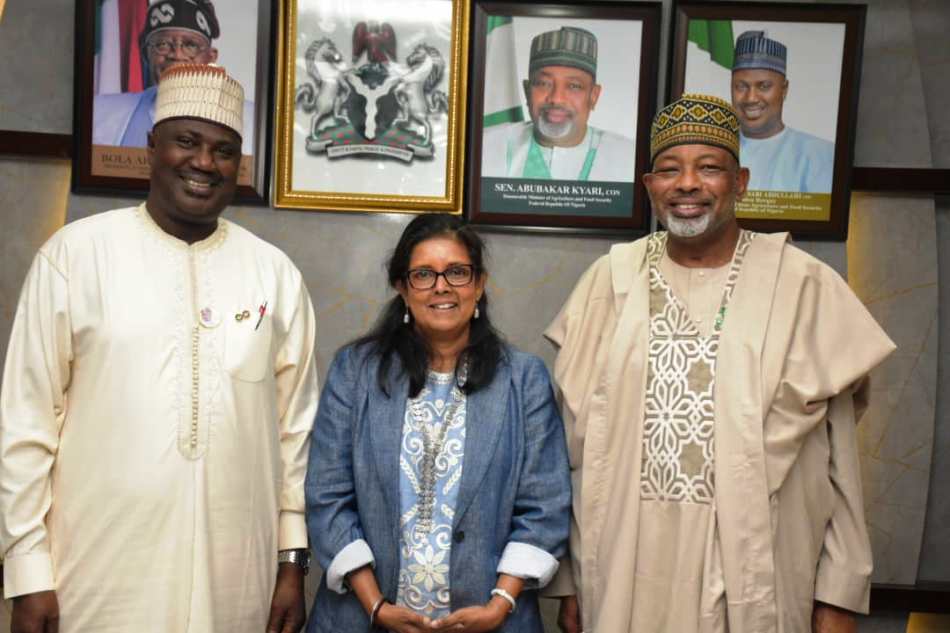
The Minister of Agriculture and Food Security, Sen. Abubakar Kyari has said that strategic market system would transform subsistence farming into profitable, competitive, and sustainable value chains as well as revolutionize the agricultural ecosystem.
The Minister made this disclosure during the courtesy visit by the Heifer International delegation led by the President and Chief Executive Officer, (CEO),Heifer International, Surita Sandosham in Abuja on Tuesday 10th March, 2026.
Kyari said that well-designed market system connects smallholder farmers to higher-value markets, directly increasing their incomes and fostering economic resilience.
He pointed out that Effective market strategies encourage private sector investment in agricultural services, reducing reliance on aid and creating sustainable, self-reinforcing markets.
The Minister stressed that Digital platforms and better market information enable farmers to negotiate better prices, reducing exploitation by intermediaries.
He added that Research identifies market access, value addition, and strengthened linkages as primary drivers of value chain competitiveness.
Kyari revealed that ‘’Extension Africa, Pullus Africa, Nimsy Agro, Vet Konnect, and Thrive Agric stand as strong examples of how catalytic support can help scale agribusiness innovation, improve farmer access to services, and strengthen agricultural value chains’’.
He acknowledged Heifer International’s continued support to Nigeria’s private sector. ‘’through your interventions and partnerships, several innovative agribusinesses have emerged and recorded notable success’’.
He further revealed that ‘’Heifer International remains a valued and longstanding partner in Nigeria’s agricultural development journey, Over the years, your organization has made meaningful contributions to supporting smallholder farmers, strengthening agricultural value chains, and improving rural livelihoods across the country. These efforts continue to align with our national priorities of building a resilient, productive, and inclusive agricultural sector’’.
According to him, ‘’ laudable initiative within our partnership is Heifer International’s collaboration with the Bank of Agriculture in support of Nigeria’s mechanization drive. Under this initiative, Heifer is working with the Bank to deploy trackers and a comprehensive digital platform designed to monitor tractor utilization as well as servicing and maintenance schedules, ensuring improved accountability and the longevity of these valuable assets.
‘’The platform is being offered to the Bank of Agriculture through a loan arrangement alongside technical support, reflecting a practical model that combines digital innovation with institutional strengthening’’.
In her remarks, the President and Chief Executive Officer, Heifer International, Surita Sandosham stated that ‘’ we are here to align our Program with your national priorities. Our goal is as bold as it is necessary: to support two million Nigerian households in achieving a sustainable living income by 2030. We recognize that this vision can only be achieved by the enabling environment you have created, which allows us to improve the livelihood of smallholder farmers’’.
Sandosham pointed out that ‘’ a critical pillar of this transition is our strategic collaboration with the Ministry of Agriculture and Food Security and IFAD in the monumental task of harmonizing the National Digital Farmers’ Registry. We are moving away from the fragmented, inconsistent records of the past and toward a unified, technology-driven database anchored on the National Identification Number’’.
She added that ‘’ by integrating geo-referencing and sophisticated data mapping, we are ensuring that every intervention, from subsidized inputs to extension services, reaches the real farmers on their real farmlands with absolute transparency’’.
She revealed that ‘’ the success in Edo State, where our tripartite partnership with the state government and Amo Farm is integrating women and youth into the poultry sector through the In-Power Her project. This model of ‘Market Systems Development’ is exactly what we hope to scale across other value chains, proving that when the public and private sectors align, we can create dignified, profitable jobs in rural communities.
By focusing on non-farm agricultural income activities, we are ensuring that the poultry value chain benefits every project participant’’, Sandosham added.
Ezeaja Ikemefuna
Head, Department of Information
10/3/2026