


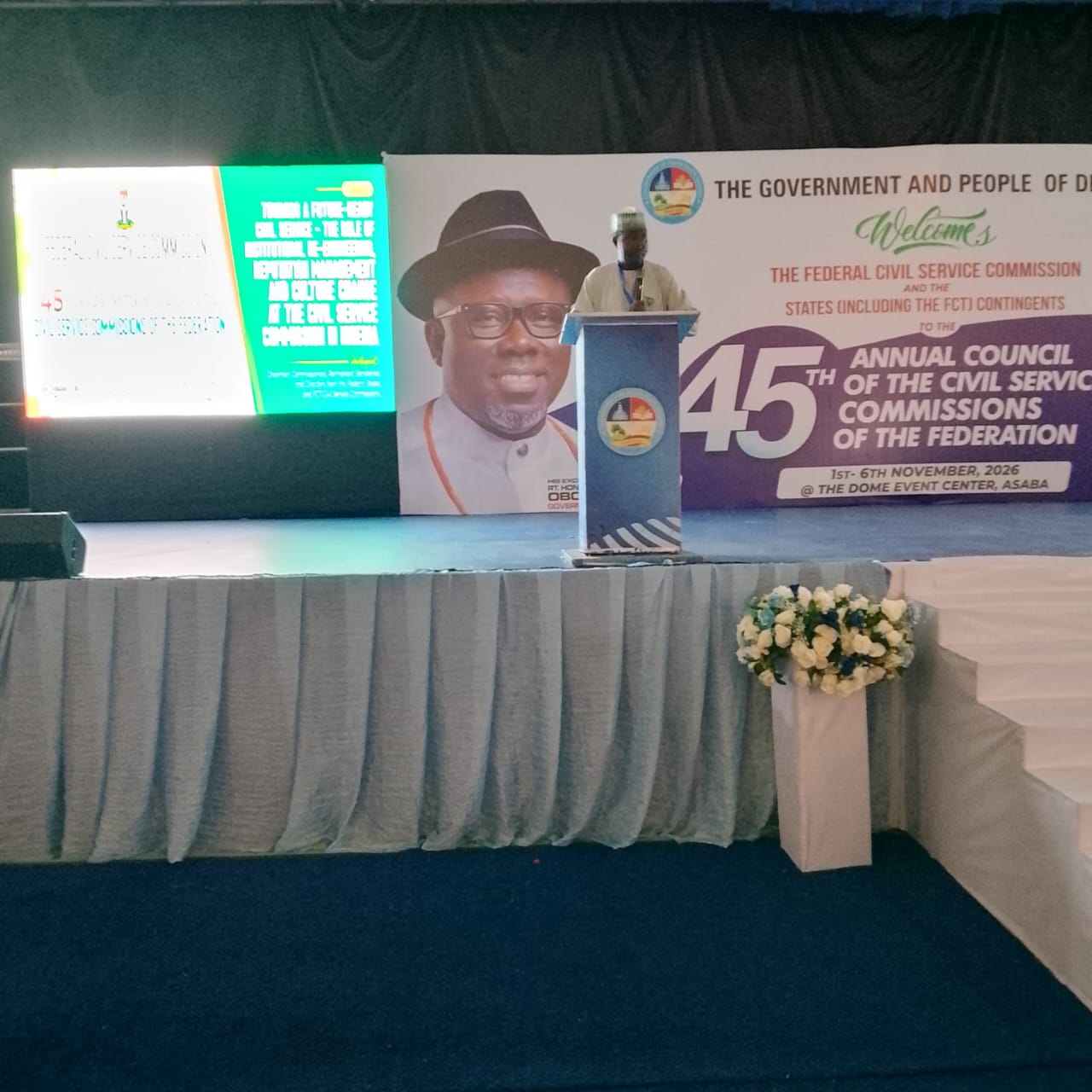
FIC REPORT (DELTA STATE) – At the week long 45th National Council of the Civil Service Commissions currently underway in Asaba, the Delta State Capital, participants and stakeholders from the 36 States and the Federal Capital Territory (FCT) Civil Service Commissions, have been charged to see institutional re-engineering as an essential foundation of a future-ready Civil Service.
The Director overseeing the Office of the Permanent Secretary, Federal Civil Service Commission (FCSC), Mr. Dahiru Lawal who doubles as the Chairman of this year’s Technical Session of the annual event, gave the charge while declaring the session open on Monday at Asaba.
Mr. Lawal described the Technical Meeting as a significant preparatory stage which provides an opportunity to examine the issues before the Council, clarify areas requiring technical attention, identify common challenges and develop practical recommendations expected to enrich the deliberations of the main Council.
He called on participants and stakeholders to approach the event with open minds, shared sense of purpose and a firm commitment to producing outcomes that will advance the effectiveness, integrity and credibility of the Civil Service Commissions across the Federation.
He described the theme of this year’s Council tagged;”Towards a Future-Ready Civil Service. The Role of Institutional Re-Engineering, Reputation Management and Culture Change at the Civil Service Commissions in Nigeria” as “timely and significant” while noting that the world of public administration is changing rapidly. He pointed out that technical advancement, increasing public expectations, evolving economic realities, complex governance challenges and the growing demand for transparency are reshaping the way governments operate and deliver services.
According to Mr. Lawal, “citizens increasingly expect public institutions to be responsive, accessible, efficient, fair and accountable. They expect government processes to be less cumbersome, decisions to be timely, recruitment and promotion to be credible and public resources to be managed responsibly”, he stated.
In his view, these expectations, require Civil Service that is not only capable of responding to present challenges but is also prepared to participate and manage the demands of the future.
“A future-ready Civil Service must be professional, competent, ethical, adaptable and result-oriented. It must possess the capacity to embrace innovation while preserving the core values of impartiality, continuity, discipline, integrity and service to the public”, Mr. Lawal noted.
He stated that Civil Service Commissions occupy a strategic position in achieving institutional objectives, adding that through their constitutional and statutory responsibilities, the Commissions influence the quality, composition, professionalism and performance of the workforce that implements government policies and programmes.
He, therefore, noted that the task before Civil Service Commissions extend
beyond routine personnel administration, emphasizing that as Civil Service Commissions, they have a responsibility to help shape a public service that can meet the aspirations of Nigerians and support sustainable national development.
Concerned on how Civil Service Commissions can be repositioned to build and sustain a professional, credible, technologically enabled and future-ready Civil Service across the Federation, he observed that institutional re-engineering is one of the essential foundations of a future-ready Civil Service, but noted that overtime, many public institutions have developed administrative processes, structures and working methods that may no longer be adequate for present day demands. He pointed out that in some instances, lengthy procedures, fragmented responsibilities, manual record-keeping, inadequate data systems and resistance to change can slow down decisions and undermine service delivery.
The Technical Session The chairman, therefore, called for a deliberate reassement of arrangements to ensure that current structures, systems and processes remain fit and should involve reviewing administrative procedures, strengthening internal controls, clarifying responsibilities, improving coordination and adopting appropriate digital solutions to personnel management.
Mr. Lawal emphasized the need for continual examination of recruitment, appointment, confirmation, promotion, discipline, record-keeping and other personnel management processes to identify unnecessary delays, inconsistencies and opportunities for improvement.
He stressed that digital platforms should be deployed to support secure personnel databases, electronic document management, timely processing of application and decisions as well as effective monitoring personnel actions. Such reforms he noted, must be accompanied by appropriate safeguards for data protection, cyber security, record integrity and accountability.
Meanwhile, he noted that Institutional re-engineering must also address the human dimension reform, asserting that new technologies and revised procedures will achieve limited results unless officers possess the skills, motivation and institutional support required to use them effectively.
Consequently, Mr. Lawal cautioned that we must invest in capacity development, leadership, change management and the continuous improvement of work processes.
Moving forward, he encouraged the Technical Meeting to examine the practical steps required to modernise our institutions with particular attention to digital transformation, effective monitoring and measurable results. He stressed that the objective should not simply be to digitise existing procedures, rather, it should be to redesign processes in ways that make them faster, more transparent, more reliable and more responsive to the needs of the government and the public.
Mr. Lawal who tasked participants and stakeholders to ensure that deliberations at the 45th National Council of Civil Service Commissions produce recommendations that can be implemented, monitored and sustained, thanked the Chairman and Members of the Federal Civil Service Commission, the Chairmen and Members of the states and FCT Civil Service Commissions, resource persons, facilitators and all participants for their commitment.
He also expressed profound thanks and appreciation to the host, Delta State Government and all stakeholders for the successful hosting of the 45th National Council of Civil Service Commissions of the Federation in Asaba, Delta State.
Earlier in a welcome address, the Permanent Secretary, Delta State Civil Service Commission, Mr. Fredrick Yoro while welcoming participants, noted that the event provides a unique opportunity for the Hon. Chairman, Federal Commissioners, Permanent Secretaries and other senior public servants to collectively examine emerging challenges, evaluate existing practices and develop innovative approaches to strengthening the machinery of government.
Speaking on the relevance of this year’s theme; “Towards a Future-Ready Civil Service. The Role of Institutional Re-Engineering, Reputation Management and Culture Change at the Civil Service Commissions in Nigeria”, Mr. Yoro recalled that in recent times, the Nigerian Public Service has come under serious attacks as being a clog in the wheel of progress due to deep seated issues like bureaucratic inefficiency, weak accountability, poor service delivery and declining employee performance. This according to him, has raised a lot of concerns in Public Administration discourse regarding how the Public Service couldb be modernized and transformed into a merit-based, efficient and professional apparatus.
Mr. Yoro noted that Institutional re-engineering, reputation management and culture change have been identified as possible primary drivers for modernising Nigeria’s Civil Service.
Consequently, Mr. Yoro observed that institutional Re-Engineering has therefore, become necessary, stressing that we must restructure underlying frameworks , systems and technologies of the Civil Service from outdated models to new public management systems.
He also stressed the need to engage in Reputation Management to strategically rebuild institutional trust by changing the public perception of the Nigerian Public/Civil Service which he noted had been marred by allegations of corruption, low capability and poor responsiveness.
On the need for culture change, the Permanent Secretary said we must also focus on transforming individual mindset and institutional norms, to drive a value-based work environment while affirming that building a future-ready Civil Service will not happen through isolated reforms. “It requires our collective leadership, Institutional commitment, political will, professional competence and sustained investment in people and systems”, he noted.
Mr. Yoro expressed optimism that discussions, presentations and deliberations during the week-long event would generate practical recommendations capable of strengthening our institutions and improving service delivery.
He welcomed stakeholders, participants and delegates from the Federal Civil Service Commission, States and the FCT Civil Service Commissions to Delta State and extended the heartfelt appreciation of the Chairman and Members of the Delta State Civil Service Commission to the leadership and members of the National Council for choosing Delta State to host the important annual gathering of Civil Service Commissions across the Federation.
Dignitaries at the opening session of the 45th National Council of the Civil Service Commissions included the Hon. Chairman FCSC, Prof. Tunji Olaopa NPOM, FCSC Commissioners representing various states in the Commission, the Chairman Delta State Civil Service Commission, Noble Lady (Chief) Amioku Roseline Eno JP, fica and members of the Commission as well as delegates from other states.
A communique is expected to be issued at the end of the Council deliberation which ends on Friday 6th November, 2026.
Felix Ijomah
FIC Asaba Delta State.
3rd November, 2026.