


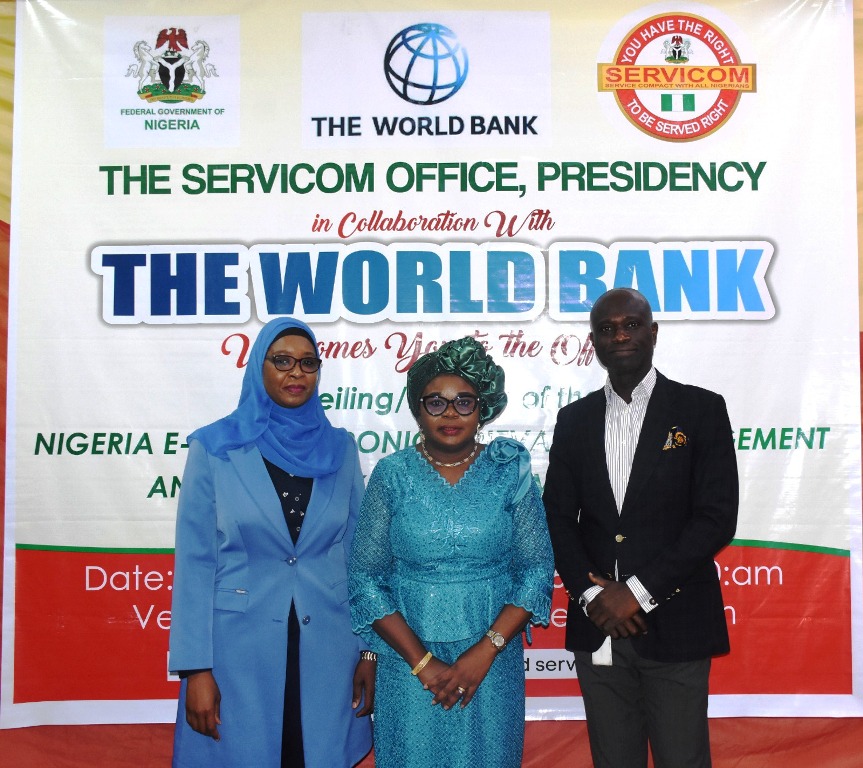
The SERVICOM Presidency Office, in collaboration with the Environmental and Social Framework (ESF) Unit of the World Bank, has launched the Nigeria Electronic Grievance Management platform EGM today in Abuja.
The Acting National Coordinator SERVICOM Presidency, Mrs. Helen Lawal, in her welcome address said that, the launch of the E- Grievance Mechanism by the SERVICOM Presidency Office and the World Bank is a defining milestone marked by the collective commitment to transparency, accountability, and citizen-centered service delivery in Nigeria.
This event according to her means more than the unveiling of a digital platform. It represents a deepening of accountability, a strengthening of national systems, and a renewed commitment to ensuring that the voices of citizens remain central to governance and development in Nigeria.
The SERVICOM Office since year 2023, has been engaging with the Environmental and Social Frame Work (ESF) Unit of the World Bank in strategic collaboration aimed at domesticating and institutionalizing the Bank’s Electronic Grievance Management (e-GM) within SERVICOM Office.
This engagement she said, took numerous forms such as series of meetings, one-on-one interview with SERVICOM Staff, workshops involving SERVICOM Staff and pilot Ministries, Department and Agencies (MDAs), hands-on trainings and establishment of a situation room for management of the platform, etc.
She explained that the overriding objective of the E- GM feedback back platform is to ensure that grievance redress processes tied to World Bank-assisted projects do not terminate at the end of the project cycles, but rather continue seamlessly within Nigeria’s national accountability framework.
She further highlighted that, developmental projects may have defined timelines, funding windows may close and programs may conclude, however, citizens’ concerns do not expire when projects end.
Communities continue to seek answers and beneficiaries would continue to demand resolutions at the long run.
The selection of the SERVICOM Office as the World Bank’s ESF Unit preferred choice for this engagement was neither accidental nor incidental, but rather, she strategic added.
She reiterated that by domiciling the World Bank’s Electronic Grievance Management (e-GM) Platform within SERVICOM, is a guarantee for continuity of complaint resolution beyond the life span of individual World Bank projects and programs.
“We are moving from a project-based grievance structure to a sustainable, nationally owned system.”
Mrs. Helen Lawal noted that, SERVICOM’s nationwide presence through its established SERVICOM Units Structure—Ministerial and Parastatal SERVICOM Units across Ministries, Departments and Agencies—provides a ready-made institutional architecture for grievance redress and service accountability.
This existing framework ensures that complaints can be received, escalated, tracked, and resolved across all tiers of government in a coordinated and standardized manner, therefore, offering what development sustainability demands: structure, reach, permanence, and accountability service wide.
The Ag. Coordinator emphasized that, Nigeria e-GM Platform builds upon this strong institutional foundation and leverages digital innovation to create a centralized, transparent, and trackable mechanism for receiving and managing complaints and feedback, that enhances data-driven oversight, strengthens monitoring, and fosters responsiveness across World Bank projects and government institutions.
This collaboration she further said, would also demonstrate a critical principle in development practice with durable reforms being achieved not by creating parallel systems, but by strengthening national institutions, by embedding the Electronic Grievance Management (e-GM) Platform within SERVICOM, the World Bank’s ESF Unit has reaffirmed its confidence in Nigeria’s institutional capacity and its commitment to long-term sustainability.
“We must therefore view today’s launch not as a conclusion, but as a beginning—a beginning of enhanced collaboration, improved service delivery, and greater public trust”.
She urged MDAs to be more committed to ensuring that this platform does not become merely a technological tool, but a living instrument of accountability and also serve as a bridge between citizens and government and let it stand as proof that feedback is valued, grievances are addressed, and service standards are upheld.
The Representative of the World bank, Mr. Elijah Siakpere, a Senior Social Development Specialist, briefed the Stakeholders on the essence to domicile the EGM, feedback platform in SERVICOM Office because of the need to strengthen accountability and enhance service delivery initiatives in all Ministries Departments and Agencies of Government where the Banks projects are warehoused.
He further explained that Grievance management is a core mandate of the Bank, hence the need to collaborate with the SERVICOM Office because of her track record of feedbacks gleaned from the various service windows of the Ministerial SERVICOM Units of MDAs that are customer facing.
In his key note address, the Permanent Secretary General Services Office, Office of the Secretary to the Government of the Federation, Dr. Ibrahim Abubakar Kana, represented by the Director Legal Services, Mrs. Kalimatu Mustapha – kida said that, this occasion celebrates institutional resilience, reform-driven leadership and strengthens the mechanisms that ensure citizens satisfaction remain the focus of governance.
He appreciated the SERVICOM Office for its relentless efforts over the years in promoting service excellence across Ministries, Departments, and Agencies. SERVICOM has consistently championed the principle that government exists to serve, and that service delivery must meet defined standards that satisfy citizens.
He further said that. he was not surprised when the World Bank sought a credible, sustainable, and nationally anchored institution to host and manage its Electronic Grievance Redress (e-GM) Platform for World Bank-supported projects, SERVICOM emerged as the number one choice for this partnership.
This decision he highlighted, is a testament to SERVICOM’s proven capacity, nationwide presence, and institutional mandate. It reflects the World Bank’s confidence in Nigeria’s systems and its recognition that sustainable grievance redress must be embedded within an enduring national structure rather than exist as a temporary project-based mechanism.
He commended the SERVICOM Office for its steadfast commitment to service reform and for positioning Nigeria as one of the few countries to institutionalize grievance management in Africa for World Bank projects.
He equally appreciated the World Bank for its foresight, partnership, and confidence in our national systems.
“As we launch this platform today, let us reaffirm our shared responsibility to ensure that it functions effectively, transparently, and efficiently. Let us commit to timely responses, professional conduct, and measurable outcomes.
Most importantly, let us remain guided by the principle that governance is meaningful only when it delivers value and satisfaction to citizens”. He added.
Henrietta Okokon
Deputy Director Information / Public Relations
SERVICOM Presidency
5/3/26