


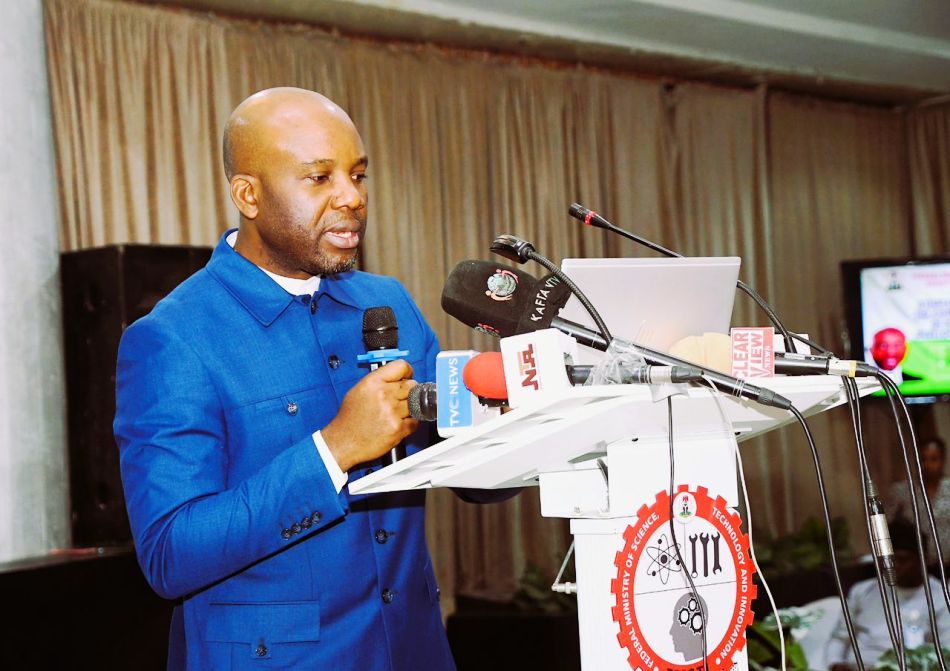
The Federal Ministry of Innovation, Science and Technology (FMIST) has launched a strategic national drive to convert Nigeria’s vast scientific research outputs into commercially viable products, industries and jobs, as part of efforts to strengthen the country’s innovation-led economic growth.
Speaking at the Strategic Meeting today in Abuja on the Commercialization of Scientific Research Outcomes with Honourable Commissioners of Science, Technology and Innovation (STI) from across the states, the Honourable Minister of Innovation, Science and Technology, Dr. Kingsley Tochukwu Udeh, SAN, emphasized that Nigeria must urgently bridge the gap between research discoveries and market applications.
According to the Minister, while Nigeria has made significant investments in research and development across universities, polytechnics and research institutes, the country has yet to fully harness the economic value of these investments.
“Too many valuable research outputs remain on laboratory shelves, in technical reports or academic journals without translating into products, services or enterprises that can transform lives,” the Minister said.
Dr. Udeh noted that in today’s global economy, national prosperity is increasingly determined by a country’s ability to convert knowledge into economic value.
He observed that Nigerian scientists and innovators are producing solutions in critical sectors such as agriculture, renewable energy, biotechnology, digital technology, health sciences, manufacturing and climate resilience, yet many of these innovations remain underutilized.
To address this challenge, the Minister announced the constitution of a Committee to develop a National Policy on the Commercialization of Research and Development (R&D) Results and Inventions in Nigeria. The policy, he explained, will serve as a national blueprint to harmonize federal and state efforts, eliminate fragmentation and provide a clear framework for researchers, investors, industry players and development partners.
He stressed that state governments play a critical role in building vibrant innovation ecosystems and called on Commissioners to align their STI policies with commercialization objectives, strengthen collaboration between tertiary institutions and industries, support innovation hubs and incubation centres, and promote demand-driven research tailored to state economic priorities.
Dr. Kingsley also highlighted the need for innovative financing mechanisms to support commercialization, including public–private partnerships, venture capital investments, industry-sponsored research programmes and state-level innovation funds.
He further emphasized the importance of inclusiveness in the innovation ecosystem, noting that Nigeria’s youthful population represents a powerful engine for technological advancement. He called for structured support for youth-led start-ups, women in science and innovation, and balanced development of innovation infrastructure across the country.
“If we succeed in commercializing our research outputs, Nigeria will reduce import dependency, stimulate local manufacturing, strengthen SMEs and create sustainable jobs. This is how we position our country competitively in the global knowledge economy,” the Minister stated.
Earlier in his welcome remarks, the Permanent Secretary of the Ministry, Mr. Philip Ndiomu Ebiogeh, described the meeting as a critical step towards transforming Nigeria’s research excellence into tangible economic outcomes.
He noted that while research institutions across the country continue to generate patents, prototypes and technological solutions, the real challenge lies in converting these innovations into scalable enterprises and market-ready products.
“The challenge before us is not the generation of knowledge but the conversion of knowledge into marketable products, enterprises, jobs and national wealth,” he said.
The Permanent Secretary emphasized that state governments are central to the commercialization process because they are closest to the innovation ecosystems where research institutions, start-ups, SMEs and local industries operate.
Mr. Ebiogeh explained that the strategic meeting was convened to strengthen federal–state collaboration, harmonize policies supporting innovation uptake, identify financing and technology transfer mechanisms, promote public–private partnerships and develop a clear roadmap for coordinated national action, urging Commissioners to engage in solution-driven discussions that will produce practical and measurable outcomes.
The strategic engagement brought together Honourable Commissioners of Science, Technology and Innovation from across the federation, alongside key stakeholders in Nigeria’s science, research and innovation ecosystem.
Mrs. Pauline Sule,anipr
Head, Press and Public Relations