

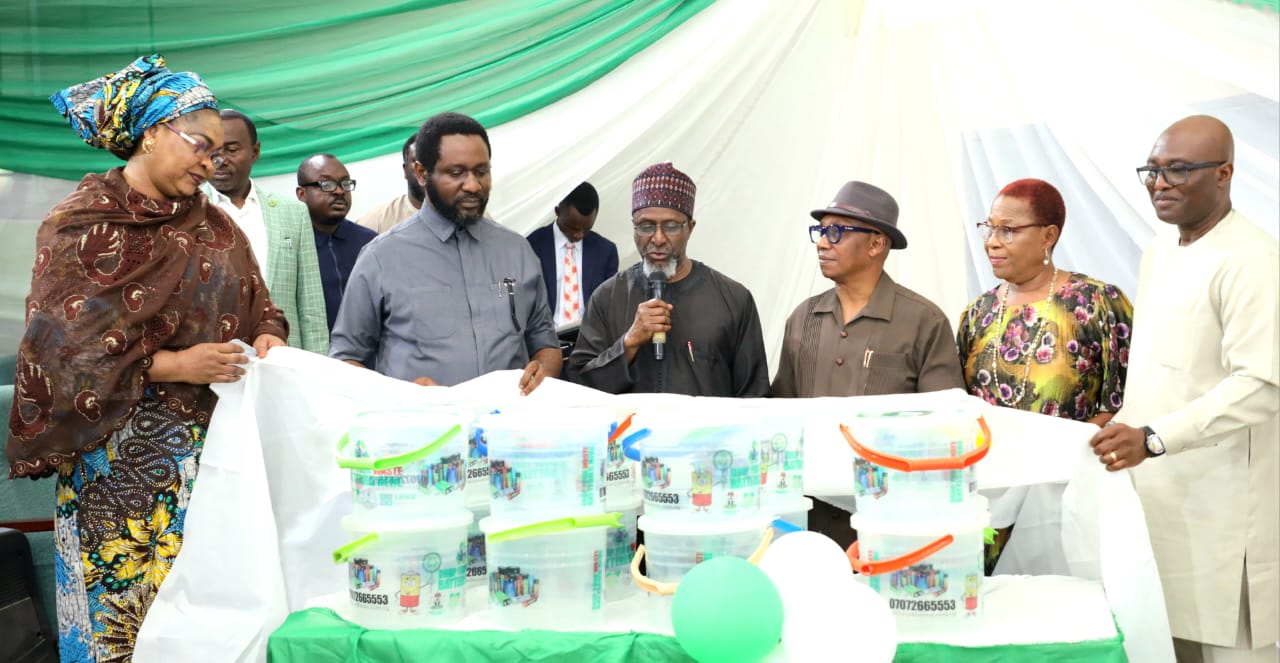
The Minister of the Federal Ministry of Environment Balarabe Abbas Lawal has launched the Receptacles for the environmentally-sound management of small-sized waste batteries, revealing that improperly disposed household batteries commonly found in remote controls, toys and mobile devices are quietly contaminating Nigeria’s soil, water and food chain with dangerous heavy metals therefore called for Nationwide Revolution in Waste Battery Management .
Lawal made this known at the launch of the environmentally sound management (receptacle) of small-sized waste batteries in Nigeria recently in Abuja.
The Minister described the initiative as a decisive intervention to close a long-standing gap in Nigeria’s waste management system, noting that unlike larger car batteries, small batteries are often ignored because they carry little or no economic value for informal recyclers.
“Because they are small and seemingly insignificant, they are carelessly thrown away, yet they pose some of the most dangerous risks to human health, especially to children and women,” the minister said.
According to the Minister, the new scheme introduced a centralised system for the collection, storage and recycling of used batteries, with designated receptacles to be deployed across markets, schools, offices and public spaces in the Federal Capital Territory (FCT) as a pilot phase before nationwide expansion.
Lawal stated that the initiative is implemented in partnership with the Alliance for Responsible Battery Recycling (ARBR) as part of efforts to enforce Nigeria’s National Policy on Waste and Battery Management introduced in 2022.
He further disclosed that enforcement agencies would step up compliance monitoring, signaling a tougher stance on environmental violations. He hinted at plans to push for stricter legislation, lamenting Nigeria’s weak legal framework on environmental protection compared to countries like Finland and Canada, where stringent laws and penalties drive compliance.
“We cannot continue to rely on policies without enforcement. There must be laws with real consequences to change behaviour,” he said.
He called on the media, lawmakers and other governments at sub-national levels to support the initiative, stressing that public awareness and legislative backing are critical to reversing environmental abuse and safeguarding public health.
The minister further revealed that the programme aligns with global efforts to combat lead exposure, which has gained increased attention at international forums, including recent deliberations at the United Nations.
With plans to extend the project nationwide, the Federal Government says the initiative marks the beginning of a broader strategy to address Nigeria’s mounting waste crisis while unlocking economic value from recycling.
“This is just the starting point,but it is a necessary step toward a cleaner, safer and more responsible Nigeria”, he reaffirmed.
In his goodwill message, the Deputy Chairman, House Committee on Environment, Hon. Julius Pondi lauded the initiative, disclosing that certain steps have been taken at the Green Chamber on Waste Management in Nigeria.
He lauded the effort of the ministry and implored the ministry to replicate the similar initiative at the Subnational levels, private sector and other relevant Stakeholders in the Environment Sector.
Ibrahim Haruna
Director, Information and Public Relations
25th April, 2026