

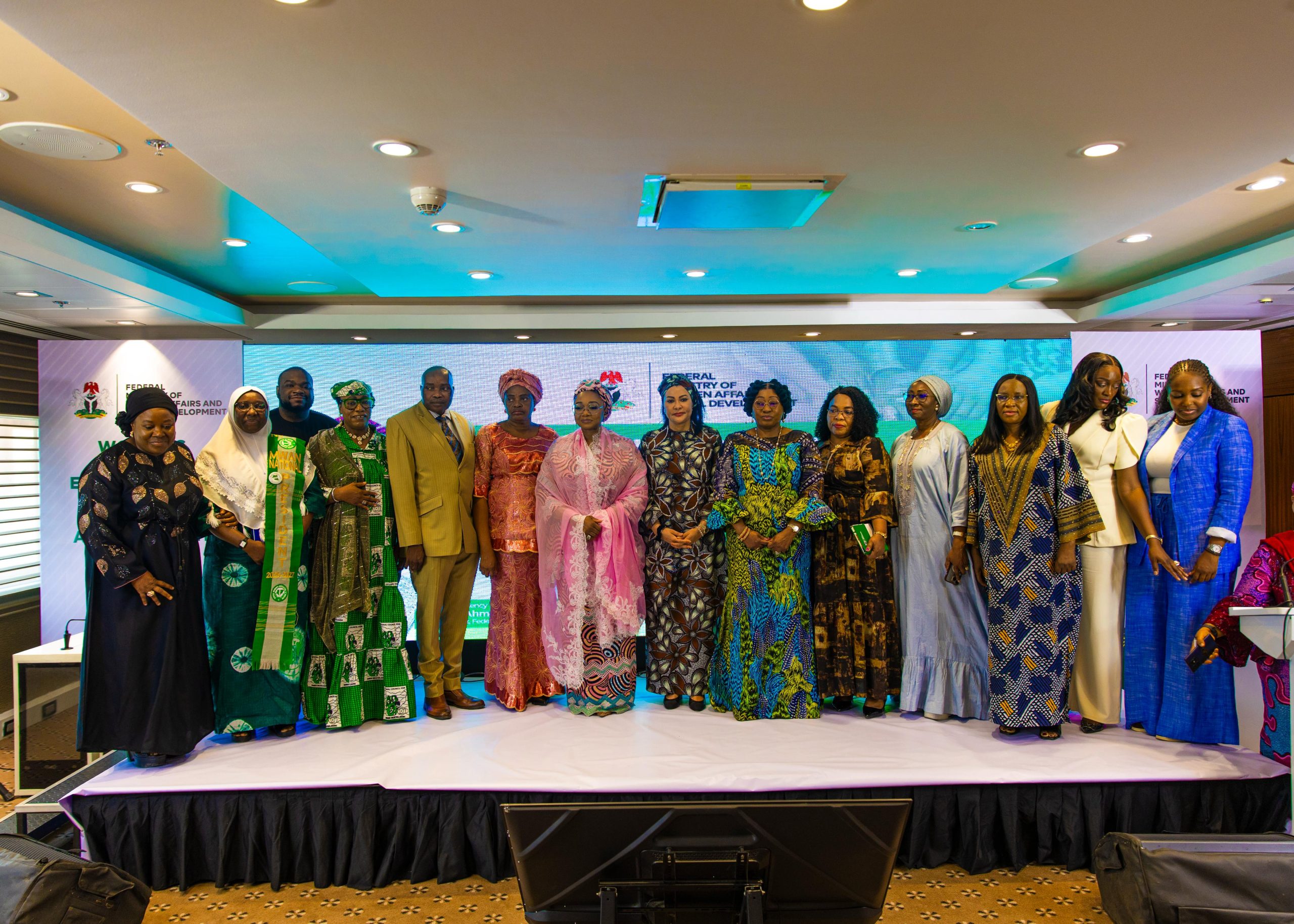
Nigeria has reaffirmed its unwavering commitment to unlocking the full economic potentials of its women as key drivers of national growth, as stakeholders convened at the High-Level Women’s Economic Empowerment (WEE) meeting organised by the Federal Ministry of Women Affairs and Social Development in collaboration with Albright Stonebridge Group at the Transcorp Hilton Hotel, Abuja to undertake a Midpoint Review of the policy.
The landmark gathering brought together senior government officials, development partners, private sector leaders, civil society actors, and the media to assess progress, strengthen partnerships, and accelerate the implementation.
Delivering the keynote address at the occasion, the Honourable Minister of Women Affairs and Social Development, Hon. Imaan Sulaiman-Ibrahim, fsi, described the moment as a convergence “where promise meets performance, and policy finds its purpose,” emphasizing that the WEE Policy is not just a social initiative but a strategic economic blueprint central to Nigeria’s transformation.
The Minister highlighted significant progress made since the policy’s launch, noting its successful domestication in Kaduna, Kano, Lagos, and Kwara States, with over two-thirds of states demonstrating commitment to implementation. The Minister underscored the integration of the WEE agenda into the Renewed Hope Social Impact Interventions (RHSII-774), including flagship programmes such as EmpowerHer, WAVE 774, PowerHer 774, Her SafeHaven, Families First Initiative, and DigitalHer.
According to her, these interventions are designed to drive inclusion, productivity, and resilience at scale, ensuring that women transition from economic margins to the centre of national development.
She further emphasized the significance of President Bola Ahmed Tinubu’s declaration of 2026 as the “Year of Families and Social Development,” noting that women’s empowerment is intrinsically linked to stronger families, improved child welfare, and more resilient communities.
Meanwhile, Minister of Budget and Economic Planning, Atiku Bagudu, represented by the Minister of State, Dr. Doris Uzoka-Anite reinforced the economic imperative of women’s empowerment, stating that closing gender gaps in access to finance, labour participation, and productivity is critical to building a resilient and globally competitive Nigerian economy.
She revealed ongoing efforts to institutionalize gender-responsive planning and budgeting, including refining Budget Call Circulars to ensure Ministries, Departments, and Agencies (MDAs) demonstrate measurable impact on women through public expenditure. She also emphasized the importance of mobilizing blended finance through partnerships with institutions such as the Bank of Industry, AFAWA, and UN Women to unlock capital for women-led enterprises.
Earlier in her welcome address, the Permanent Secretary, Federal Ministry of Women Affairs and Social Development, Mrs. Asanye Nko Esuabana, described the gathering as both timely and strategic, providing an opportunity to review progress, share lessons, and chart a more impactful path forward.
She highlighted the development of the WEE Costed Framework as a critical milestone, offering a structured and evidence-based tool for translating policy commitments into actionable and fundable programmes, while strengthening accountability and resource mobilization.
The UN Women Country Representative to Nigeria and ECOWAS, Beatrice Eyong, represented by the Programme manager Osalobo Osemhenjie commended the Government of Nigeria for its leadership and reaffirmed UN Women’s commitment to supporting inclusive economic growth through system-strengthening interventions, affirmative procurement, and gender-responsive budgeting frameworks.
She noted that while progress has been made, structural barriers such as limited access to finance, unpaid care burdens, and socio-cultural constraints continue to hinder women’s full participation in the economy, calling for sustained implementation, adequate financing, and stronger accountability mechanisms.
Across all remarks, a consistent message emerged: investing in women is not only a moral imperative but one of the highest-return economic strategies available to the nation.
The convening also spotlighted innovative platforms such as the Happy Woman App, designed to provide real-time access to opportunities, resources, and support services, as well as the expansion of the Nigeria for Women Programme, targeting 4.5 million women through community-based Women Affinity Groups.
Stakeholders collectively agreed that the midpoint review is not a pause, but a call to accelerate action—focusing on execution, alignment, and scaling impact through coordinated efforts across government, private sector, and development partners.
As Nigeria advances toward its 2028 targets, the WEE Policy continues to serve as a transformative framework aimed at ensuring that opportunity is determined not by gender, but by potential—positioning women not just as participants, but as powerful drivers of economic growth and national development.
Ahmed Lawan Danbazau Mnipr
Head, Press and Public Relations Dept..