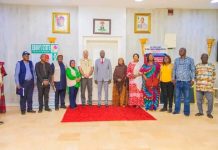

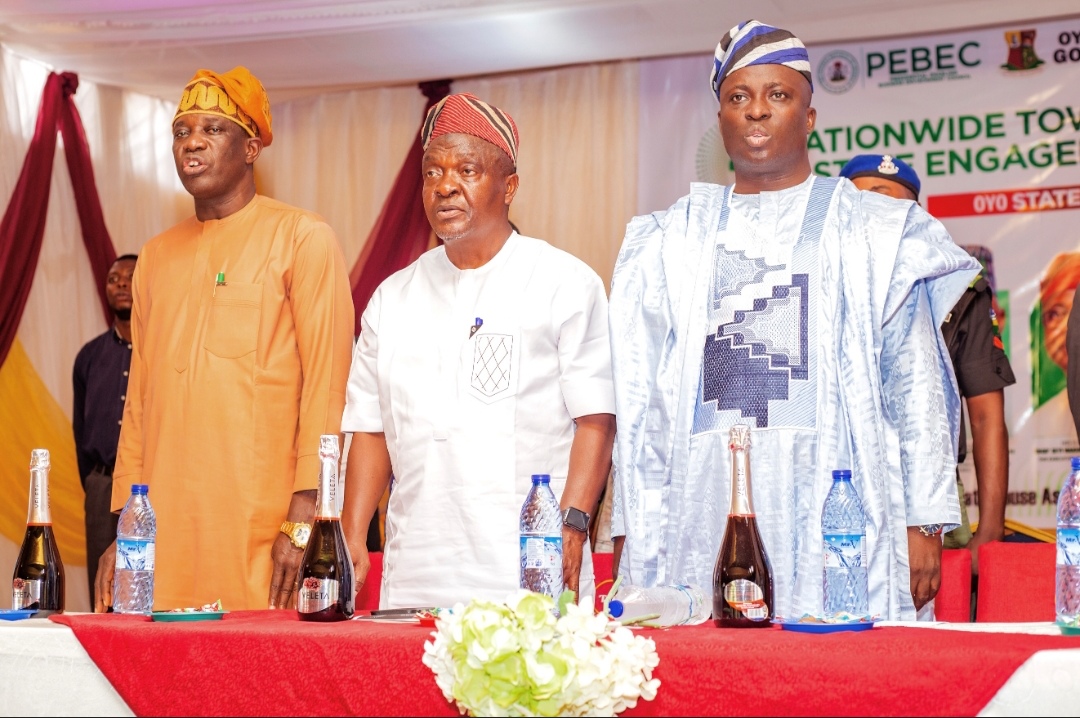
FIC Report (Oyo State) – The Presidential Enabling Business Environment Council was in Ibadan, the Oyo State capital, to drive the Federal Government’s policy on an enabling business environment to the government and other business stakeholders in Oyo State.
This was the package of the Nationwide Tour and Town Hall Meeting organised by PEBEC in Ibadan on Tuesday the 9th of June, 2026.
The events of the tour and the town hall meeting, which were held in the Western Hall, Parliament Building of the State Assembly Complex were a technical workshop and stakeholder meeting.
While welcoming the participants, the Director General of PEBEC, Princess Zahrah Mustapha Audu, who was represented by Hajia Saratu Adamu, gave an overview of PEBEC Nationwide and Subnational Engagement Tour. According to her, the nationwide tour was designed to further strengthen the existing collaboration among Federal and the subnationals, Private Sector and other Stakeholders in improving Nigeria’s business environment.
Princess Audu stated that the Initiative targeted at seeking to identify any new challenges confronting businesses across the country and facilitate Reforms that will make business operation easier and more efficient. Other members of the PEBEC team include Sylvester Nandi-Esom and Mahmud Jafar.
AT the workshop, which was anchored and delivered by the technical team of PEBEC, eight(8) technical papers were presented across the 8 sections of the workshop. They were ‘Strengthening Regulatory Governance through Regulatory Impact Analysis (RIA)’; ‘Understanding the Investment Lifecycle and Improving Investor Experience’; ‘One Government Approach – One Stop Shops and Integrated Service Delivery’; ‘Harmonisation of Levies, Fees and Regulatory Charges’; ‘Access to Justice and Commercial Dispute Resolution – Small Claims Court and Multidoor Court House Systems’; ‘Sustainability and Transition in Government Reforms’; ‘Metrics and Parameters for Subnational Ease of Doing Business Rankings’, and ‘Introduction to the PEBEC Portal and Digital Reform Tools’, which was followed by a highly engaging interactive session with probing questions from the participants, and eloquent answers by the PEBEC team.
The highlights of the tour were various decisions, suggestions and mandates, which were jointly set up by the stakeholders. It was suggested to the Oyo state government that it was necessary to harmonise its taxes to avoid duplications taxes, which was agreed could stifle businesses. It was suggested that, for various taxes, fees and levies, the state government should create a one-stop service point for business owners to ease payments for their taxes, levies, fees, permits and other government’s charges.
While giving its own stewardship on its efforts so far towards ease of doing business in Oyo state, the state government praised Federal government for coming up with the PEBEC, stating that the reforms, which has been driven by the council, were not just “administrative adjustments, but that “they represent a fundamental shift towards a private-sector-led economy”.
The state government stated that “under the leadership of Governor Seyi Makinde,Oyo State has continued to institutionalize reforms aimed at improving the business environment, strengthening investors’ confidence, enhancing regulatory efficiency, and promoting private-sector-led economy”. This, according to the state government, has led to the state attaining the 3rd best performing subnational entity in Nigeria, with a score of 62.7%position in the PEBEC rating for the 2025.
According to the state government, some of its legislations, which have worked to ease doing business in in the state, were the Rule of Law Enforcement Authority Act(2024), the Executive Order No.003, and the Executive Order 006. The state stated further that it has achieved a high level in modernization of land and asset administration, which the government said, would enhance property acquisition by businesses and individuals, which could facilitate ease of securing business loans for willing and needy businesses.
It would be recalled that the management of the World Bank has recently praised the economic reforms of the President Bola Ahmed Tinubu.
On February 4th 2026, while at a meeting in Aso Rock with the President Tinubu and his deputy, Senator Kazeem Shettima, the World Bank’s Managing Director, Mrs. Anna Bjerde, had said that Nigeria was now a “global reference point” for reforms. Bjerde said: “Nigeria is a frequent example in my discussions with people around the world, presidents around the world, policymakers around the world, investors around the world, because I think in these two years, the results that have been achieved are really commendable.”
She called Nigeria an example of “steady, credible reform leadership”, and said the outcomes are “widely discussed among global leaders, policymakers and investors”.
Mrs. Bjerde commended President Tinubu’s “consistent resolve to stay the course despite challenges”, and noted:
“Even when reform implementation can be difficult, there is no turning back. You’re staying the course, because it is what’s needed to get the results that you’re looking for”, she said.
The World Bank’s MD remarked further that “the consistency and clear evidence of positive results have built strong confidence among investors, policymakers, and the private sector”. She said that feedbacks from the private sector in Nigeria have confirmed “strong reform outcomes and improving investor sentiment”
Although the World Bank’s Nigeria lead economist, Fiseha Hailey, has noted that the inflation in the country has remained high, which, according to him, posed risks that could erode the real outcomes of the current reforms and slow down poverty reduction efforts of the government, President Bola Ahmed Tinubu, in his response to the World Bank’s Managing Director, said that his government was poised to sustain its economic reforms, saying “we have our hands on the plough, and we are never going to look back”, the president said.
PEBEC is a federal government’s initiative, established to galvanise all the 36 States of the Federation, private sector and other stakeholders towards creating and achieving a business friendly economic society for Nigeria and foreign businesses and other investors. Since its establishment, the organisation has influenced many subnatiinal bodies in reviewing their local business laws, taxes, levies and fees, and the operation of these payments in order to remove bottlenecks, bureaucratics and other systems which might have been making doing business tiring and cumbersome is various states across Nigeria.
Participants at its June 9th Ibadan engagement include the representatives of the Oyo State government, led by Prof. Musibau Babatunde, the Secretary to the Oyo State government(SSG). Other are Dr.(Mrs) Adenike Fasina, the Oyo State Head of Service, Hon.Olukemi Awokan, Chairman of Oyo State’s Board of Internal Revenue Services, Baale Alhaji Kamorudeen Aderibigbe, Chairman, Oyo State Civil Service Commission, Elder Adekola Ayoade, Chairman, Oyo State BOTAVEN, Olatilewa Folami, DG, OYSIPA, M.A.Bolarinwa, Executive Secretary, OYSIPA, Auditor-General(State), the Auditor-General(Local government), State’s Accountant-General, Alhaji Kolawole Bello, Executive Assistant to the State Governor on Budget and Economic Matters, Clerk of the state’s House of Assembly.
Others are Permanent Secretaries, Executive Secretaries of various regulatory agencies, General Managers, Directors in the Oyo State’s MDAs, various Department partners, Private sector operators, quite a number of investors, various entrepreneurs and other key stakeholders in the state.
Report by Temitope Abosede Oyewole, SI&PRO.
Edited by Moses Oyelade, AD(I&PR). FIC, Ibadan.