

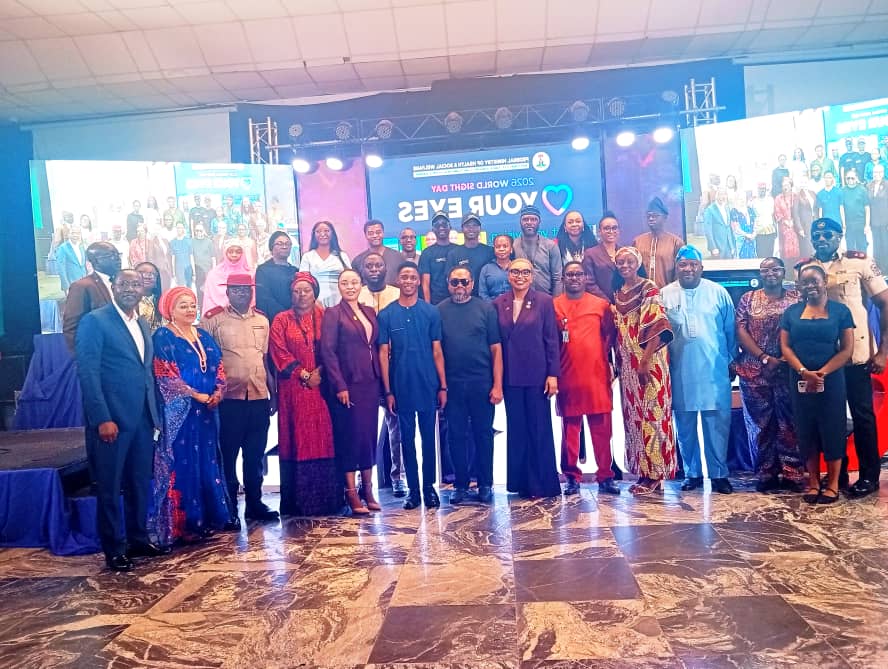
The Federal Government has reaffirmed its commitment to strengthening eye health services nationwide, with a target to provide 25,000 free cataract surgeries across the country by the end of 2027, as part of efforts to reduce avoidable blindness and improve access to quality eye care.
The Honourable Minister of State for Health and Social Welfare, Dr. Iziaq Adekunle Salako, disclosed this while commemorating the 2026 World Sight Day, themed “Love Your Eyes”, with the national sub-theme “Protect Your Vision, See Clearly, Live Fully.”
Represented by Dr. Doris Afam Aneke,mni, the Director, E-Health Division, the Minister, said the Federal Government considers eye health both a public health and development priority, given its impact on education, productivity, independence and quality of life.
Dr. Salako highlighted major interventions by the Federal Government and its partners, including the training of over 3,000 healthcare workers across 16 states and the activation of more than 1,400 primary healthcare centres to provide primary eye care services.
Furthermore, he disclosed that over 1.5 million pairs of reading spectacles had been distributed to Nigerians across the 16 states under the Effective Spectacle Coverage Initiative Nigeria (ESCIN), also known as Jajibola 2.0, with preparations advanced to extend the initiative to 10 additional states.
According to the Minister, government has also intensified efforts to protect children’s vision, with over 1.5 million school-age children screened for visual problems through the School Eye Health Programme, while four additional vision centres are being established within secondary healthcare facilities in Enugu, Edo, Sokoto and Nasarawa States, noting that the interventions are designed to strengthen the continuum of eye care, improve referral pathways and ensure that Nigerians can access appropriate services closer to where they live.
“Eye health is not an isolated intervention; it is an integral part of a resilient health system and a critical component of our journey towards Universal Health Coverage. No child should be prevented from learning because of an undiagnosed vision problem, and no Nigerian should live with avoidable blindness simply because treatment is beyond reach,” the Minister said.
Dr. Salako further stated that the planned 25,000 free cataract surgeries under the Renewed Hope Health Connect initiative would restore sight, independence and productivity to thousands of Nigerians, describing cataract as a major cause of avoidable blindness in the country.
He assured Nigerians that the Federal Ministry of Health and Social Welfare would continue to work with state governments, development partners, professional associations and the private sector to expand equitable access to quality eye care.
He also noted Nigeria’s growing leadership in global eye health, including the country’s co-hosting of the first-ever Global Summit for Eye Health, scheduled for November 2 in Antigua and Barbuda, describing it as an opportunity to advance the integration of eye health into Universal Health Coverage and strengthen Nigeria’s contribution to global health diplomacy.
The Minister called on Nigerians to make eye health a personal and collective responsibility through regular eye examinations, early presentation for treatment and adoption of healthy practices that protect vision.
“When people can see clearly, they can learn better, work better, contribute more and live fuller lives. That is the vision to which the Federal Government remains firmly committed. Together, let us continue to love our eyes, protect our vision, see clearly and live fully,” Dr. Salako stated.
In her welcome remarks at the commemoration, the Permanent Secretary of the Ministry, Daju Kachollom S. mni, represented by Dr. Oteri Okolo said eye health remains fundamental to human dignity, educational attainment, economic productivity and individual independence, stressing that protecting the sight of Nigerians is critical to national development.
She noted that Nigeria’s eye health sector has recorded significant progress over the past decade through stronger policy governance, multisectoral collaboration and strategic partnerships, citing the development and dissemination of Nigeria’s first Comprehensive National Eye Health Policy, ratified by all 36 states and the FCT, as well as the National Strategic Eye Health Plan 2024–2028, alongside the establishment of state and national eye health coordination structures.
The Permanent Secretary also commended professional bodies, development partners and implementing organisations for their sustained contributions to strengthening eye care services across the country.Partners Reaffirm Commitment to Inclusive Eye Care as Nigeria Marks World Sight Day 2026
Partners including the National Commission for Persons with Disabilities (NCPWD), Sightsavers Nigeria, Clinton Health Access Initiative (CHAI), CBM International, OneSight EssilorLuxottica Foundation, Peek Vision and Helen Keller International, called for greater investment in prevention, early detection, timely treatment, rehabilitation and accessible eye health services, particularly for vulnerable and underserved populations.
The Executive Secretary of NCPWD, Chief Ayuba Burki Gufwan, particularly emphasised the need to place persons with disabilities at the centre of eye health policies and interventions, noting that inaccessible facilities, communication barriers and inadequate consideration of specific needs continue to limit access to healthcare.
Sightsavers Nigeria, CBM International and Helen Keller International similarly urged stakeholders to ensure that eye care services are equitable, inclusive and accessible to all, particularly children, women, persons with disabilities and underserved communities.
The Clinton Health Access Initiative highlighted the importance of integrating eye care into the Primary Healthcare System, noting its collaboration with the National Eye, Ear and Sensory Functions Health Programme to bring primary eye care closer to communities and expand access to reading glasses.
Peek Vision also underscored the role of technology, screening and quality data in connecting people to care, while OneSight EssilorLuxottica Foundation called for sustainable partnerships, innovation and a lifelong continuum of vision care.
The partners commended the Federal Ministry of Health and Social Welfare and the National Eye, Ear and Sensory Functions Health Programme for their leadership in advancing eye health in Nigeria and called for sustained collaboration, and reaffirmed their commitment to strengthening access to affordable, inclusive and quality eye care.
Ado Bako
Assistant Director, Information and Public.