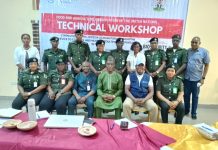



The Director-General of the Bureau of Public Procurement, Dr. Adebowale A. Adedokun, FCIPS, has urged the Board and Senior Management of the South-South Development Commission, SSDC, to make compliance with the Public Procurement Act 2007 central to all their operations.
Dr. Adedokun gave the charge virtually during a two-day Induction Programme for SSDC Board Members and Senior Management jointly organized by the Bureau of Public Service Reforms(BPSR) and the SSDC.
Speaking on the topic, “Essentials of the Public Procurement,” the BPP DG described procurement as a strategic instrument for national development and not merely a purchasing function.
”Public procurement is the bridge between budget approval and service delivery. It is one of the most powerful instruments of governance for delivering public value, driving economic growth, and ensuring prudent management of public resources,” he said.
He charged the Commission to be guided by the core principles of fairness, transparency, accountability, open competition, value for money, efficiency, and effectiveness.
Dr. Adedokun also warned against common violations, including defective bidding processes, manipulation of evaluations, bypassing BPP oversight, misuse of emergency provisions, poor record-keeping, and failure to comply with bid-opening timelines.
“There is no provision for urgent procurement outside the exceptions provided by the law,” he warned.
The DG outlined some ongoing BPP reforms aimed at strengthening the procurement system to include:
1. Review of the Public Procurement Act,2007
2. Development of a National Procurement Strategy Framework
3. Procurement performance monitoring and evaluation system
4. Price Intelligence and Benchmarking system
5. Capacity Building and certification for Public Procurement Officers
6. Category management and Pool Procurement
7. Affirmative procurement to include women, youths, and persons with disabilities
8. Sector-Based procurement system
He further highlighted the deployment of digital platforms such as e-procurement, e-marketplace, electronic audits, and AI-powered chatbots to enhance transparency and efficiency.
Dr. Adedokun disclosed that approximately N1.1 trillion was saved from procurement processes in 2025. He added that non-compliance detection mechanisms have also prevented billions of Naira in potential losses to the Federal Government.
The DG stressed that all procurement activities must commence only after an approved procurement plan is in place, noting that initiating procurement without such a plan constitutes a criminal offence.
He explained that plans must be centrally coordinated by the Procurement Department, reviewed by the Procurement Planning Committee, and approved by the Tenders Board and forwarded to BPP via NOCOPO for review and approval.
On recent amendments in the Finance Act, he noted that Tenders Board decisions now require written confirmation by the political head within a specified period. He also cited new provisions on mobilisation fees, mandatory open competitive bidding as the default method, and stricter conditions for alternative procurement methods.
Dr. Adedokun reminded participants that procurement responsibilities must be carried out only by trained and certified professionals, and that contractors must meet all statutory requirements before participating in government procurement.
He outlined the full procurement cycle from needs assessment and market survey to post-procurement audit, and emphasized that all engineering designs, bills of quantities, and technical specifications must be prepared and certified by qualified professionals.
He further explained the roles of key stakeholders, including the Board Chairman and Board Members, Accounting Officers, Tenders Boards, Procurement Planning Committees, civil society, professional bodies, BPP, and enforcement agencies such as the ICPC, EFCC, Nigeria Police, and Code of Conduct Bureau.
Specificaly, that the Board Chairman and Members are to provide strategic and policy directions, perform oversight functions, ensure sound governance and internal control, ensure management complies with the PPA, 2007 and exercise powers specifically granted under the SSDC Act and extant government policies. They are not to award contracts or conduct procurement activities.
Citing cases where senior officials faced investigation, prosecution, and imprisonment for abuse of procurement laws, the DG cautioned participants against sacrificing compliance for personal relationships or political pressure.
“Public officers are held personally liable for unlawful choices,” he said.
In conclusion, Dr. Adedokun urged the SSDC to leverage public procurement as a strategic tool to transform the South-South region through impactful projects in infrastructure, education, tourism, energy, and other critical sectors.
e-Signed:
Zira Zakka Nagga
Head of Press and Public Relations (BPP)
August 3rd, 2026