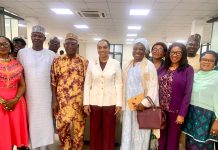



The Honourable Minister of Humanitarian Affairs and Poverty Reduction, Dr. Bernard M. Doro, has received a delegation led by Hon. Bridget Anne Afor, a young elected politician representing Sweden at the European Union Committee of the Regions, to explore Nigeria’s approach to poverty reduction and its potential relevance to addressing irregular migration.
The visit provided an opportunity for the delegation to learn more about the One Humanitarian, One Poverty Response System (OHOPRS) and the Ministry’s broader efforts to link humanitarian intervention, social protection and poverty reduction in a coordinated pathway towards sustainable economic inclusion.
Welcoming the delegation, Dr. Doro explained that while regular migration can contribute to personal development and knowledge transfer, irregular migration, particularly through dangerous routes, should be discouraged. He noted that Nigeria must also create opportunities that enable young people to participate meaningfully in the global economy without necessarily having to relocate.
“What regular migration does for us is that it develops us and helps us see life from a different perspective. So, this speaks to the benefit of migration. What we do not want to see is irregular migration.”
The Minister explained that OHOPRS is designed to move vulnerable populations from repeated humanitarian support towards sustainable pathways out of poverty by connecting humanitarian response with social protection and poverty reduction.
“The philosophy behind it is moving people from repeated palliatives to pathways, pathways towards economic inclusion.”
He further explained that the system incorporates unified social registries and the National Poverty Intelligence Lab, which will leverage data and analytics to improve targeting, programme design and poverty-graduation interventions. The Ministry is also working towards a proof of concept targeting 12,000 vulnerable households to determine effective pathways before wider scale-up.
Dr. Doro noted that the system is designed to be interoperable with relevant sectors of government, development partners and subnational governments, enabling data to support more coordinated and evidence-based interventions for poor and vulnerable Nigerians.
In her remarks, Hon. Bridget Anne Afor expressed enthusiasm about the Minister’s emphasis on youth inclusion, noting that young elected politicians are also an important component of the European Union Committee of the Regions’ engagement.
“I am very excited that you are passionate about young people, because that is what the Committee of the Regions is passionate about as well.”
Hon. Afor said the focus on poverty reduction was particularly relevant to irregular migration, as young people who perceive that they have no viable opportunities may resort to dangerous migration routes.
“Europe also does not want irregular migrants. So this is a very, very good platform where we can meet together to solve the problem of irregular migration.”
She expressed interest in further studying Nigeria’s approach, particularly OHOPRS, and in presenting the Minister’s vision to the leadership of the Committee of the Regions. She noted that the Nigerian context and the system’s focus on poverty reduction could provide useful perspectives for broader discussions on migration between countries of origin and destination.
The Minister, in his concluding remarks, described investment in poverty reduction as a strategic investment that can contribute to reducing insecurity, lowering humanitarian needs and freeing resources for human capital development.
“If we invest in poverty reduction, insecurity drops. There will be less need for humanitarian intervention, and we can then use that money for human capital development. Supporting us to be able to reduce poverty is a wise investment.”
Present at the meeting were the accompanying delegation from International Alert, led by its Country Director; Dr. Kingsley Udo, Senior Technical Adviser to the Honourable Minister; Director information and Public Relations, Barr. Deborah Manasseh; Dr. Abimbola Fasanu; Kingsley O. Onuoha, among others.
E – signed
Kingsley O. Onuoha
Principal Information and Public Relations Officer
For: Director, Information and Public Relations