

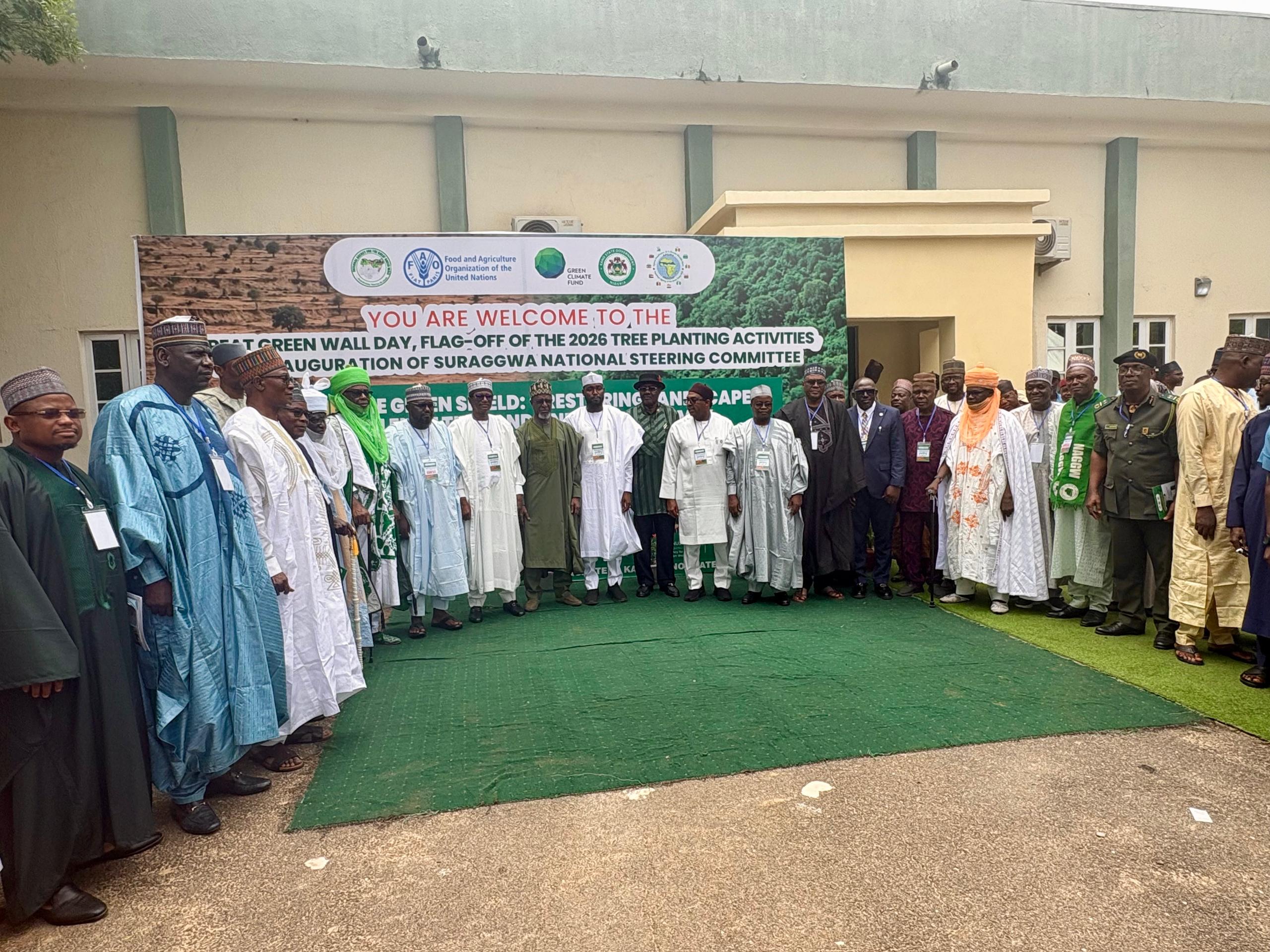
The Federal Government has flagged off the “2026 Great Green Wall” Day celebration and the nationwide tree planting exercise as part of efforts to combat desertification, restore degraded landscapes and strengthen climate resilience across the country.
The event, held on Thursday at the headquarters of the National Agency for the Great Green Wall (NAGGW) in Kano, also featured the inauguration of the Scaling-up Resilience in Africa’s Great Green Wall (SURAGGWA) National Steering Committee.
Speaking at the ceremony, the Minister of Environment, Balarabe Abbas Lawal, said environmental sustainability remains central to President Bola Ahmed Tinubu’s Renewed Hope Agenda, describing healthy ecosystems as essential for food security, economic growth and the well-being of Nigerians.
Lawal said this year’s theme, “The Green Shield: Restoring Landscapes to Silence the Sand and Dust Storms,” reflects the urgent need to address the growing threat of desertification and dust storms across northern Nigeria and the wider Sahel region.
According to him, the Great Green Wall Initiative is more than a tree planting programme, noting that it is designed to restore degraded land, conserve biodiversity, improve livelihoods, strengthen food security and build climate-resilient communities across the eleven frontline states of Adamawa, Bauchi, Borno, Gombe, Jigawa, Kano, Katsina, Kebbi, Sokoto, Yobe and Zamfara.
The minister said the Federal Government relocated the headquarters of the NAGGW to Kano in recognition of the state’s strategic role in implementing the initiative.
He said the agency has so far raised more than 48 million indigenous and exotic tree seedlings and established thousands of hectares of shelterbelts, community woodlots, orchards, Acacia plantations, indigenous forests and other restoration projects.
Lawal added that over 10.8 million drought-resistant seedlings and 869,089 date palm seedlings have been distributed to farmers to support agroforestry, improve food security and increase rural incomes.
According to him, more than 210,000 Nigerians, particularly women and youths, have directly benefited from the agency’s environmental restoration programmes, while over 1,300 forest guards have been trained to support conservation efforts.
Representing Governor of Kano State, Abba Kabir Yusuf, the Commissioner for Water Resources, Environment and Climate Change, Dr. Dahiru Muhammad Hashim, described the relocation of the National Headquarters of the NAGGW to Kano as a landmark decision that reflects the state’s strategic importance in Nigeria’s environmental and climate agenda.
He expressed appreciation to President Tinubu for approving the relocation and assured the Federal Government of Kano State’s unwavering support in providing an enabling environment for the agency to effectively deliver on its mandate.
In his address, the Director General and Chief Executive Officer of the NAGGW, Saleh Abubakar MFR said the agency has made significant progress in restoring degraded landscapes across Nigeria’s frontline states, describing the achievements as evidence of the Federal Government’s commitment to combating desertification and strengthening climate resilience.
He thanked President Tinubu, the Minister of Environment, the Kano State Government, development partners and local communities for their support, saying their collaboration has sustained the Great Green Wall Initiative over the years.
Abubakar added that Agency has also restored degraded sand dunes to productive farmland, established banana plantations in Bauchi, Gombe, Kano, Jigawa and Yobe states, while expanding access to renewable energy through the distribution of solar home systems, fuel-efficient cookstoves, solar-powered irrigation pumps and hundreds of boreholes.
He described the relocation of the agency’s headquarters to Kano as a landmark decision that demonstrates the Federal Government’s resolve to strengthen environmental restoration efforts in Northern Nigeria.
According to him, the move will improve coordination of programmes aimed at addressing desertification, restoring ecosystems and supporting communities affected by climate change across the Great Green Wall frontline states.
Also speaking at the event, Dr. Hussein Gadain, the Food and Agriculture Organization (FAO) Representative in Nigeria and to ECOWAS, described the inauguration of the National Steering Committee for the SURAGGWA Programme as a major milestone in Nigeria’s efforts to combat desertification, restore degraded landscapes and strengthen climate resilience.
He commended the Federal Ministry of Environment, NAGGW and other development partners for their commitment to addressing land degradation, biodiversity loss, food insecurity and rural poverty through coordinated action.
Gadain said Nigeria remains the largest beneficiary of the Green Climate Fund-supported SURAGGWA Programme, which is expected to directly impact more than 1.9 million people through landscape restoration, climate adaptation, biodiversity conservation and livelihood improvement.
Amina Ahmed Garba
Assistant Director Information
Thursday, 9th July 2026.