

………Says Partnership Will Improve Programme Efficiency and Impact.
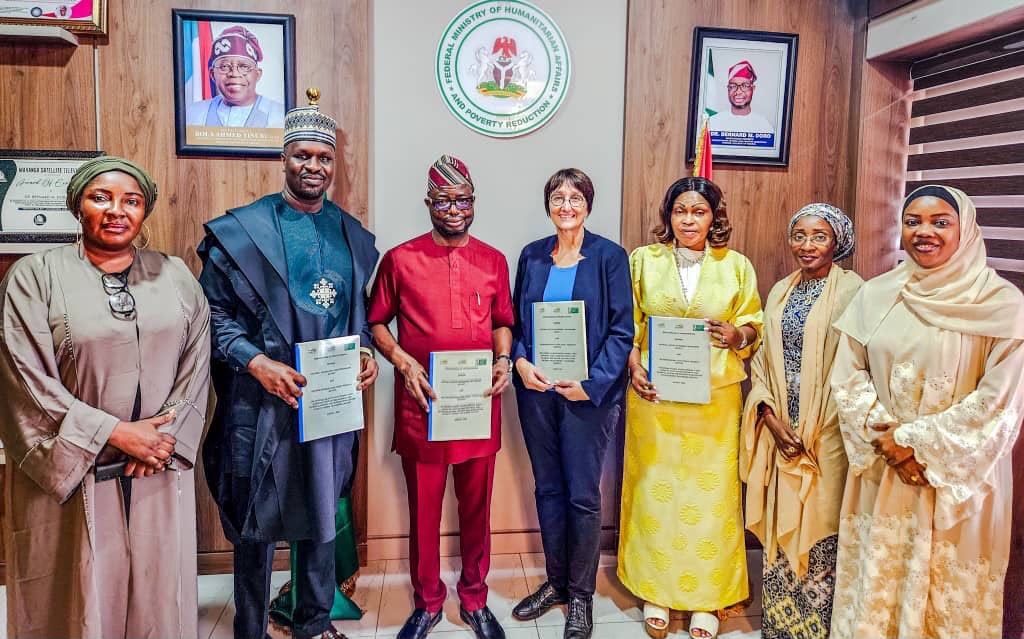
The Federal Government has signed a Memorandum of Understanding, MoU, between the National Home-Grown School Feeding Programme, NHGSFP, under the National Social Investment Programme Agency, NSIPA, and the International Food Policy Research Institute, IFPRI, to strengthen evidence-based policymaking in school feeding, child nutrition and food systems.
The signing ceremony, which took place at the Ministry of Humanitarian Affairs and Poverty Reduction in Abuja, brings together government and global research expertise to improve the design, implementation and monitoring of Nigeria’s flagship school feeding programme.
Speaking at the event, the Honourable Minister of Humanitarian Affairs and Poverty Reduction, Dr. Bernard Doro, described the partnership as a significant step towards strengthening evidence-based policymaking in social protection.
He was represented by his Technical Adviser on Poverty Reduction, Pharm. Augustin Ajijelek.
“The National Home-Grown School Feeding Programme has a critical role to play in improving children’s nutrition, encouraging school enrolment and attendance, and supporting local agriculture. Through this collaboration with IFPRI, the Ministry looks forward to generating reliable evidence, strengthening programme implementation, improving monitoring and evaluation, and developing innovative approaches that will make the school feeding programme more effective, sustainable and impactful,” the Minister stated.
In his remarks, the National Coordinator and Chief Executive Officer of NSIPA, Associate Professor Badamasi Lawal, said the MoU signifies government’s commitment to ensuring that every intervention under the National Social Investment Programme is informed by credible data, rigorous research and global best practices.
“Effective social protection requires more than good intentions. It requires robust evidence, continuous learning, effective monitoring, and reliable data to guide policy formulation and programme implementation. This is precisely why today’s partnership with IFPRI is both strategic and timely,” he said.
Professor Lawal who was represented by the Head of Legal of the Agency, Barrister Rabi Iyimoga added that the collaboration will deepen NSIPA’s institutional capacity in research, impact assessment, programme evaluation, policy development, and data-driven decision-making. He noted that the Agency is optimistic that the partnership will support innovative approaches to enhance programme efficiency, improve targeting mechanisms, strengthen transparency, and maximize impact for beneficiaries.
Also speaking, the National Programme Manager, National Home-Grown School Feeding Programme, Dr. Princess Aderemi Adebowole, described the event as another significant milestone in strengthening NHGSFP through evidence-driven policies and strategic partnerships.
“The National Home-Grown School Feeding Programme remains one of the Federal Government’s flagship social protection interventions. Beyond providing nutritious meals to school children, the Programme contributes to increased school enrolment, improved attendance and retention, enhanced learning outcomes, better nutritional status, and sustainable livelihoods for local farmers and food vendors,” Dr. Adebowole stated.
She added that the partnership with IFPRI will provide valuable insights to continually improve programme design, strengthen implementation mechanisms, and ensure that every investment in school feeding delivers measurable and lasting benefits to Nigerian children and communities.
The National Programme Manager further noted that the collaboration reinforces Nigeria’s commitment to achieving the Sustainable Development Goals, particularly those relating to Zero Hunger, Quality Education, Good Health and Well-being, Poverty Reduction, and Partnerships for the Goals.
In his remarks, the Nigeria Country Director of IFPRI, Dr. Oliver Kirui, stated that IFPRI’s role in the partnership is to bring rigorous research, monitoring, evaluation, learning and technical expertise to bear on key questions.
These include: whether the school feeding programme is reaching the children who need support the most; whether the meals are delivering the expected nutrition outcomes; whether local food systems and farmers are benefiting; and what is working, what is not working, and how the programme can be continuously improved.
Speaking further, he said the Institute’s aim is not just to produce reports, but to generate knowledge that can inform real decisions and improve real lives.
“Our ambition is that every piece of evidence takes us one step closer to a stronger programme. That data helps us identify where progress is happening, and that learning helps us to scale up successful approaches into solutions that can work at a greater level,” he stated.
He concluded that the partnership will become a model of productive collaboration between government institutions and international research organizations, delivering practical solutions that support national development priorities.
Attari M. Hope Anipr
Deputy-Director and Head
Information and PR