

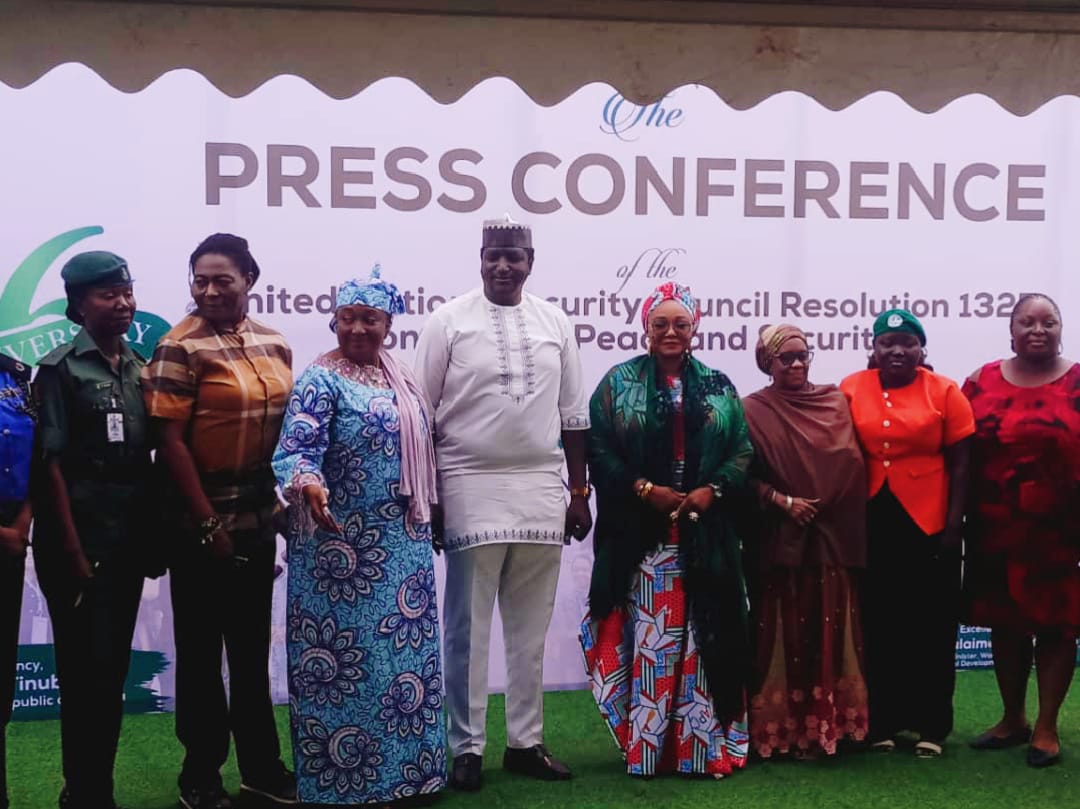
The Federal Government has reaffirmed its commitment to strengthening women’s participation in peacebuilding, national security and decision-making, with the approval of landmark social protection policies and the establishment of the National Council for Social Work as part of efforts to translate the Women, Peace and Security Agenda into measurable national impact.
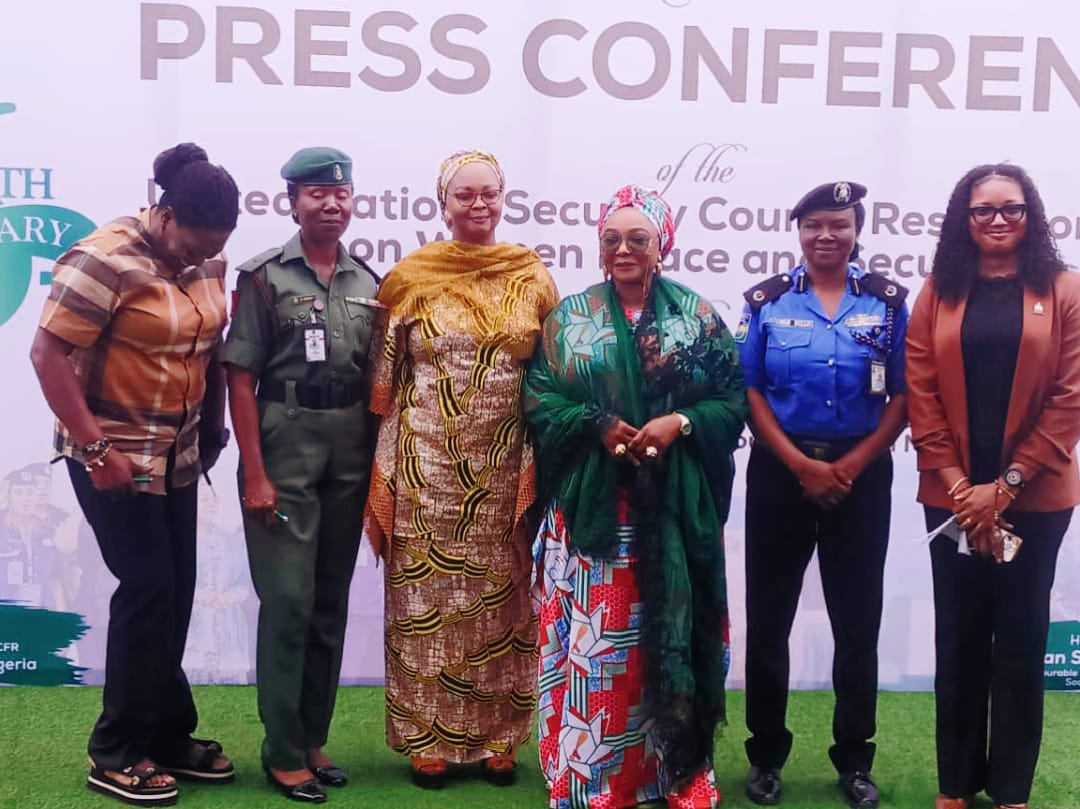
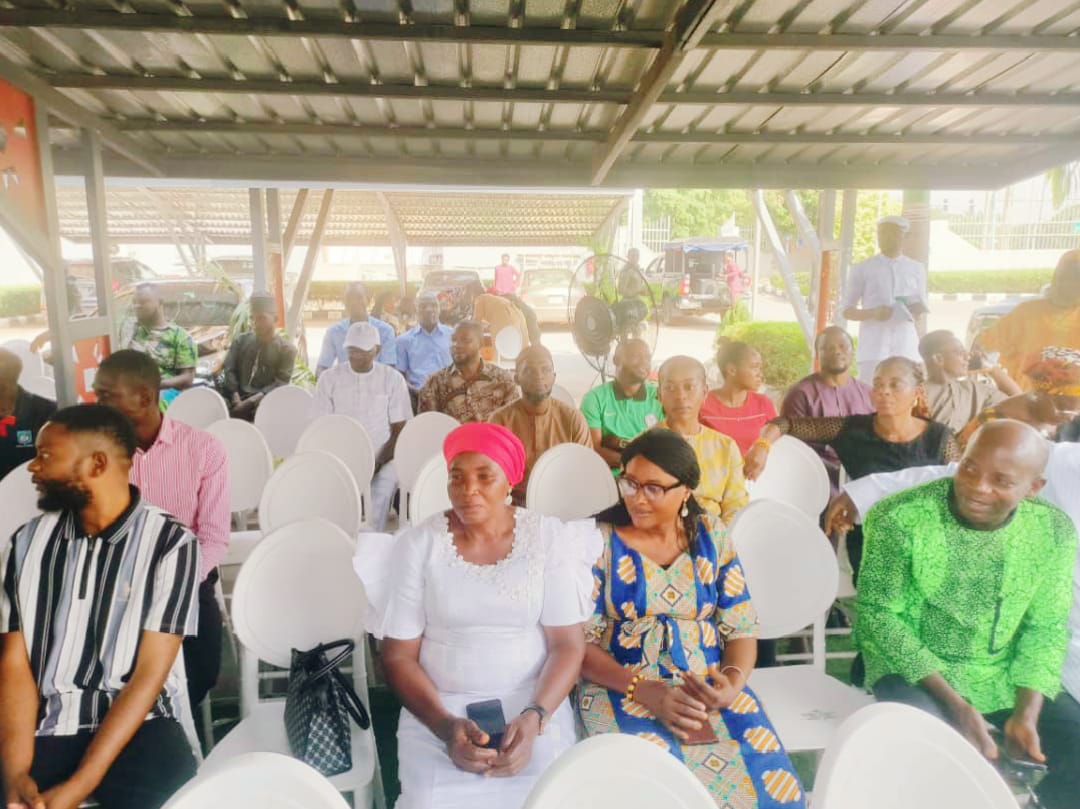
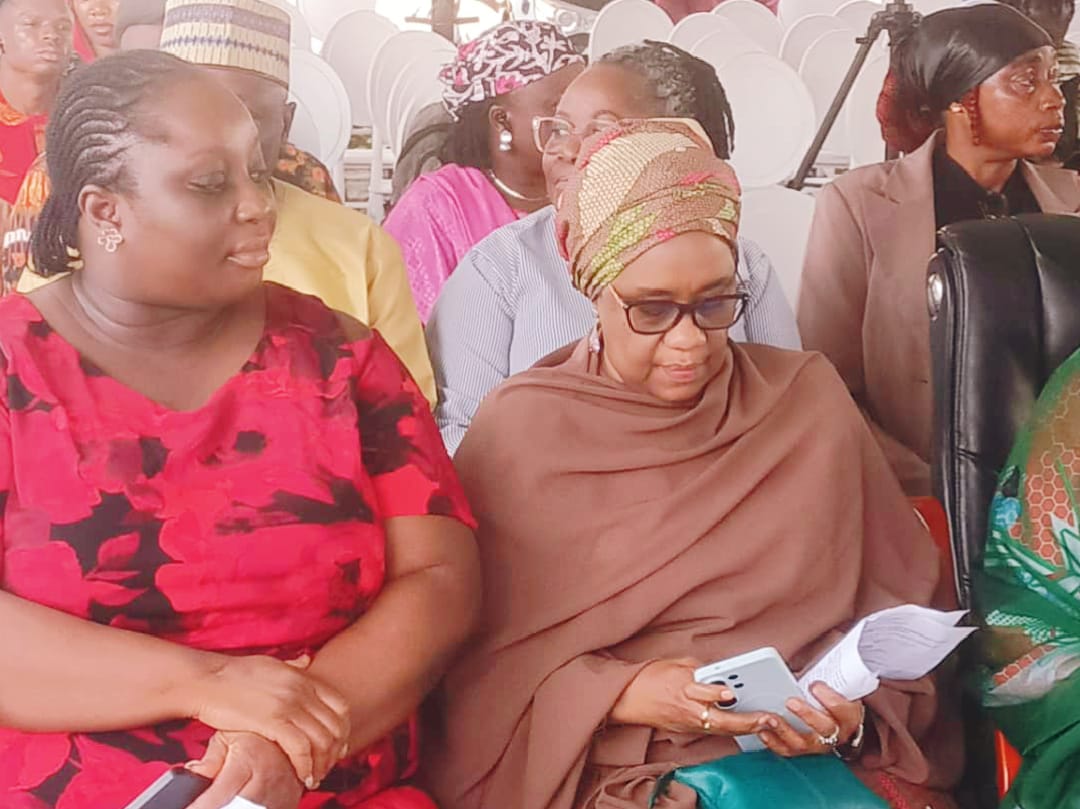
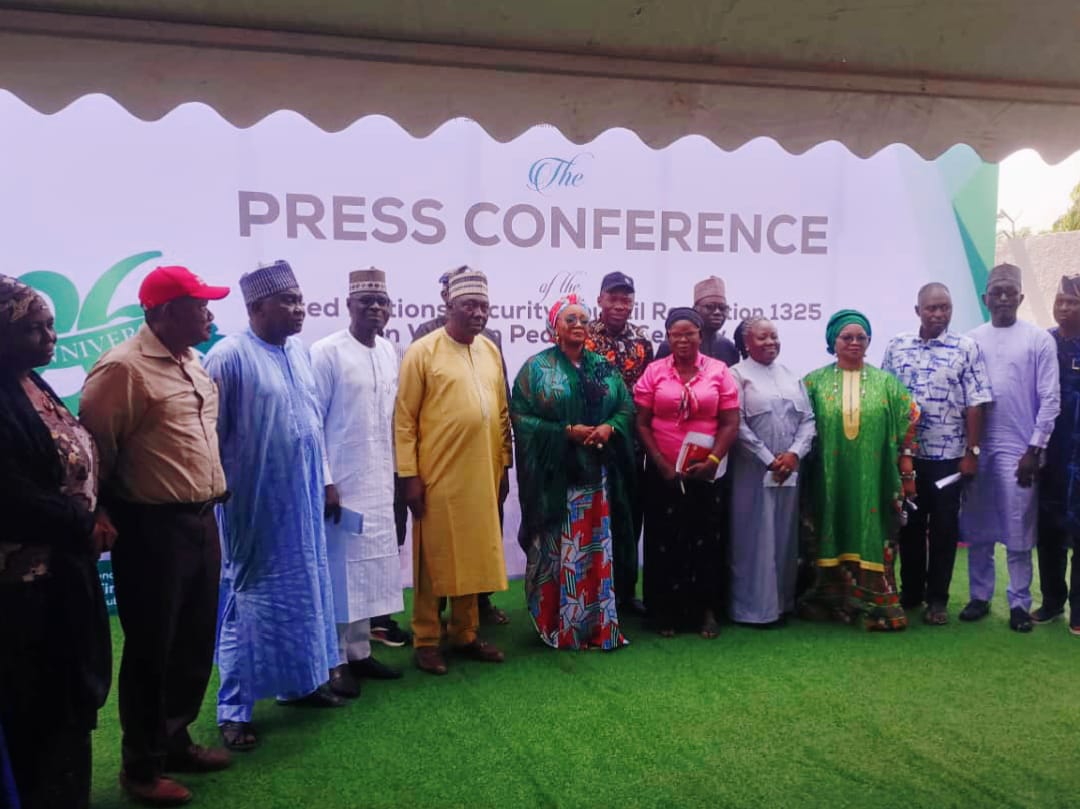
The Honourable Minister of Women Affairs and Social Development, Hajiya Imaan Sulaiman-Ibrahim, FSI, made this known on Thursday October 29, 2026, at a press conference in Abuja to commemorate the 26th Anniversary of the United Nations Security Council Resolution 1325 (UNSCR 1325) on Women, Peace and Security.
The event, held under the theme, “From Commitment to Impact: Advancing Women, Peace and Security through Inclusive Leadership, Local Action and National Accountability in Nigeria,” provided an opportunity to assess Nigeria’s progress in implementing the resolution and renew collective commitment to protecting women and girls while strengthening their leadership in peace and security processes.
The Minister recalled that UNSCR 1325, adopted on October 31, 2000, fundamentally transformed global perspectives on women in conflict situations by recognising them not merely as victims but as essential actors in conflict prevention, peacebuilding, security and national recovery.
She noted that 26 years after its adoption, the true measure of the resolution must be reflected in the lives of women and girls rather than government commitments alone.
“Twenty-six years on, the measure of Resolution 1325 is no longer what governments sign. It is what women live,” she declared.
Highlighting Nigeria’s security challenges, including insurgency in the North-East, banditry and kidnapping in the North-West, and conflicts over land and livelihoods in the Middle Belt, the Minister observed that women and girls continue to bear disproportionate consequences through displacement, sexual violence, loss of livelihoods and disruption of education.
She, however, stressed that Nigerian women remain indispensable partners in addressing insecurity and building resilient communities.
The Minister highlighted Nigeria’s commitment to implementing UNSCR 1325 through its First National Action Plan in 2013, the Second National Action Plan in 2017, and the Third National Action Plan (NAP III), launched on December 15, 2025, by the First Lady of the Federal Republic of Nigeria, Senator Oluremi Tinubu, CON.
According to her, the Third National Action Plan is anchored on five pillars: Prevention, Protection, Participation, Relief and Recovery, and Crisis Response and Emerging Threats, placing women, children, families and vulnerable populations at the centre of Nigeria’s peacebuilding and inclusive governance framework.
In what she described as a major institutional milestone, the Minister disclosed that President Bola Ahmed Tinubu, GCFR, had approved the establishment of the National Council for Social Work, complete with a Chairman, Registrar and administrative structure.
She explained that the initiative, supported by a World Bank-assisted project, would facilitate the training, certification and deployment of professional and licensed social workers nationwide.
“For the first time in Nigeria’s history, we now have approval for the establishment of the National Council for Social Work. It means that a woman fleeing violence, a child in danger or a family in crisis will meet a trained, certified professional, not an improvised response,” she said.
The Minister further announced that the Federal Executive Council, presided over by President Tinubu, had approved three major national instruments presented by her Ministry, describing the decisions as significant interventions for strengthening social protection, safeguarding children and advancing women’s economic participation.
The three instruments are:
1. National Action Plan on Ending Violence Against Children: The costed action plan will strengthen child protection mechanisms across the 36 states and the Federal Capital Territory through a Pathfinder State Model, ensuring improved prevention, response and protection for Nigerian children.
2. National Policy on Menstrual Health and Hygiene Management, 2026–2030: The policy seeks to eliminate barriers that prevent girls from attending school because of inadequate access to menstrual hygiene products. It will also promote local manufacturing of sanitary products through women-owned businesses and establish Pad Banks in public spaces to improve access for vulnerable women and girls.
3. National Care Policy and Implementation Plan, 2026–2030: The policy recognises unpaid care work, particularly the contributions of women caring for children and elderly relatives, while promoting regulated childcare and elderly care services, professional care employment, minimum standards for care centres and stronger safeguards in child adoption. It also provides for a National Care Fund and the eventual development of an enabling Act of the National Assembly.
She explained that these policies were directly connected to the Women, Peace and Security Agenda because insecurity often begins with vulnerabilities within homes and communities.
“Insecurity does not begin on the battlefield. It begins in the home where a child is abused, in the classroom a girl misses for want of a sanitary pad, and in the household where a woman’s every hour is consumed by unpaid care,” the Minister stated.
On women’s representation in national security and justice institutions, Sulaiman-Ibrahim noted that Nigerian women were increasingly occupying strategic leadership positions, citing the appointments of Kemi Nanna Nandap as Comptroller-General of the Nigeria Immigration Service and Folashade Adekaiyaoja as the first female Deputy Director-General of the Department of State Services.
She also acknowledged the contributions of female ambassadors, women serving in the Armed Forces, female military pilots, women peacekeepers deployed abroad and women occupying leadership positions across the judiciary and legal profession.
The Minister particularly celebrated the election of Oyinkansola Badejo-Okusanya, SAN, as the first female President of the Nigerian Bar Association in July 2026, describing such developments as evidence of the growing influence of women in national leadership.
She further disclosed that the Federal Government, under the Renewed Hope Agenda, was implementing the Renewed Hope Social Impact Interventions – 774 (RH-SII 774), designed to reach 50 million women, children and vulnerable citizens across all Local Government Areas in Nigeria.
The intervention encompasses women’s economic empowerment, clean energy initiatives through PowerHer 774, the Happy Woman App, Women in Green Economy, affirmative procurement in collaboration with the Bureau of Public Procurement, child protection, family strengthening, social care and support for widows of fallen security personnel, senior citizens, displaced survivors and persons with disabilities.
Addressing existing gaps, the Minister admitted that Nigeria’s 52 Sexual Assault Referral Centres were insufficient to serve a population of over 200 million people, assuring that efforts were ongoing to expand the facilities.
She also disclosed that the Ministry was working to strengthen the Child Rights Act 2003, already domesticated by all 36 states, and the Violence Against Persons (Prohibition) Act 2015, domesticated in 35 states, to address emerging threats, including technology-facilitated violence.
On the economic dimension of women’s security, she emphasised that access to finance, land, productive assets and economic opportunities remained essential safeguards against violence and vulnerability.
She recalled the Federal Government’s declaration of 2026 as the Year of Families and Social Development, adding that the Ministry was advocating for a Decade of the Family in Nigeria to institutionalize early childhood development, strengthen intergenerational care, protect vulnerable children and promote resilient households.
The Minister called on the media to sustain public awareness and accountability by taking the implementation of NAP III beyond national-level activities to states and local governments.
“I ask you to carry this message beyond today’s headlines: follow NAP III into the States and local governments, tell the stories of the women who are building peace, and hold us to the commitments we have made,” she urged.
The Honourable Minister expressed appreciation to UN Women, the Like-Minded Ambassadors Caucus, development partners, critical stakeholders and the technical team from her Office and the Ministry for their continued support towards advancing the Women, Peace and Security Agenda in Nigeria.
She reiterated that the Federal Government remained committed to translating policy declarations into measurable results, ensuring that Nigerian women and girls enjoy safety, dignity, equal opportunities and meaningful participation in shaping the country’s peaceful and secure future.
Earlier, the United Nations Women Representative to Nigeria and ECOWAS, Ms Beatrice Eyong, represented by the Programme Manager, Women, Peace and Security, Mr Peter Mancha, commended the Federal Government for its sustained commitment to implementing UNSCR 1325 through the development and adoption of three successive National Action Plans in 2013, 2017 and 2025.
Eyong observed that women’s participation in peace processes was not merely a question of representation but a strategic necessity for sustainable peace, citing evidence that peace agreements involving women as negotiators, mediators, signatories and witnesses have a 35 per cent greater probability of lasting at least 15 years.
She also highlighted Nigeria’s achievements, including the establishment of a network of over 5,000 women mediators across states and the integration of more than 800 women into traditional councils as members and advisers involved in decision-making and peacebuilding.
However, she expressed concern that nearly 80 per cent of active peace negotiations in the previous year took place without a single woman at the table, stressing that institutional barriers and unequal power relations continued to undermine women’s participation.
She called for increased investment in conflict prevention, peace building and women’s leadership, while acknowledging the contributions of development partners, particularly the European Union, UN Peace building Fund and the Governments of Norway, the United Kingdom, Germany and Japan.
In her goodwill message, the representative of the Honourable Minister of Defence, Lieutenant Colonel Nneka Olimma-Adinweruka, Special Adviser on Gender to the Honourable Minister of Defence, General Christopher Gwabin Musa (Rtd.), OFR, reaffirmed the Defence Ministry’s commitment to advancing women’s participation and leadership in national security.
She noted that female military personnel had continued to contribute significantly to operational, administrative, medical, intelligence and peacekeeping assignments, demonstrating that women were indispensable partners in national defence.
She identified increased women’s participation in security decision-making, stronger protection against sexual and gender-based violence, gender-responsive security-sector reforms, institutional collaboration and adequate funding as critical requirements for achieving the objectives of UNSCR 1325.
According to her, “There can be no sustainable peace without women’s participation, no meaningful security without women’s protection, and no lasting development without gender inclusion.”
Similarly, the representative of the Director-General of the National Institute for Legislative and Democratic Studies, Professor Abubakar Olanrewaju Sulaiman, Rakiya Attah, congratulated the Federal Government and Nigerian women on the anniversary, commending the progress made in advancing women’s participation in peace and security.
She reaffirmed the Institute’s support for initiatives that promote women’s inclusion in peace building, democratic governance and national development.
Also speaking, the representative of the Institute for Peace and Conflict Resolution, Mrs Desola Olowokere Principal Research Fellow and Acting Head of the Gender, Peace and Security Unit, on behalf of her Director General, commended the Minister and the Ministry for sustaining the Women, Peace and Security Agenda.
She stressed the need to move beyond symbolic representation to meaningful participation and influence, noting that the implementation of the Third National Action Plan must produce visible improvements in communities.
“As Nigeria celebrates the implementation of the third National Action Plan, we must move beyond women’s presence to meaningful participation and influence, beyond policy commitments to effective implementation, and beyond national frameworks to visible impacts in our communities,” she said.
In her remarks, the representative of the Nigeria Police Force, Assistant Commissioner of Police Zainab Bello, representing AIG Aisha Abubakar Baju, reaffirmed the Force’s commitment to strengthening responses to sexual and gender-based violence and improving the handling of cases involving women and girls.
She identified the strengthening of gender desks, gender-responsive policing, professional training of designated officers, community partnerships and accountability mechanisms as priority areas.
According to her, gender desk officers have been deployed across states and at divisional levels to ensure that survivors of sexual violence receive appropriate support and that sensitive cases are handled with professionalism, confidentiality and discretion.
The outgoing National President of the Association of Nigerian Female Students, Comrade Peter Attracta Precious, represented the association in calling for greater inclusion of women and girls in leadership, decision-making and national development.
She commended the Minister for championing initiatives aimed at empowering women and girls, while emphasising the need to strengthen protection and create more opportunities for young women to participate in peacebuilding.
“At ANFS, we remain committed to empowering female students to become responsible leaders and advocates for peace. Together, let us build a Nigeria where every woman is safe, every girl has a voice, and every woman has a seat at the table,” she stated.
Ahmed Lawan Danbazau Mnipr
Head, press and Relations Dept
FMWASD