


……..Alausa targets digital solutions to bridge one-million-teacher gap, expand learning access and strengthen education planning nationwide.
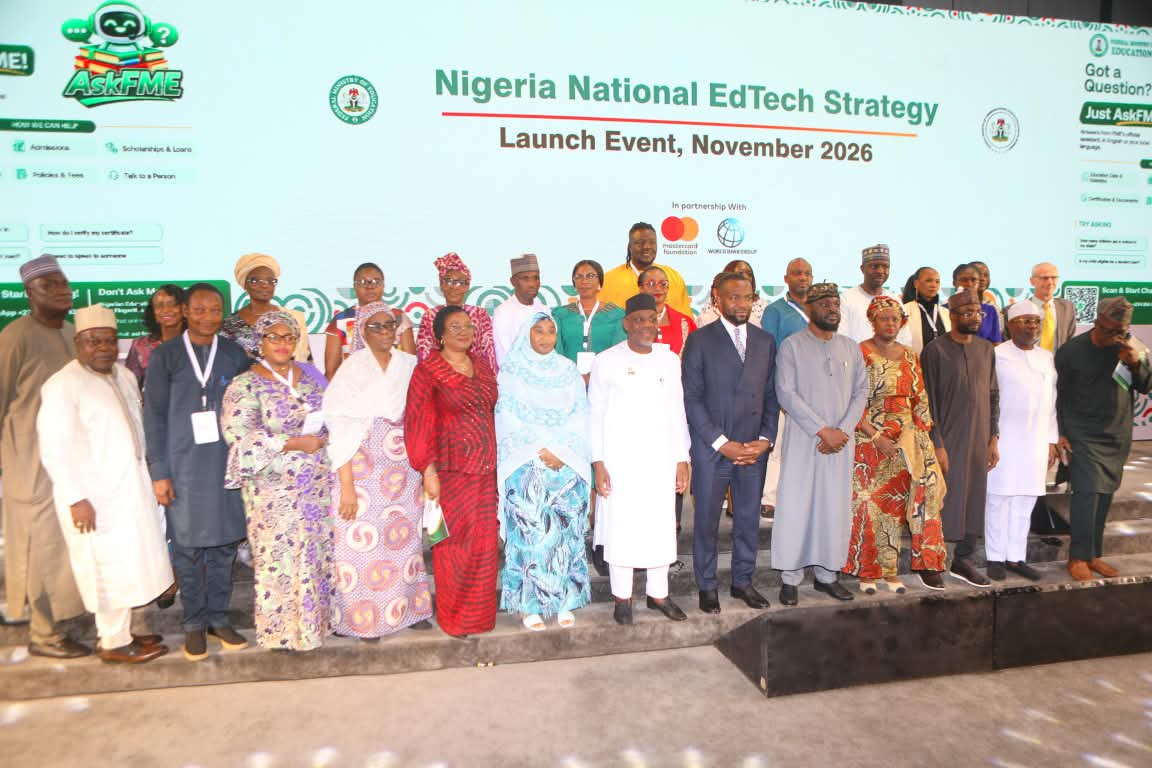
The Federal Government has unveiled the National Education Technology (EdTech) Strategy and National Call to Action, officially launched the Federal Ministry of Education’s Artificial Intelligence-powered AskFME Chatbot and reviewed the implementation of the Nigeria Education Data Infrastructure (NEDI), in a major drive to accelerate digital transformation and improve learning outcomes across the country.
Speaking at the engagement in Abuja, the Honourable Minister of Education, Dr. Maruf Tunji Alausa, CON, described technology-enabled education as a critical intervention for addressing Nigeria’s nearly one-million-teacher deficit, expanding access to quality learning and strengthening education delivery, particularly in underserved communities.
Dr. Alausa explained that digital teaching platforms would enable qualified teachers to deliver interactive, curriculum-based lessons remotely to learners in schools lacking subject teachers, irrespective of their geographical location. He highlighted initiatives including Inspire, Ignite, Learning Passport and Winframe as platforms supporting digital learning and teacher development.
The Minister also disclosed that the Federal Government was collaborating with the Nigerian Communications Commission (NCC) to facilitate zero-rated data access to selected educational platforms, enabling learners to access digital resources without incurring internet data charges.
On education data management, he said the Ministry was strengthening the Nigeria Education Data Repository, National Education Management Information System and Child Electronic Information System to improve data reliability and integration. He further disclosed plans to integrate data from JAMB, NECO, NYSC and other education agencies into a unified system to track learners’ educational progression and support evidence-based planning and targeted interventions.
He called on state governments, development partners and private-sector investors to align their interventions with the national strategy, particularly in school connectivity, smart classrooms and digital infrastructure. He also advocated sustainable maintenance funding to ensure the continuity of technology-enabled educational facilities.
In his remarks, the Honourable Minister of Communications, Innovation and Digital Economy, Dr. Bosun Tijani, disclosed that the Federal Government was targeting 3,700 telecommunications towers and a 90,000-kilometre national fibre-optic network to extend broadband connectivity to schools and underserved communities. He reiterated the government’s ambition to ensure that no Nigerian community remains without connectivity by the end of 2027, stressing the importance of public-private collaboration.
The Honourable Minister of State for Education, Prof. Suwaiba Said Ahmad, described the National EdTech Strategy as a common framework for ensuring that technology addresses the practical needs of teachers and learners. She highlighted the Nigerian Learning Passport, Inspire and Inspire Live, and EduRevamp as key initiatives expanding access to curriculum-based resources and quality learning, particularly in underserved schools.
She noted that the strategy prioritises interoperable education data systems, sustainable digital infrastructure, needs-based procurement, teacher development and effective stakeholder coordination. She called for inclusive implementation that addresses the needs of rural and underserved communities and learners with disabilities, stressing that no learner should be left behind in Nigeria’s digital education transformation.
The Director-General of the Nigeria Governors’ Forum, Dr. Abdulateef Shittu, described the strategy as an important milestone in Nigeria’s education transformation efforts, stressing that its success would depend on effective ownership, adoption and implementation by state governments.
In her contribution, the Director Overseeing the Office of the Permanent Secretary, Dr. Folake Olatunji-David, stressed that the success of the strategy would be measured by its tangible impact on teachers, learners and schools, rather than its unveiling alone. She called for sustained collaboration, accountability and effective implementation in alignment with President Bola Ahmed Tinubu’s Renewed Hope Agenda.
The World Bank Country Director for Nigeria, Mr. Matthew Verghis, and the Mastercard Foundation Country Director, Ms. Rosy Fynn, commended the Federal Government on the National EdTech Strategy, reaffirming their commitment to supporting its implementation. They emphasised that technology must complement, not replace, teachers, with foundational literacy and numeracy, digital skills, critical thinking and creativity remaining central to education transformation. They stressed the importance of relevant learning content, reliable connectivity, inclusive access and strengthening teachers’ digital competencies, while ensuring that underserved communities, particularly young people and young women, are not left behind in accessing quality digital learning opportunities and skills for the future.
Providing implementation details, the NEDI
Coordinator, Dr. Abubakar Isah, disclosed that approximately 80 per cent of preparatory activities had been completed, with implementation scheduled in three phases from 2026 to 2030. The strategy is anchored on five pillars : data and interoperability; infrastructure ecosystem; technology and procurement; teacher transformation; and governance and coordination.
The Federal Ministry of Education reaffirmed its commitment to translating the initiatives into measurable improvements in access, equity, quality and accountability, ensuring that technology and reliable education data deliver meaningful learning opportunities for every Nigerian child.
Boriowo Folasade
Director, Press and Public Relations