

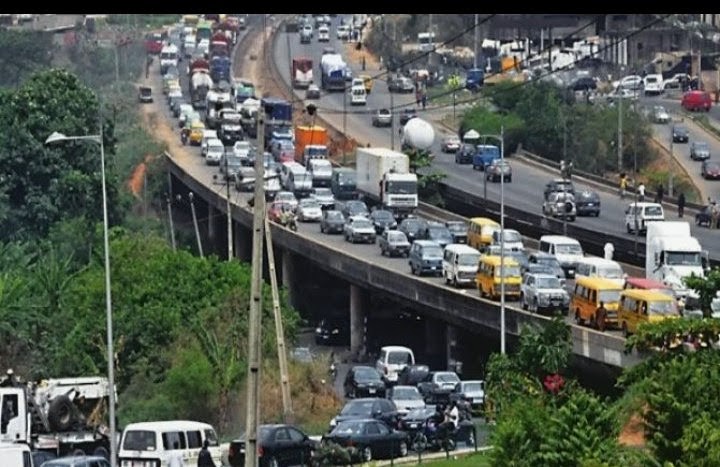
FIC REPORT (LAGOS STATE) – The ongoing repair of the Kara Bridge along the Lagos-Ibadan Expressway has plunged thousands of motorists and commuters into what is fast becoming one of the most disruptive traffic crises witnessed along the Lagos-Ogun corridor in recent times, with the resulting gridlock spilling deep into the Lagos metropolis and leaving road users stranded for hours.
What was announced as a two-week intervention to replace deteriorating expansion joints on the strategic bridge has exposed the enormous vulnerability of Lagos’ transportation network, as the partial restriction of traffic at one of the country’s busiest transport corridors has triggered a chain reaction across connecting roads.
The situation became even more severe on Tuesday, September 15, when a container-laden trailer fell on the Kara Bridge, forcing the temporary total closure of the outward-Lagos section and compounding the congestion already generated by the repair operation.
According to Channels Television, the incident brought traffic to a standstill on the Lagos-bound section, with the resulting gridlock extending beyond the Berger area. Motorists travelling in the opposite direction were also affected because vehicles had to share the available side of the expressway.
Traffic management officials from Lagos and Ogun were deployed as authorities worked to create an alternative passage.
But even before Tuesday’s trailer incident, the repair work had already generated extraordinary frustration among road users.
The scale of the disruption was vividly illustrated by a complaint received from Mr Ojo Samuel, who was travelling towards Ikorodu on Tuesday night. At 10:21pm, Samuel contacted this reporter to describe his experience on Western Avenue.
“I am on Western Avenue at 10:21 pm heading to Ikorodu, but can’t move an inch. The situation is unbearable.”
His experience underscores an important dimension of the Kara Bridge crisis: the consequences are no longer confined to the immediate Kara-Berger axis or even the Lagos-Ibadan Expressway.
As motorists seek alternative routes to escape the Kara bottleneck, the pressure is being transferred to other major roads, creating secondary and tertiary congestion across the metropolis.
Road users travelling through Berger, Ojota, Otedola, Alausa, Ikeja, Agege and other connecting corridors have reported prolonged delays, while motorists heading towards Ikorodu and other parts of Lagos have increasingly found themselves caught in traffic generated several kilometres away from the actual construction site.
Six Hours on a Journey That Should Take Far Less
Reports from the past week show that the disruption has been severe. Motorists were reported to have spent up to six hours on the Lagos-Ibadan Expressway as the repair works drastically reduced the available road capacity. At one point, the congestion stretched more than 20 kilometres into Lagos.
PUNCH reported that the gridlock stretched from the Kara Bridge towards the 7Up Junction, while traffic from Ikeja and Agege attempting to access the Otedola underpass was also caught in the congestion. The pressure extended towards Otunba Jobi Fele Way.
The Guardian similarly reported that motorists endured journeys lasting almost four hours during one of the worst periods of congestion, with traffic still moving slowly even after the first phase of concrete works was completed.
For ordinary commuters, the figures translate into lost working hours, missed appointments, increased transport costs, physical exhaustion and uncertainty over when they will arrive home.
For businesses, the implications are potentially wider. Goods spend longer in transit. Commercial vehicles burn more fuel while idling or crawling through traffic. Drivers spend additional hours on the road, while passengers are compelled to alter travel plans or seek more expensive alternatives.
Why Is Kara Being Repaired?
The disruption, however, should not obscure the reason the Federal Government embarked on the intervention. The immediate problem is the deteriorating expansion joints on the Kara-Berger Bridge.
According to the Federal Ministry of Works, the joints had exceeded their service life and required replacement. The Acting Federal Controller of Works in Ogun State, Richard Adeleye, explained that expansion joints are designed to allow bridge structures to accommodate movement caused by temperature changes.
When such joints deteriorate, the consequences can include cracking, buckling and other structural problems. The authorities have also linked the damaged joints to accidents along the section.
The repair is therefore not merely cosmetic road maintenance. It is intended to address a component of the bridge directly associated with its safety and durability.
The Federal Government scheduled the latest intervention to run from September 8 to September 22, 2026, subject to construction and operational conditions. The work is being executed in phases, with one half of the affected section closed while traffic is managed through the available carriageway.
The Mathematics of the Gridlock
The problem is essentially one of capacity. The Lagos-Ibadan Expressway is designed to carry a huge volume of vehicles moving between Lagos, Ogun and other parts of southwestern Nigeria.
When several lanes are suddenly removed from service at Kara, the road’s ability to absorb traffic drops sharply. Vehicles that would ordinarily be distributed across several lanes are compressed into fewer lanes. Once the number of vehicles approaching the restricted section exceeds the reduced capacity, the queue begins to move backwards.
And that queue does not respect the geographical boundary of the construction site. It spreads. One blocked corridor pushes vehicles onto another.
Alternative routes become congested. Traffic management personnel are forced to intervene at junctions farther away from the original obstruction.
That is how a bridge repair in the Kara axis can eventually produce traffic problems on roads in other parts of Lagos.
Rain Makes a Difficult Situation Worse
The traffic crisis has also been aggravated by weather. PUNCH reported that rainfall disrupted movement and affected some aspects of the repair operation, while the reduced number of available lanes compounded the congestion.
The Federal Controller of Works in Ogun State, Michael Komolafe, however, said the repair itself continued according to plan, explaining that concrete and stone works scheduled for the first phase had been completed before the rain began and that measures were taken to protect the completed work. This distinction is important.
The traffic crisis should not automatically be interpreted as evidence that construction has stopped or that the project is being poorly executed. Some of the disruption is an unavoidable consequence of undertaking structural work on an active, heavily trafficked bridge.
The more immediate question is whether traffic-management measures are sufficient for the extraordinary volume of vehicles using the corridor.
Alternative Routes Under Pressure
Authorities have repeatedly advised motorists to consider alternative routes. Earlier advisories identified routes through Ikorodu, Ogijo, Shimawa and other connecting corridors, depending on the traveller’s destination.
Motorists have also been urged to plan journeys ahead, obey traffic-management instructions and avoid unnecessary trips through the affected corridor.
But alternative routes have their own limitations.
The sheer number of motorists attempting to avoid Kara means that some diversion routes can rapidly become congested. This is precisely what commuters such as Samuel are experiencing. For a traveller heading towards Ikorodu, avoiding Kara may simply mean joining another traffic queue somewhere else.
The Human Cost
Behind the kilometres of stationary vehicles are people. Workers who leave their offices at the normal closing hour can arrive home several hours later.
Parents may be unable to pick up children on time. Students can spend hours in commercial buses. Patients travelling to hospitals may face unpredictable delays.
Commercial drivers spend longer hours consuming fuel while making fewer trips. Private motorists face additional fuel consumption, vehicle wear and psychological stress.
And for commuters who depend on daily wages or multiple trips to earn a living, hours lost in traffic can translate directly into lost income.
The problem is particularly serious for residents who live in communities around the Lagos-Ogun boundary but work in Lagos. For them, the Lagos-Ibadan Expressway is not simply a highway to another state. It is part of their daily commute.
The Bigger Lagos Question
The Kara crisis has once again exposed a structural problem in Lagos’ transport system: the extraordinary dependence of millions of people on a limited number of major corridors.
When one critical link is restricted, the impact quickly cascades across the metropolitan road network. This raises questions beyond the current repair.
How much spare capacity exists in Lagos’ road network? How quickly can traffic be diverted when a major corridor is restricted? Are alternative routes sufficiently developed to absorb emergency traffic? Can road repairs on critical corridors be accompanied by more extensive traffic simulations and public communication before implementation? And, perhaps most importantly, how can authorities ensure that necessary infrastructure repairs do not create disproportionate mobility and economic disruption?
These questions become increasingly important as Lagos continues to expand and the number of daily road users rises.
A Necessary Repair With an Unbearable Price?
There is an uncomfortable reality at the heart of the Kara Bridge crisis. The repair is necessary. The consequences of allowing deteriorating bridge components to remain unattended could ultimately be more serious than the present inconvenience.
But necessity does not eliminate the responsibility to manage the consequences.
The Federal Ministry of Works and the Lagos and Ogun traffic authorities therefore face a dual challenge: finish the repair safely and quickly, while keeping the surrounding road network moving as much as possible.
The first phase of the concrete works has already been completed, and authorities have indicated that the overall intervention remains targeted for completion by September 22.
But for commuters trapped in traffic late into the night, the official completion date offers little immediate comfort.
At 10:21pm on Tuesday, Samuel was still stuck on Western Avenue, unable to move towards Ikorodu. His complaint captures the reality confronting thousands of Lagos commuters: a repair being undertaken to make a vital bridge safer has, for the moment, made the journey across a large part of the Lagos metropolis considerably harder.
The task before the authorities is therefore no longer simply to repair Kara Bridge. It is to repair it without allowing Lagos’ wider transport system to grind to a halt.
IYEDEH Onowouzou David
CIO&PRO
16/09/2026