

The Honourable Minister of State for Health and Social Welfare, Dr Iziaq Adekunle Salako has reaffirmed the commitment of President Bola Ahmed Tinubu led administration in strengthening scientific capacity and transforming new technologies into impactful treatments for Nigerians.
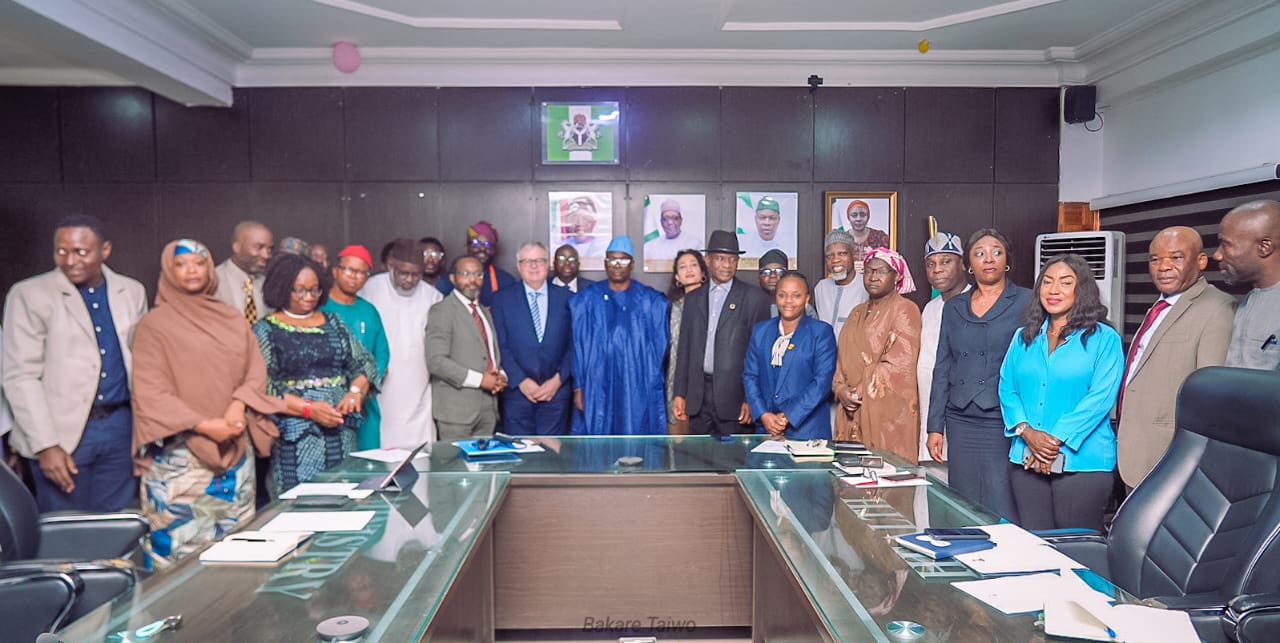
Dr. Salako made the remarks in Abuja during a Ministerial Engagement with delegation from Caring Cross- a US-based NGO and International Partners, led by the Director General, National Institute of Pharmaceutical Research Development, Dr. Obi Adigwe.
He said that President Bola Ahmed Tinubu, has accorded highest priority to health and contextual research, pointing out that key initiatives such as PVAC and the Pharma Sector Presidential Order, have catalysed health security, economic growth and employment by promoting evidence-based policy and practice reforms, as well as accelerating value-chain transformation.
These novel interventions, he added exemplify the focus of the administration to cleverly leverage and synergise seemingly diverse factors domiciled in government, industry, academia and the community, stating that the mandate of the Ministry is to oversee institutional coordination, foster collaboration, catalyse innovation and ensure that all these efforts directly impact on people’s health and wellbeing, by working closely with organizations like Caring Cross.
He further added that under the leadership of His Excellency, President Bola Ahmed Tinubu, a strong collaboration ethos has underpinned an all-of-government approach and by extension, Africa, in driving key initiatives, to equip clinicians and scientists with relevant access to partnerships and an impact oriented ecosystem, especially as regards leveraging cutting edge technologies from the world over.
“These skills are indispensable if we are to deliver locally relevant solutions, strengthen medicine security, and build resilient health systems across Africa” he reiterated.
Dr. Iziaq Adekunle, described the meeting as critical, and hoped that the discourse be remembered as the dawn of a new era, where science meets impact, research informs policy, and innovation saves lives. He further explained that it aimed to leverage the cutting edge science of Chimeric Antigen Receptor (CAR) T-Cell therapy, in improving access to care for our people, noting that across Africa, for far too long, people were deprived of new and innovative treatments, due to lack of engagement with the potentials in our setting.
The Minister said a National Phytomedicines Development Committee, was constituted aimed at harnessing local biodiversity assets to solve African issues through homegrown processes and world class products, and shortly after, the chairman of the Committe, Dr. Obi Adigwe, the NIPRD Director General brought the Chinese Ambassador to brief the Minister on their collaboration and progress.
“In that meeting, the well-known anecdote was told of how Chinese scientists used the translational research model, to develop artemisinin from a centuries’ old Chinese herbal remedy. Everyone now knows the story of how the work done by that team earned them a Nobel, created a billion dollar revenue stream for the Chinese and most importantly, gave the world a new gold standard medicine for malaria, when treatment failure limited the use of other therapeutic options.” he stated.
Salako, said Africa is the only continent that has not begun to leverage the CAR T-Cell Therapy in a robust and comprehensive manner. He also described the caliber of the participants at the engagement as a clear evidence that the Nigeria’s thought leaders recognized that without deliberately prioritizing healthcare access, Nigeria, the African continent, and indeed our world as a whole cannot heal and grow.
“Our gathering here today, however symbolizes only the first step in our journey to leverage this model, and others like it, in definitively addressing our unique pressing issues on the continent.”
Earlier in her welcome remarks, the Permanent Secretary Federal Ministry of Health and Social Welfare, Daju Kachollom, represented by Dr. John Ovoraye said the Ministry remains committed to strategic engagement and meaningful partnership with reputable institutions that can support the achievement of presidential priorities in the health sector. “This engagement reflects our shared determination to strengthen Nigeria’s health system through innovation, collaboration, and sustainable investment.” She emphasized.
She was delighted to host Caring Cross, a US-based non-profit organization with notable expertise in molecular and genetic research, including advanced therapies such as CAR-T and stem cell implants, assuring that these emerging areas of medicine provide great promises in the treatment of complex diseases and represent an important frontier in modern health care.
“We also commend the collaboration between Caring Cross and the National Institute of Pharmaceutical Research, especially the vision to explore investment opportunities in local manufacturing and delivery of CAR-T and gene therapies in Nigeria.”
Daju further explained that the meeting provides an excellent platform for productive dialogue among holistic leaders, clinicians, researchers, and industry stakeholders, therefore urged the participants to engage actively and identify practical ways to support institutions that ensure quality, safety, and sustainability in our nation.
In his presentation, the leader of the delegation, Dr. Boro Dropulic stated that they were the first group to build a vector that’s used to deliver the genes themselves, linking viral vectors into humans, and established their safety for the entire field, adding that in CAR-T, they made the vector for chimeride product.
Dr. Dropulic who assured that caring cross enables affordable and accessible cellular gene therapies, also stated that there’s a rising incidence of sickle cell and blood cancer in Nigeria, such as leukemia, lymphoma, and multiple myeloma, with increasing pediatric involvement.
Recounting on the strides so far achieved by National Institute of Pharmaceutical Research Development under the Minister’s directive, Dr. Obi Adigwe, the Director General of the institute, said they used the all-of-government approach, as well as an all-of-Africa in implementing the interventions, adding that this model used and leverage the Minister’s office to pull in Africa’s biggest grant in vaccines, R&D worth 18 million euros, signed on October 30th, 2025. He added that Six agencies have now begun to work with expertise from UNICEF to implement.
He also mentioned that a framework to position Nigeria to be at the forefront of interventions has been developed and they have already engaged and have partnerships in terms of potential to do collaborative clinical trials with some African countries like: Egypt, Ethiopia, DRC, Tanzania, Morocco, Ghana, and others.
He further stated that under the leadership of the present administration a biggest contextual Afrizem Bank grant has been secured for active pharmaceutical ingredients, confirming that the project is about 90% completed. In addition, he continued “In collaboration with Standford University, Nigeria hosted close to 100 African scientists, and they were trained by Stanford professors and other colleagues on translational research”.
Ado Bako
Assistant Director, Information and Public Relations.