

………Calls for a New Compact on Health Workforce Mobility.
Nigeria has declared its readiness to actualize the Africa Health Workforce Investment Charter, reaffirming to demonstrate this commitment through policy, investment, and accountability.
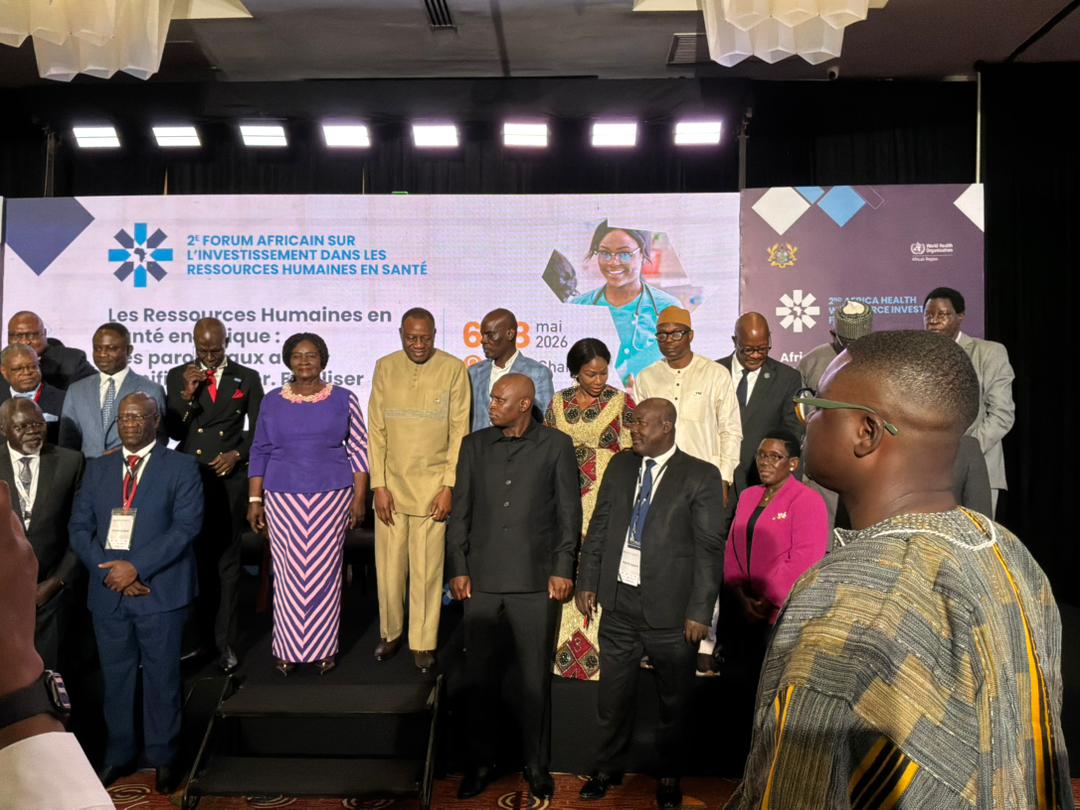
Minister of State for Health and Social Welfare, Dr Iziaq Adekunle Salako, made this declaration when delivering an opening remarks at the 2nd Africa Health Workforce Investment Forum, holding between 6th & 8th May, 2026 at Marriot Hotel, Àcçra Ghana.
Dr. Salako who stressed the need for more investment to develop the health workforce base for Africa, also identified financing gap as one of the most critical barriers to achieving Universal Health Coverage (UHC), noting that despite the growth of Africa’s health workers density from 11 in 2013 to 27 per 10,000 in 2024, it is projected that if the present trajectory continues, there will be shortfall of 6.1 million by 2030.
Narrating some of the Commitments, Dr. Iziaq Adekunle revealed that in August 2024, the Federal Government of Nigeria approved the National Policy on Health Workforce Migration — a landmark policy developed with key pillars around ethical recruitment, bilateral agreements, diaspora engagement, retention incentives, and rural deployment.
He added that the policy sought to address the growing exodus of health workers, and it aligned with the WHO Global Code of Practice on International Recruitment of Health Personnel.
Elaborating more, he revealed that under President, Bola Ahmed Tinubu (GCFR), Nigeria has launched the Health Sector Renewal Investment Initiative targeting about US$900 million in health system investment from 2024 to 2026, aimed at emphasizing on rebuilding primary health care infrastructure, expanding training capacity, and deploying community health workers.
“Nigeria has also completed the National Health Workforce Country Profile and established the National Health Workforce Registry (NHWR), with WHO technical support. A Health Labour Market Analysis (HLMA) is underway to inform Nigeria’s investment compact under the Africa Health Workforce Investment Charter.” Salako continues.
The Health Minister announced that training quotas have been increased at health training institutions to close workforce gaps, over 70,000 frontline health workers were retrained toward a target of 120,000 under the PHC workforce strengthening initiative, and committed to deploying community health workers nationwide as part of Nigeria’s Universal Health Coverage roadmap.
On the issue of workforce migration, Nigeria advocated for a new compact on health workforce mobility, a Managed Migration Agreement with clear terms and KPIs including structured investment in the training of health workforce in source countries like Nigeria by destination countries, urging that the current model, in which low-income countries invest in training and high-income countries reap the benefits, is neither sustainable nor just.
Nigeria further proposed structured bilateral and multilateral agreements that include compensation for source countries, joint training programmes, managed circular migration pathways that allow health workers to gain experience abroad and return with enhanced skills, and investment in health training infrastructure in countries of origin, and called for an annual report on each country’s graduate-employment ratio, as part of a standardized Africa Health Workforce Scorecard.
Highlighting more on some issues affecting Health and Health Workforce in Africa, the Minister cited financing landscape which is undergoing a profound and structural shift with Overseas Development Assistance(ODA) declined by estimated 70% between 2021 and 2025, 27% unemployment among skilled professionals despite the shortage, increase in public health emergencies by41% between 2022 and 2024, and shouldering of 25% of the World health burden.
To address the 27% unemployment among qualified health workers in Africa, Salako said, a 43% increase in employment investment is needed, and the 15% Abuja declaration target should be met as only three out of the 54 African countries (Rwanda, Botswana and Cabo Verde) have so far reached the target.
Ado Bako
Assistant Director Information and Public Relations