

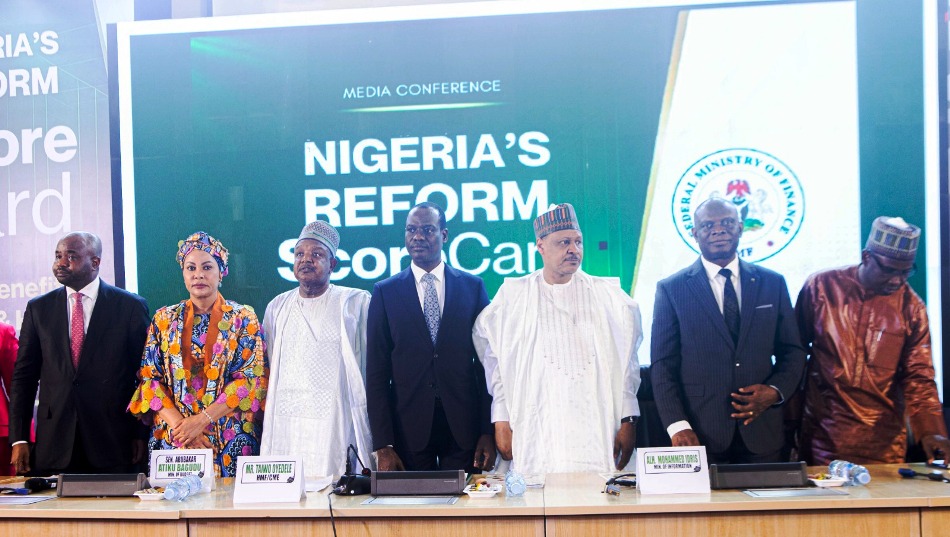
The Minister of Finance and Coordinating Minister of the Economy, Mr. Taiwo Oyedele, has said the economic reforms introduced by the President Bola Ahmed Tinubu administration have begun to restore fiscal and external stability while preventing potentially more severe consequences, including state bankruptcies, further naira depreciation, depleted foreign exchange reserves and deeper poverty across the country.
Presenting Nigeria’s Reform Scorecard, titled “The Gains, Costs and Harms Prevented,” in Abuja, Oyedele said the reforms had delivered measurable gains in public finance, foreign exchange, investment, economic growth and productivity, while acknowledging the significant costs and difficult adjustments experienced by Nigerians.
He said the reforms were not an end in themselves but were designed to build a more stable and productive economy capable of creating jobs, supporting businesses, attracting investment and ultimately improving the living standards of Nigerians.
According to the scorecard presented by the Minister, Nigeria’s debt-service-to-revenue ratio, which stood at about 100 per cent in 2022, is projected to decline to about 50 per cent in 2026. Without the reforms, the ratio was estimated to have risen to between 100 and 200 per cent.
Similarly, the number of states unable to pay salaries has fallen from 27 in 2023 to zero in 2026, while the Government’s counterfactual assessment indicated that at least 30 states could have faced bankruptcy without the reforms.
Oyedele said Nigeria’s external position had also strengthened significantly, with gross foreign exchange reserves rising from about $35 billion in May 2023 to $52.5 billion by July 2026. Net foreign exchange reserves also increased from approximately $3 billion in 2023 to $34.8 billion by the end of 2025.
He said the gap between the official and parallel foreign exchange markets had narrowed from more than 60 per cent to less than five per cent, while the current account balance strengthened from a $1.21 billion surplus in 2023 to a $14.04 billion surplus in 2025.
The Minister said the improvement in investor confidence was reflected in capital flows, with total capital importation rising from $1.13 billion in the first quarter of 2023 to $10.37 billion in the first quarter of 2026.
Foreign direct investment also increased from $895 million in 2022 to $4.01 billion in 2025, while stock market capitalisation expanded from about ?31 trillion in May 2023 to approximately ?150 trillion by June 2026.
Oyedele said the economy was also showing stronger signs of growth, noting that real GDP growth increased from 2.31 per cent in the first quarter of 2023 to 3.89 per cent in the first quarter of 2026.
He added that non-oil GDP growth was projected at about four per cent in 2026, manufacturing growth reached 3.29 per cent in the first quarter, while oil production improved to between 1.6 million and 1.75 million barrels per day.
The Minister, however, acknowledged that the reforms had imposed real costs on households and businesses, particularly during the transition period.
He said headline inflation, which stood at 22.41 per cent in May 2023, had moderated to 15.91 per cent in June 2026, while food inflation fell from 24.82 per cent to 17.52 per cent. Petrol prices, however, increased substantially from about ?185 per litre before subsidy removal to between ?1,100 and ?1,400 per litre.
Oyedele said the Government recognised that household welfare remained a work in progress and that the ultimate test of the reforms was their ability to translate macroeconomic stability into tangible improvements in the lives of ordinary Nigerians.
He said the reforms had generated and mobilised ?20.4 trillion in incremental resources, comprising ?5.4 trillion in subsidy savings accruing to the Federal Government under the statutory FAAC allocation formula, ?3.1 trillion in other incremental revenue and ?11.9 trillion in incremental borrowing.
Against this, Oyedele said total incremental expenditure stood at ?30.64 trillion, with wage adjustments accounting for ?9.39 trillion; additional external debt service arising from exchange-rate depreciation, ?9.37 trillion; strategic infrastructure development, ?6.47 trillion; and incremental electricity subsidy, ?3.14 trillion.
He explained that ?20.4 trillion of the expenditure was funded by incremental resources, while ?10.24 trillion was absorbed from the existing revenue base.
Oyedele said the resources were being used to support higher wages and more timely payment of salaries and pensions, settlement of pension arrears and gratuities, infrastructure development, student loans, affordable credit, housing initiatives, social transfers, agricultural interventions and improved energy security.
He also said the reforms had helped prevent potentially damaging outcomes, including the bankruptcy of states and local governments, hyperinflation arising from unchecked monetary financing, further collapse of the naira, fuel scarcity, greater poverty, mass business failures, higher interest rates and corruption associated with opaque foreign exchange allocation and the former fuel subsidy regime.
Oyedele said the next phase of the reform programme would focus on ensuring that the gains recorded at the macroeconomic level were increasingly felt by households and businesses.
He said the Government would continue the implementation of the Nigeria Tax Act, strengthen fiscal reporting and accountability, increase the tax-to-GDP ratio, push inflation towards single digits, maintain a unified and predictable exchange rate, deepen agricultural interventions, reduce poverty and improve the quality and prioritisation of public spending.
Earlier in his opening address, the Minister of Information and National Orientation, Mohammed Idris, said the briefing was convened to provide Nigerians with factual information on the savings and resources arising from fuel subsidy removal.
Idris described subsidy removal as one of the most significant and difficult economic decisions taken by the administration, acknowledging that it had imposed sacrifices on households, businesses and communities.
“Citizens have a right to know the financial implications of major economic decisions taken on their behalf. They have a right to know what resources have been freed up, what these resources mean for the federation, and how the benefits of these reforms are being translated into tangible improvements in their lives,” he said.
The Minister said transparency and accountability were essential to sustaining public confidence in the reform programme, stressing that the Government’s responsibility went beyond announcing policies to explaining them and accounting for their outcomes.
“As the fourth estate of the realm, you have the great responsibility to critique government policies and programs. But in doing so, we must remember as always that we have a nation to keep,” Idris said.
He urged journalists to report government policies and programmes responsibly, noting that the media had a critical role to play in promoting national cohesion while holding public officials accountable.
In his closing remarks, the Minister of Budget and National Planning, Senator Atiku Bagudu, said President Bola Ahmed Tinubu’s reform choices, particularly the sequencing of reforms, revenue mobilisation, investor confidence, infrastructure, security and federalism, were aimed at addressing deep structural weaknesses inherited by the administration.
Bagudu said the reforms should not be judged solely by immediate hardship or individual prices but also by the structural problems inherited and the longer-term objective of building a stronger fiscal and economic foundation.
He said the President’s Renewed Hope Agenda recognised that Nigeria was not where it wanted to be and that bold decisions were required to reverse the trend.
Bagudu disclosed that the administration inherited more than $6 billion in unpaid petroleum import obligations at a time when the country’s foreign exchange reserves were inadequate.
He said the President responded by approving the crude-for-naira policy to support domestic economic activity and demonstrate confidence in Nigerians and investors willing to commit capital to the country.
“Mr. President approved a crude Naira for crude policy just to ensure that the automotive binary works, just further demonstrating his commitment that those who believe in Nigeria will be supported by this administration,” he said.
Beyond fiscal and monetary reforms, Bagudu said the administration had identified security, human capital development and infrastructure as critical priorities, adding that the Government had continued investing in these areas despite fiscal constraints while implementing measures to cushion Nigerians affected by the reforms.
On the country’s fiscal position, he said Nigeria’s revenue-to-GDP ratio was improving, although it remained below the level considered desirable.
He stressed that subsidy removal alone could not generate sufficient resources to meet the country’s enormous development needs and appealed to Nigerians and stakeholders to support efforts to strengthen domestic revenue mobilisation.
According to him, a stronger revenue base would expand the Government’s capacity to provide public services while strengthening investor confidence.
Efe Ovuakporie
Head, Information and Public Relations
August 20, 2026