


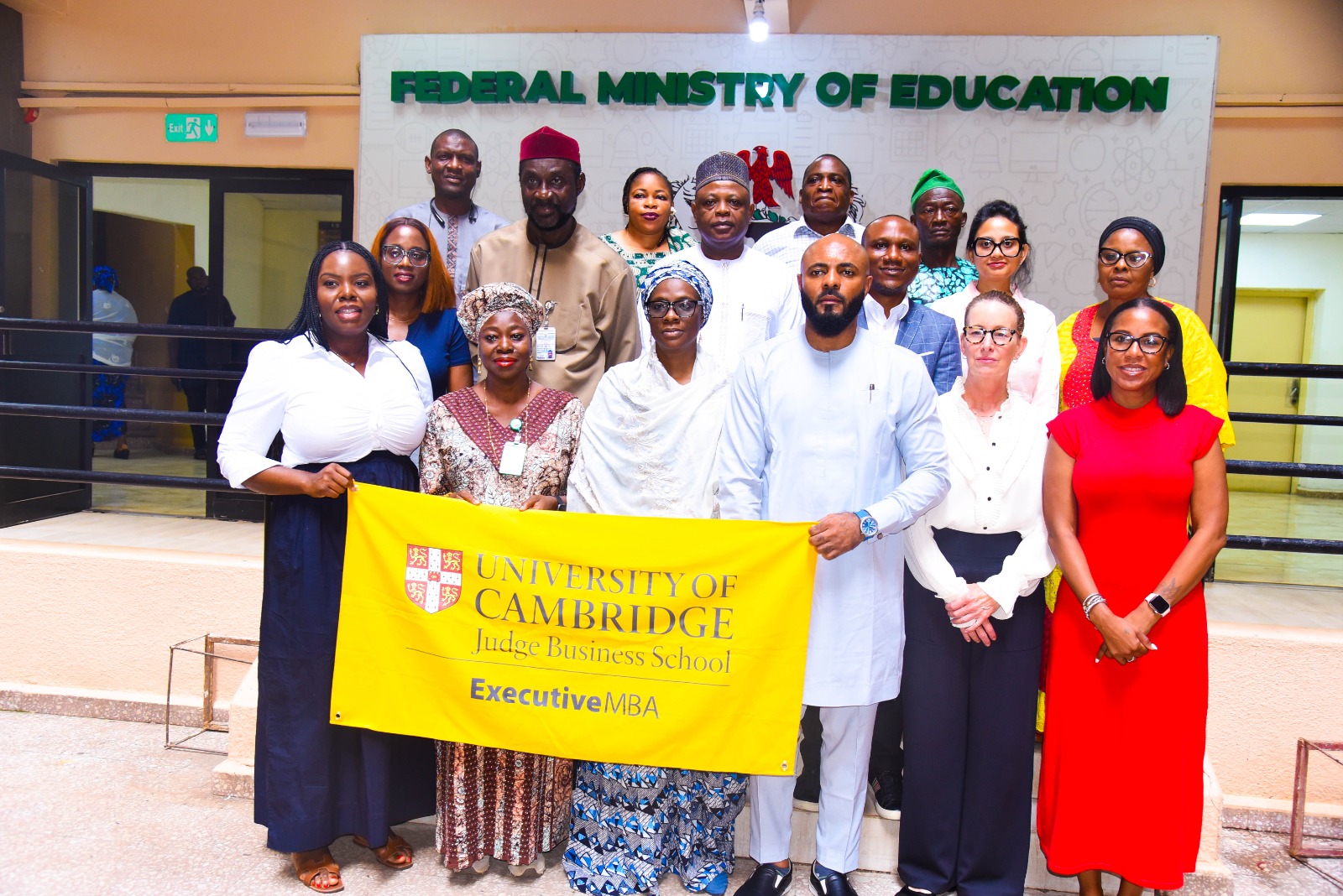
The Federal Government has called for stronger collaboration with Cambridge Judge Business School to bridge emerging skills, innovation and employment gaps and equip Nigerian youths with the knowledge and competencies required to thrive in the evolving world of work.
The Minister of State for Education, Prof. Suwaiba Sa’idu Ahmad, represented by the Director of Information and Communication Technology, Mrs. Zainab Abubakar, made the call on Friday in Abuja during an engagement with a delegation of the Cambridge Judge Business School Executive MBA Nigeria Business Trek.
Prof. Ahmad described the visit as significant, stressing that education remained central to the development of every sector of the economy because before there is an engineer, entrepreneur, banker or Chief Executive Officer, there is first a learner whose potential must be nurtured.
She said the Federal Ministry of Education was particularly interested in collaboration with Cambridge Judge Business School in Technical and Vocational Education and Training (TVET), apprenticeship, digital literacy, mentoring, innovation, internships and education financing.
The Minister explained that the Nigeria Education Sector Renewal Initiative (NESRI) was anchored on six priority areas: TVET and skills; STEMM; out-of-school children and Almajiri education; girl-child education; data and digitalisation; and education quality assurance.
She stressed the importance of stronger industry participation in skills development, noting that employers understand emerging workplace requirements and can therefore help shape relevant curricula, while providing opportunities for mentorship, internships and practical exposure.
Prof. Ahmad also highlighted the Student Venture Capital Grant, which provides up to ₦50 million in equity-free support to students with viable STEMM ventures, as well as LUMINAH 2030, EduRevamp and the Accelerated Teacher Professional Pathway, stressing that investment in girls, teachers, innovation and reliable education data remained critical to sustainable learning outcomes.
She said the Ministry was keen to hear from the Cambridge delegation about emerging skills requirements and gaps among young Nigerian graduates, with a view to translating the engagement into concrete and sustainable partnerships in skills development, mentoring, innovation, internships and girls’ education.
The Minister urged the delegation to move from dialogue to practical initiatives capable of strengthening Nigeria’s human capital and ensuring that Nigerian youths are prepared not only to work in existing businesses but also to build enterprises that will drive future economic growth.
She said: “We envisage young Nigerians not only working in businesses like yours, but building the businesses that will bring the next generation of Cambridge Executive MBA students back to Nigeria.”
Speaking on the Government’s TVET initiatives, the Director of Technology and Science Education, Mrs Patricia Ogungbemi, said the Federal Government was expanding practical and industry-relevant skills training through technical colleges and vocational training centres across the country.
She explained that the Master Six and Master Twelve vocational pathways provide structured training, certification, stipends and starter kits to support beneficiaries in transitioning into employment or establishing businesses. She added that technical students receive practical training and industry exposure, while NABTEB provides certification.
Mrs Ogungbemi further disclosed that the National Skills Information Centre (NASIC) was being developed to strengthen skills data consolidation and facilitate job matching between certified skilled workers and industries, thereby strengthening the transition from training to employment and entrepreneurship.
Also speaking, the Senior Special Assistant to the Honourable Minister of State for Education, Prof. Ali Idris, identified TVET, apprenticeship programmes, digital literacy, executive training for policymakers and transnational education funding programmes as key areas for collaboration with Cambridge Judge Business School.
Earlier, the leader of the Cambridge delegation, Mr Emmanuel Anoizi, said the visit was aimed at exploring collaboration, gaining deeper insight into the Ministry’s reforms and showcasing Nigeria’s education achievements, vision and future plans to a wider global audience.
The Federal Ministry of Education reaffirmed its openness to strategic partnerships with reputable institutions and industry stakeholders whose expertise and networks can contribute to improving the quality, relevance and accessibility of education in Nigeria.
Boriowo Folasade
Director, Press and Public Relations