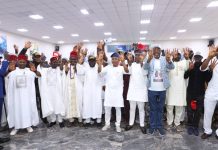


FIC REPORT (LAGOS STATE) – It was a convergence of Nigeria’s industrial heavyweights, policymakers and economic strategists on Wednesday, 7th October, 2026 at the Lagos Oriental Hotel, as the Manufacturers Association of Nigeria (MAN) held its 54th Annual General Meeting.
The theme- “Leveraging National Industrial Policy to Position Nigeria as Africa’s Industrial Hub”- set the tone for frank conversations about the future of production in Nigeria.
The Honourable Commissioner for Commerce, Cooperatives, Trade and Investment, Hon. Folashade Bada Ambrose-Medebem, mounted the podium to deliver the Lagos State Government’s goodwill message.
She came with a clear assurance — Lagos is not slowing down on its push to become Africa’s premier industrial hub.
According to her, the Babajide Sanwo-Olu administration remains unwavering in its commitment to creating an enabling environment for manufacturing, investment and sustainable economic development.
She began by paying tribute to MAN for its role in shaping policy and growing Nigeria’s productive capacity in over five decades. “Manufacturing remains fundamental to a modern, resilient economy,”she noted.
But she was quick to admit that the road is rough. “Manufacturers face significant pressures, including exchange-rate volatility, inflation, high energy costs, infrastructure gaps, and changing trade conditions,”she told the gathering.
The Commissioner insisted that fixing it cannot be left to government alone. “Responding effectively requires sustained collaboration between Government and Industry; Government must create the conditions for businesses to grow, while Industry brings the Investment, Expertise, and practical insight needed to shape workable solutions,”she stated.
To some manufacturers on the sidelines, that line resonated. One factory owner from Ikeja told said his diesel cost had tripled in one year.
Taking the audience through the state’s roadmap, the Commissioner said the Lagos State Industrial Policy 2025–2030 has been deliberately crafted to strengthen manufacturing, promote innovation, support industrial clusters and drive sustainable growth.
She pointed to what she called Lagos’ strategic economic assets. “Strategic assets such as the Lekki Deep Sea Port and Lekki Free Trade Zone were key drivers expanding the State’s potential as a hub for Trade, Logistics, and Industrial investment,”she averred.
The most striking part of her address was on power — the perennial nightmare of every manufacturer in Nigeria.
The Commissioner broke down the new Lagos State Electricity Law 2024, which now gives Lagos the legal framework to manage its intrastate electricity market.
She explained that the law creates three critical institutions — the Lagos State Electricity Regulatory Commission (LASERC), the Lagos State Electrification Agency (LSEA), and the Lagos State Independent System Operator (LAISO) — each with distinct responsibilities.
“For manufacturers, this work is directly connected to competitiveness,”she stressed.
“More reliable power can help businesses manage costs, sustain production, protect jobs, and plan for growth. Lagos will continue working with MAN, Energy providers, and other Stakeholders to ensure that our electricity reforms translate into practical improvements for industry and residents,” she assured.
She closed her remarks by applauding the President of MAN, Otunba Francis Meshioye, for his leadership, while conveying the appreciation of Governor Babajide Olusola Sanwo-Olu and the good people of Lagos State.
The keynote speaker, Prof. Ayo Omotayo, Director-General of the National Institute for Policy and Strategic Studies (NIPSS), was blunt in his assessment.
He said Nigeria cannot talk of a $1 trillion economy when manufacturing contributes a meagre 3.3% to GDP instead of the 25% envisaged.
“If Nigeria is going to work, economically, Manufacturing must work,”Prof. Omotayo declared, drawing applause from the hall.
He warned that policies alone will not save the sector. “Going forward, it is not Policy that will make Manufacturing work. Policy has its own role, but eventually, it is how we approach implementation of Policy that will make the difference,”he said.
For Otunba Meshioye, the President of MAN, whose message was about competitiveness, positioning Nigeria as Africa’s industrial hub goes beyond producing more.
“Market access will be commercially meaningful only where Nigerian Manufacturers can compete on cost, quality, standards, reliability, and delivery,”he said.
The consensus in the hall was clear- Nigeria has the policies, Lagos has shown the will with its Industrial Policy and Electricity Law, but the real test is implementation that drops energy costs, stabilizes the naira, and makes Nigerian goods cheaper and better.
And Lagos, as always, wants to lead that charge.
Compiled by:
Kareem Zainab Ibiyemi
Principal Information Officer
18 / 10 / 2026.