

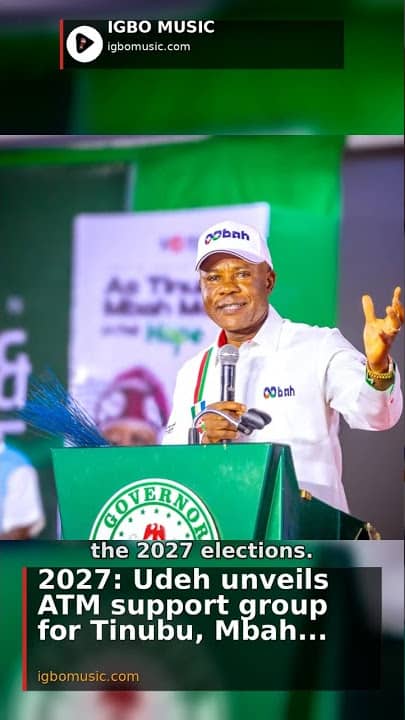
FIC REPORT (ENUGU STATE) – Governor of Enugu State, Dr Peter Mbah, says Nigeria would have suffered total economic collapse if not for President Bola Tinubu’s courageous reforms, saying the removal of fuel subsidy and floating of the naira only waited until the President’s assumption of office in 2023 because the nation delayed the ‘evil day’ and lived on borrowed time.
He made this known at the weekend during the launch of “As Tinubu Mbah Moves” (ATM), a support group convened by the Minister of Innovation, Science and Technology, Dr Kingsley Udeh (SAN), and dedicated to the re-election of President Tinubu and Governor Mbah in Enugu.
Speaking to the mammoth crowd, he said, “It would have been a lot easier for any leader to just continue with the status quo and carry on on the basis of business as usual. But for Bola Ahmed Tinubu, it was business unusual that led to the bold initiatives.
“As a person who had played very actively in the oil and gas sector, I had written quite a lot of features and articles arguing against the fuel subsidy regime long before now, for it was clear to me, even from the point of a major player in that sector, that the subsidy regime was not sustainable because of the economic devastation it was causing to us as Nigerians. We were just basically postponing the evil day.
“We were just digging our poverty pits continually. We were actually digging deeper into that pit of poverty. And it would have taken a very courageous leader in his first term to say, ‘Look, if we have to build for the future, if we have to think about our children, then we must take out the subsidy and we must also unify the exchange rate regime.’”
Mbah took a swipe at the foreign exchange regime before the floating of the naira by Tinubu, describing it as a cesspool of corruption.
“We got to a point in this country where even salary earners, once they get paid, would run to the bureau de change to change it rather than hold their salary in naira. Confidence was completely eroded in the naira. Nobody wanted to touch it with the tip of their finger. And that was the recipe for a failed nation.
“If you wanted to do a study or research of any failed nation, it is when the country, the citizens themselves, begin to lose confidence in their currency. And that was the environment that this President inherited.
“It was a major cesspool of corruption. The arbitrage was obvious and people were being taken advantage of. What was happening between the official and the parallel market was terrible. And some people were benefiting from that arbitrage at the expense of the economy. But it took this President’s understanding of the economy to be able to make those bold decisions,” he explained.
“This essentially is something that is largely driven by private capital. But government enables it by policies because I can tell you that private capital does not go to where you do not have stability.
“If your macro indicators are under pressure; if you have not addressed your foreign reserve, your foreign exchange regime, your inflationary rates, and all that, you do not have any chance of attracting private capital because private capital is blind. It is not emotional. It goes to where it makes return on investment, where it can be guaranteed some high level of security.
“People who have dollars are now going back to exchange their dollars because that confidence has been restored.
“So, now that we have stabilised our macro indicators, we have now started witnessing growth, albeit not to the level we aspire”.
He urged ATM members to take the message of the successes of Tinubu’s reforms and the President’s various infrastructural and policy interventions in the South East to the electorate.
Bonaventure Ngwu,
HOC, FIC Enugu
(16/11/2026).