

…………..Oduwole: New Export Incentive Scheme Must Reward Performance, Boost Value Addition.
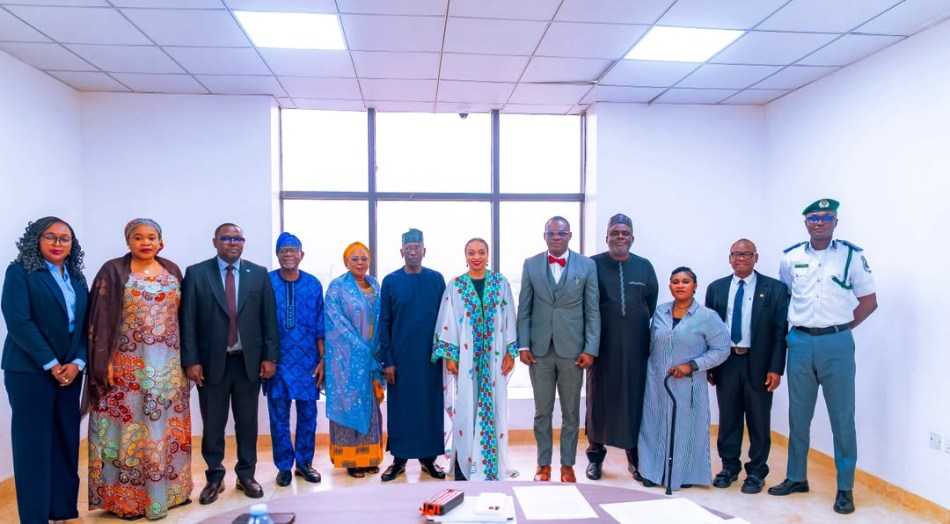
The Federal Government has inaugurated an Inter-Ministerial Working Group to undertake the comprehensive restructuring of the Export Expansion Grant (EEG) Scheme, giving the committee 60 days to develop a transparent, technology-driven and fiscally sustainable framework capable of accelerating Nigeria’s non-oil export growth.
The Honourable Minister of Industry, Trade and Investment, Dr. Jumoke Oduwole, who inaugurated the Working Group in Abuja on Monday, said the reform was aligned with Priority 7 of the Renewed Hope Agenda of President Bola Ahmed Tinubu, which focuses on economic diversification through non-oil exports.
She said the objective was to establish a practical export incentive system that would strengthen Nigerian enterprises, increase domestic value addition, create jobs, improve foreign exchange earnings and enhance the competitiveness of Nigerian products in regional and global markets.
According to the Minister, the new framework must be designed with the lessons of the past in mind, particularly to prevent the recurrence of unsustainable obligations and backlogs.
“You are not here to revisit the existence of the backlog. You are here to design a system that does not recreate it,”
she said, while stressing that duly verified legacy obligations would continue to be progressed through appropriate government processes.
Oduwole charged the Working Group to develop a reformed incentive framework that is transparent, efficient, dynamic and sustainable, aligned with global best practices and Nigeria’s current economic realities, while earning the confidence of exporters and implementing agencies.
She said the restructured scheme must prioritise domestic value addition, backward integration, diversification, productivity and export competitiveness, particularly by encouraging the export of value-added products rather than raw materials.
The Minister further directed the Working Group to establish clear parameters for eligibility, incentive calibration, funding discipline, performance measurement, verification, governance and periodic review.
She also emphasised the need for a technology-enabled execution framework covering the entire EEG process, from eligibility and application to verification, approval, payment, monitoring and reporting.
“The process should be rules-based, digital and traceable,” Oduwole said, adding that exporters should clearly understand the requirements and be able to track their applications, while government should have real-time visibility over its commitments and fiscal exposure.
The Minister disclosed that President Tinubu had approved a professionally managed Trade Facilitation Fund, with 40 per cent of monthly Nigerian Export Supervision Scheme collections ring-fenced for strategic trade facilitation and export incentive interventions.
She therefore charged the Working Group to ensure that the restructured scheme operates within available resources and rewards measurable performance.
“The test is no longer simply how much government pays, but the economic value that such expenditure delivers,” she stated.
Oduwole also directed the committee to address concerns raised by stakeholders, including verification and certification, backward integration, value-added exports, import costs, administrative charges and governance.
She said its final report should clearly identify the problems being addressed, the performance to be rewarded, the funding mechanism, verification and administrative processes, measurable export outcomes, transition arrangements, a digital operating model, an implementation timetable and performance indicators.
The Minister urged members to set aside institutional silos and bring their technical expertise, institutional knowledge and market experience to bear on the assignment.
She said the success of the reform would ultimately be measured by whether Nigeria emerges with an export incentive system that exporters can rely on, government can sustainably fund and administer, financial institutions can understand, and Nigerians can trust.
“Above all, the restructured scheme must help our businesses produce more, add more value, compete better and sell more Nigerian products to the world,” she said.
Earlier, the Permanent Secretary, Federal Ministry of Industry, Trade and Investment, Dr. Chris Osa Isokpunwu, said the restructuring of the EEG was critical to strengthening Nigeria’s productive capacity, deepening industrialisation, expanding non-oil exports, attracting investment and creating sustainable opportunities for businesses and citizens.
He said changing global trade dynamics and evolving economic realities made it necessary to ensure that export incentives remained effective, targeted, transparent and responsive to the challenges confronting Nigerian businesses.
According to him, the restructuring should position the EEG as a strategic instrument for boosting export competitiveness, encouraging value addition, supporting local production, strengthening MSMEs and increasing Nigeria’s participation in regional and global value chains.
Isokpunwu called for strong collaboration between government and the private sector, noting that the experience of exporters would be critical to developing a commercially relevant and administratively efficient scheme.
He urged members of the Working Group to approach the assignment with commitment, objectivity and a strong sense of national purpose, stressing that its recommendations should provide a credible pathway for achieving the Federal Government’s industrialisation, trade and investment priorities.
Speaking on behalf of the newly inaugurated Working Group, the Executive Director Export ( Dangote group) ,Sada Ladan-Baki pledged the members’ commitment to working closely with the Ministry, government agencies and other stakeholders to deliver meaningful reforms within the 60-day mandate and the lifetime of the present administration.
He said the committee would identify gaps in the implementation of existing laws and policies, improve coordination among government agencies, strengthen the Ministry’s leadership role in trade and export facilitation, and develop a transparent, sustainable and implementable framework for the EEG.
He stressed the need for an incremental approach to export growth, noting that an effective export incentive should reward genuine expansion in exports rather than merely sustain existing levels.
The representative also identified funding, digital infrastructure, staff training, technical expertise and private-sector participation as critical components of the reform process.
He said the committee would draw on institutional experience, industry input and global best practices while ensuring that its recommendations remained responsive to Nigeria’s economic realities.
The Director, Commodities and Export Department, Mr. Usman Ahmed B., described the Working Group as a problem-solving and delivery-focused platform established to provide concrete solutions within clearly defined timelines.
He assured the Minister that the committee’s deliberations would remain inclusive, evidence-based and solution-oriented, noting that the credibility of the EEG and Nigeria’s broader export drive would depend on the integrity, urgency and quality of the reform process.
Ahmed said the Working Group would also examine other export incentive schemes established under Nigerian law but currently inactive, including the Duty Drawback and Manufacture-in-Bond schemes, with a view to assessing how they could be strengthened and made more attractive to exporters.
He said the objective was to ensure that exporters had viable alternatives as the country continued to develop a broader and more sustainable export incentive architecture.
The Director also called for closer coordination between export promotion agencies and revenue-generating institutions, particularly the Nigeria Customs Service and other relevant agencies, to ensure that export development measures complemented, rather than undermined, legitimate government revenue objectives.
He stressed that all stakeholders must work together to achieve a balanced framework that supports exporters, protects government revenue and advances Nigeria’s broader economic interests.
The inauguration brought together representatives of the Federal Ministry of Industry, Trade and Investment, Nigerian Export Promotion Council (NEPC), Ministry of Finance, Central Bank of Nigeria, Office of the Accountant-General of the Federation, Debt Management Office, Nigerian Customs Service, Manufacturers Association of Nigeria, export associations, organised private sector and beneficiaries of the EEG scheme.
The Working Group is expected to submit its recommendations within 60 days for consideration and further action by the Federal Government.
Obilor -Duru Augustina Okechi
Head Press & PR
FMITI
5th October 2026