

In an effort to accelerate agricultural development and strengthen policy implementation, the Federal Ministry of Agriculture and Food Security, in collaboration with state governments, non-state actors and development partners, including Germany, is advancing the implementation of the Comprehensive Africa Agriculture Development Programme (CAADP) Kampala Declaration 2026–2035.
This year’s CAADP Community of Practice (CoP) provides an important platform for strengthening cooperation around food security and the transformation of Nigeria’s agrifood systems.
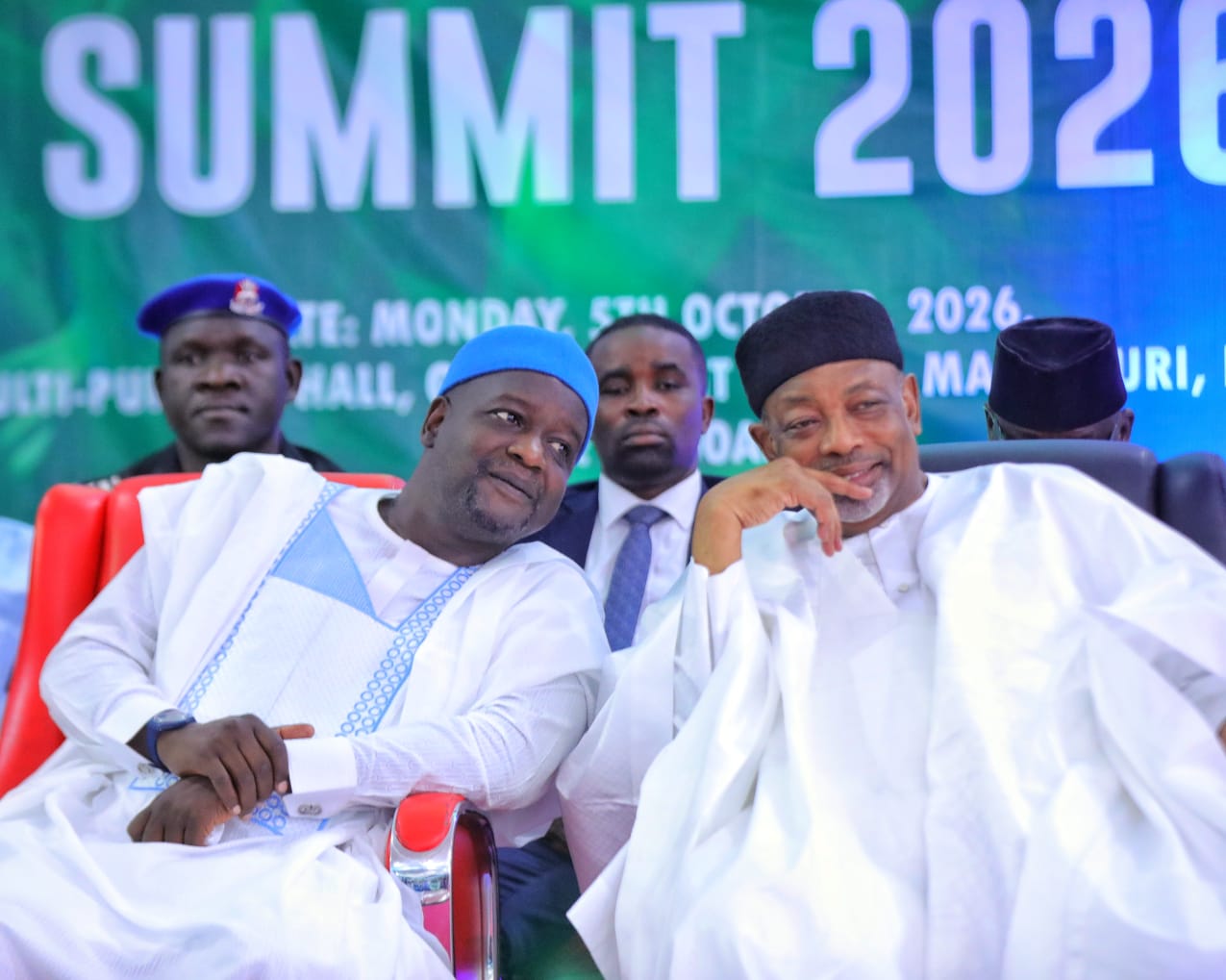
Speaking during the Annual Community of Practice (CoP) Meeting held on Monday 5th October, 2026 in Maiduguri, the Borno State, the Minister of Agriculture and Food Security, Sen. Abubakar Kyari stated that ‘’Alignment between the Federal State Governments and Partners is indispensable to sustainable food security and resilient livelihoods’’.
The Minister noted that ‘’ the alignment must translate into compatible policies, reliable data, complementary investments and clarity of responsibility for delivery. We need one coherent agrifood system in which national direction and State-level execution reinforce one another’’.
He disclosed that’’ the responsibility has become even more important with the Kampala CAADP Declaration and its Strategy and Action Plan for 2026–2035. The Kampala framework takes a broader agrifood systems approach, with priorities spanning sustainable production, investment and finance, food and nutrition security, trade, inclusion, resilience and stronger governance’’.
Sen. Kyari revealed that ‘’ His Excellency, President Bola Ahmed Tinubu, GCFR, has placed food security at the center of the national agenda. Our responsibility is to translate that mandate into increased production, greater affordability, stronger rural economies and a more resilient food system’’.
He Observed that ‘’We have seen reductions of up to 50 per cent in the prices of some essential food commodities, alongside expanded input delivery, investments in rural infrastructure and support to smallholder farmers. The task now is to sustain these gains and deepen their impact.
He disclosed that’’ the responsibility has become even more important with the Kampala CAADP Declaration and its Strategy and Action Plan for 2026–2035. The Kampala framework takes a broader agrifood systems approach, with priorities spanning sustainable production, investment and finance, food and nutrition security, trade, inclusion, resilience and stronger governance’’.
The Minister stressed that ‘’ For a country of Nigeria’s scale, the choices we make in agriculture have consequences beyond our borders, for regional markets, Africa’s wider agrifood transformation and Nigeria’s place in the global food economy. Nigeria has developed and validated a 10-Year National Agrifood System Strategy and Action Plan as the vehicle for domesticating these commitments. The Community of Practice provides an important sub-national mechanism for taking that work into implementation’’.
He stated that ‘’ A Community of Practice earns its value when experience in one State shortens the learning curve for another and when progress can be assessed against agreed indicators. We should know what is working, where it is working, what it costs and what it takes to scale it. We should be equally candid about what is not working and why’’.
Kyari further revealed that ‘’the 10-Year National Agrifood System Strategy and Action Plan is designed to provide the harmonized implementation framework for this work, with clear roles, responsibilities, timelines and accountability mechanisms.
According to him, ‘’It also integrates CAADP Biennial Review indicators into national planning, budgeting and reporting systems. Through the validation process, we are working to align national and State budgets, reduce duplication and direct investment towards agreed priorities’’.
The Minister stated that ‘’ National Agricultural Technology and Innovation Policy is explicit that agricultural development should capitalize on the different production potentials and natural-resource endowments of Nigeria’s five major agricultural zones. Our task is to build on those comparative advantages with adaptable technologies, infrastructure and market linkages, rather than expect every State to produce everything’’.
On input security, early procurement under the Presidential Fertilizer Initiative, now under the Ministry of Finance Incorporated, helped secure supply for the 2026 season and generated ₦61.58 billion in savings. Nigeria remains on course to deliver a 1.1 million metric tonne fertilizer programme this year, Kyari said.
The Minister mentioned that ‘’in August we unveiled the National Agricultural Mechanization Policy and the National Agricultural Mechanization Investment Strategy. Together, they provide the framework for moving from fragmented equipment interventions towards a sustainable mechanization ecosystem, including plans for a mega tractor assembly plant with capacity to produce between 2,000 and 4,000 tractors annually’’.
He stated that ‘’we are also expanding all-season production through irrigation, improved access to quality seed, support for our National Agricultural Research Institutes and stronger translation of research into practical solutions for farmers. The Special Agro-Industrial Processing Zones are designed to connect production areas more effectively to processing and markets. These investments must increasingly align with rural infrastructure, extension, agricultural finance, nutrition and the sustainable management of our land and water resources’’.
The Minister appealed for robust participation of women and young people across agricultural value chains and create stronger conditions for private investment and development finance.
He urged that ‘’States should leave this meeting clearer on how their action plans will advance the Kampala commitments and align with national priorities across rural infrastructure, extension, credit and quality inputs, labour-saving technologies, post-harvest loss reduction and climate-resilient agriculture’’.
In his remarks, the Governor of Borno State, Prof. Babagana Zulum, represented by the Deputy Governor, Hon Usman Kadafur, stated that ‘’ the Summit is more than a gathering of policymakers, development practitioners, agricultural experts, researchers, farmers, private-sector actors and development partners. It is a platform for shared learning, honest reflection and collective action towards building a more resilient, productive and sustainable agricultural sector for our nation’’.
Governor Zulum stated that ‘’ a Community of Practice should not simply be a gathering where ideas are presented and applauded. It should be a platform where experience becomes knowledge, knowledge becomes action, and action produces measurable improvement in the lives of our people’’.
In her remarks, Dr Karin Jansen, Head of Development Cooperation at the German Embassy in Nigeria, said Germany welcomes Nigeria’s leadership in advancing the CAADP Kampala Agenda and is pleased to support the country as it moves from commitments to coordinated implementation.
She noted that the transformation of Nigeria’s agrifood systems requires strong cooperation between the Federal Government and the states, as well as the active participation of non-state actors.
Dr Jansen highlighted the importance of the CAADP Community of Practice as a mechanism that connects national priorities with action in the states and provides a platform for exchange, learning and joint problem-solving.
She recalled that the first Community of Practice focused on building a common understanding of the Kampala Declaration and strengthening state-driven approaches to implementation. The second Community of Practice, she said, marks the next step: moving from understanding to implementation and from commitments to coordinated action.
Dr Jansen stressed that states have a central role in translating national priorities into plans, budgets and concrete action for farmers, businesses and communities. Through the project “Sustainable Agricultural Systems and Policies” (AgSys), funded by the German Federal Ministry for Economic Cooperation and Development (BMZ) and implemented by the Deutsche Gesellschaft für Internationale Zusammenarbeit (GIZ) GmbH, Germany supports Nigerian partners in strengthening agricultural policy processes, scaling successful approaches and strengthening civil society participation.
She reaffirmed that Germany remains committed to supporting Nigeria and its partners in turning national commitments into concrete action and tangible results.
During his close remarks, the Minister of State for Agriculture and Food Security, Sen. Dr. Aliyu Sabi Abdullahi stated that ‘’a central theme emerging from our interactions is the need to leverage Nigeria’s comparative advantages. We must move beyond the siloed approach of the past. As we have discussed, the path to national food security is paved by each State focusing on its specific strengths’’.
Sen. Dr. Aliyu Abdullahi added that ‘’we have reaffirmed that the challenges facing our agrifood systems are multidimensional. They require the kind of integrated, multi-sectoral approach that we have championed here. The synergy between the Ministries of Agriculture, Health, Environment, and Rural Development is not merely a bureaucratic ideal; it is a practical necessity. The nexus between food production, nutrition, environmental sustainability, and rural development is the cornerstone of our national prosperity’’.
The meeting had in attendance the Commissioners of Agriculture, Livestock, Fisheries, Health, Environment, Commerce and Rural Development, and other relevant stakeholders in the agricultural sector.
Ezeaja Ikemefuna
Head, Department of Information
5th October, 2026