
….…Minister Imaan Sulaiman-Ibrahim calls for end to impunity, announces review of National Gender Policy, seeks Sexual Assault Referral Centres in all 774 LGAs.
The Federal Government has intensified its commitment to ending Gender-Based Violence (GBV) in Nigeria with the operationalisation of the National GBV Electronic Dashboard and Situation Room, alongside a renewed national drive to strengthen survivor protection, expand access to justice and empower over 10.57 million women through structured grassroots networks.
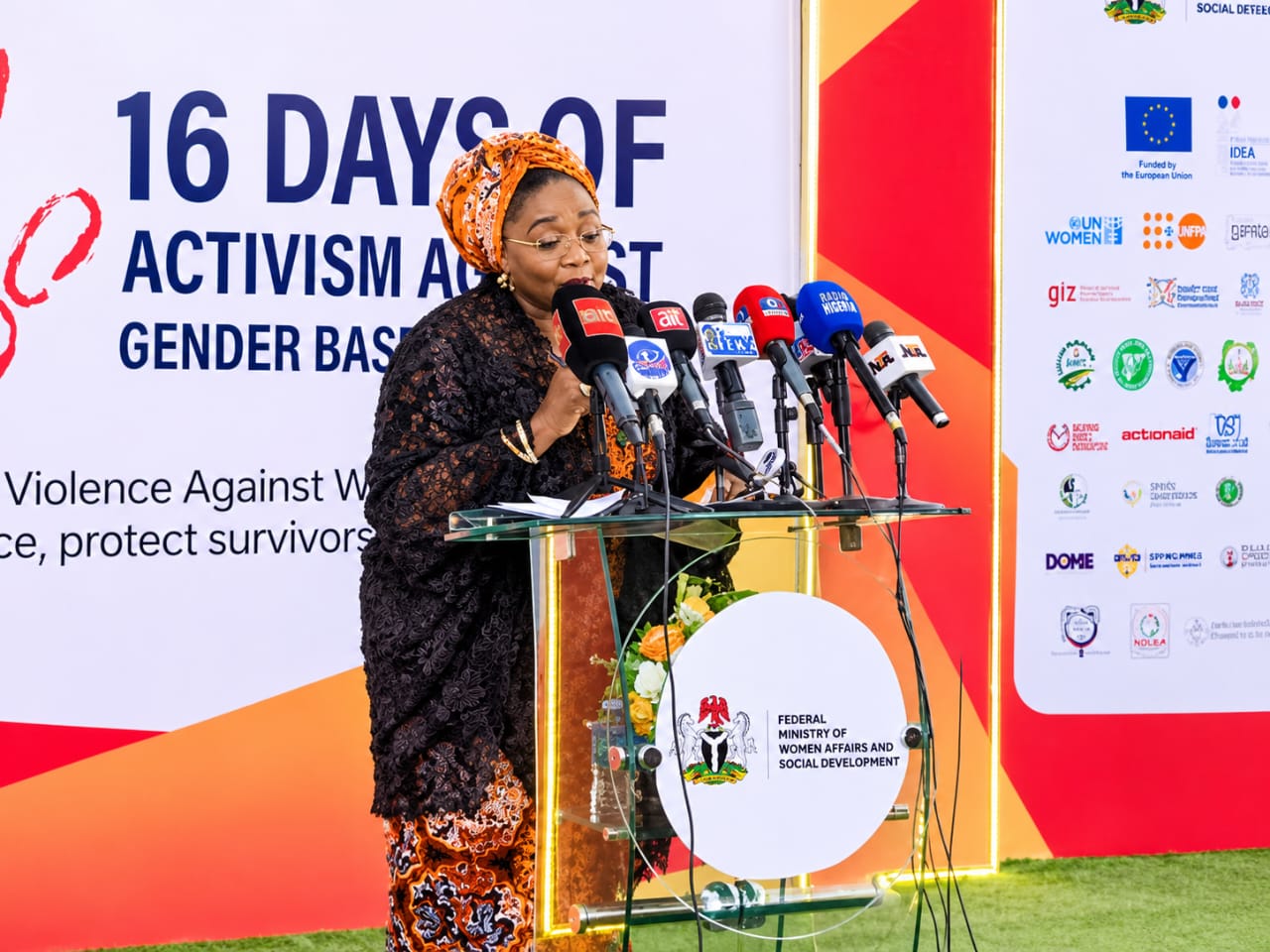
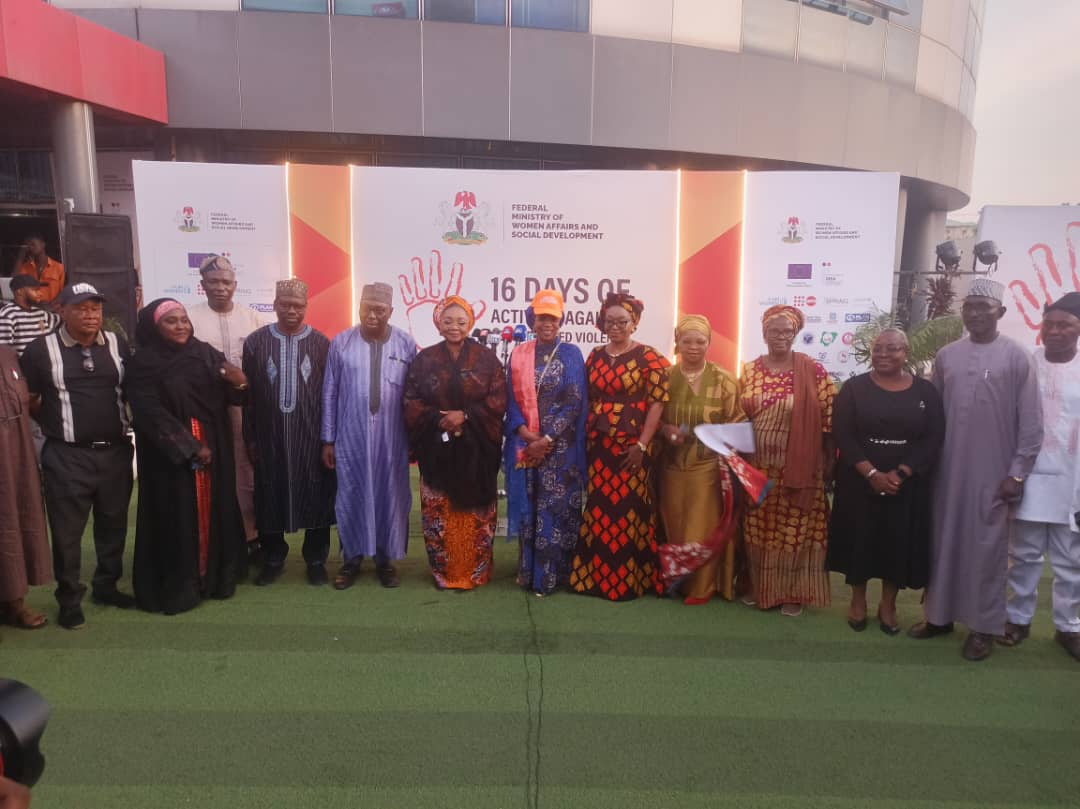
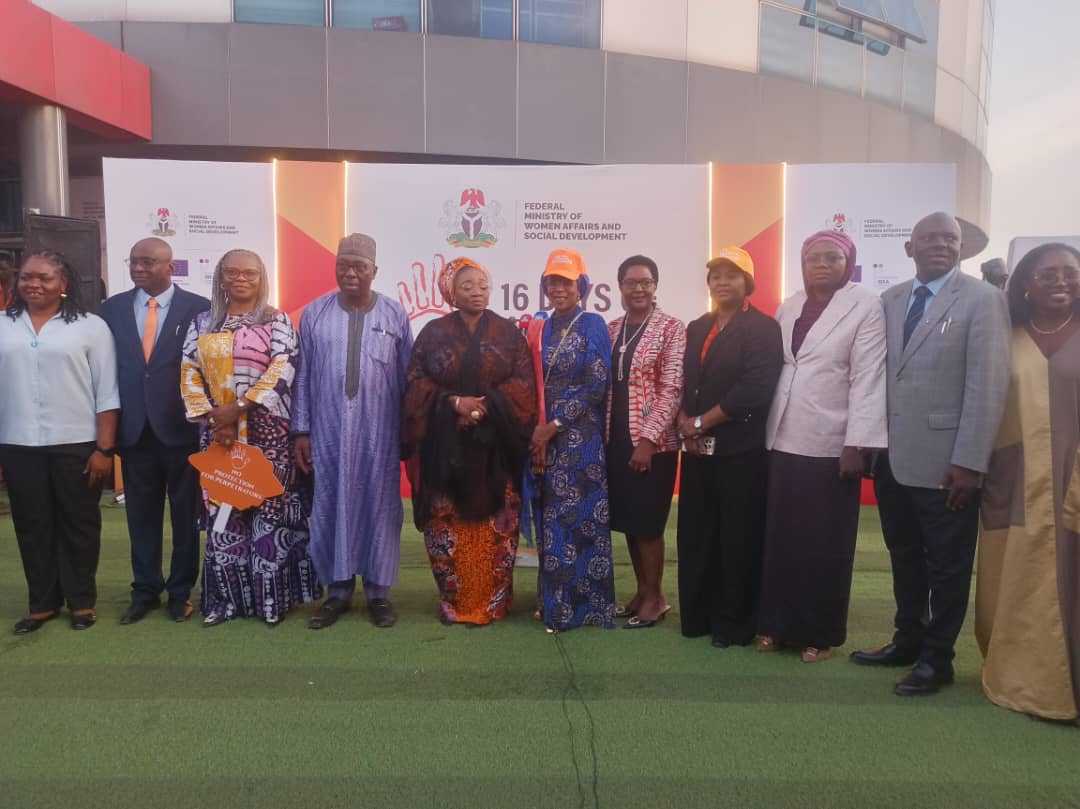
The Honourable Minister of Women Affairs and Social Development, Hon. Imaan Sulaiman-Ibrahim, FSI, made this known on Monday, November 23, 2026, during the 2026 Ministerial Press Briefing to flag off the 16 Days of Activism Against Gender-Based Violence at the Federal Ministry of Women Affairs and Social Development, Abuja.
The global campaign, which runs from November 25 to December 10, is being commemorated under the theme: “UNiTE to End Violence Against Women and Girls: Ensure Justice, Protect Survivors, End Impunity.”
The Minister, who described this year’s campaign as a decisive call to move beyond awareness and ceremonial activities to measurable action, challenged stakeholders to assess the real impact of previous interventions on the safety and protection of women, girls, boys and vulnerable members of society.
“Beyond the annual commemoration, what has all of this truly translated into? Beyond the speeches, the conferences and the fanfare, is the woman in the market safer today? Is the girl child better protected from harm? Are our homes and streets genuinely more secure?” she queried.
She stressed that the 16 Days of Activism must translate into 365 days of sustained commitment, insisting that Nigeria could no longer afford a situation where survivors suffer in silence while perpetrators escape accountability.
“The time for silence is over; the time for collective action is now. Let us UNiTE to end violence against women and girls, ensure justice, protect survivors and end impunity,” she declared.
Providing an overview of the magnitude of the challenge, the Minister disclosed that nearly one in three Nigerian women aged 15 to 49 has experienced physical or sexual violence, while more than 27,000 documented Sexual and Gender-Based Violence cases were recorded in recent reporting cycles, alongside millions of unreported incidents.
She further noted that GBV imposes an estimated economic burden of 1.5 per cent of Nigeria’s Gross Domestic Product, approximately $3 billion annually, through lost productivity, healthcare costs and disrupted livelihoods.
According to her, the Federal Government, under the leadership of President Bola Ahmed Tinubu, GCFR, and his declaration of 2026 as the Year of Families and Social Development, is implementing a comprehensive national response that addresses both the immediate consequences and underlying socio-economic drivers of violence.
The Minister announced that the Ministry’s National GBV Electronic Dashboard and Situation Room is now operational, describing it as a significant milestone in strengthening real-time data management, evidence-based interventions, coordination and institutional accountability in the fight against gender-based violence.
She specially appreciated UNFPA for its support in making the initiative possible.
She disclosed that 52 Sexual Assault Referral Centres are currently providing essential medical, psychosocial and referral services to survivors across the country.
However, she expressed concern that the number remains inadequate for a population exceeding 240 million, revealing that the Ministry is working with State Governments to establish at least one centre in every Local Government Area, with the long-term ambition of extending the facilities to every ward.
On economic empowerment as a preventive mechanism against gender-based violence, the Minister highlighted the Renewed Hope Social Impact Intervention 774 (RHSII-774), a nine-pillar national framework designed to reach 50 million women, children and vulnerable Nigerians across all 774 Local Government Areas.
She explained that the framework integrates economic inclusion, clean energy, digital literacy, agriculture, healthcare, social protection, affirmative procurement, leadership and family development.
Under the initiative, the Renewed Hope Women in Nigeria’s Gas Sector (RH-WiNGS), implemented in partnership with the Ministry of Petroleum Resources, is designed to transform women into owners and operators of micro-LPG refilling plants and enterprise hubs
Similarly, PowerHer 774 targets three million women with access to clean and reliable energy solutions, while the Nigeria for Women Programme Scale-Up (NFWP-SU), a World Bank-supported intervention, aims to empower five million women through Women Affinity Groups and livelihood collectives, with an indirect economic impact on more than 25 million Nigerians.
Other flagship interventions include the Happy Woman App, targeting 10 million women for digital financial literacy, savings and enterprise support; Digital Harmony, which aims to train five million women in digital skills; Women Rise, Innovate and Create (WRIC), targeting three million women in the creative economy; and the Women in Green Economy Programme, designed to engage one million women in climate-smart agriculture and clean cooking transition.
The Minister also spotlighted the Power of 10 Million initiative, anchored on the philosophy of “One Voice, One Movement, One Choice,” as a strategic grassroots empowerment and mobilisation structure.
She explained that the initiative will organise women into 50 clusters of 24 members each, amounting to 1,200 women per ward across Nigeria’s 8,809 electoral wards, ultimately creating a network of over 10.57 million organised women.
According to her, the structure will facilitate access to credit, cooperative enterprises, peer protection, collective resilience and increased participation in community governance and democratic processes.
Emphasising the importance of legal and institutional protection,
Sulaiman-Ibrahim disclosed that the Child Rights Act of 2003 has been domesticated across all 36 states, while the Violence Against Persons (Prohibition) Act of 2015 has been domesticated in 35 states.
She, however, maintained that the Ministry is strengthening the implementation of these laws and addressing outstanding legislative and institutional gaps.
In a significant policy development, the Minister formally announced the commencement of the review of the National Gender Policy (2021–2026), following the completion of its end-term review and the launch of the Nigeria Gender Profile.
She called on development partners, civil society organisations, relevant government institutions and other stakeholders to participate actively in the review process, noting that the National Women’s Economic Empowerment Policy of 2023 would serve as a major benchmark.
She further revealed that the Ministry had developed, reviewed and validated more than 38 policy instruments, standard operating procedures and specialised frameworks aimed at strengthening protection and advancing gender equality nationwide
The Minister also highlighted the review of the National Children’s Policy of 2009 and the development of Nigeria’s first National Boy Child Policy, describing the latter as a deliberate intervention to address increasing school dropout rates, substance abuse, street vulnerability and social neglect confronting boys.
She stressed that protecting both the girl and boy child is essential to breaking the cycle of intergenerational violence and building responsible citizens capable of sustaining peaceful families and communities.
On child protection, she disclosed that the National Strategy and Costed Action Plan on Ending Child Marriage in Nigeria (2025–2030) was endorsed by the Federal Executive Council on October 28, 2026, providing a coordinated national roadmap for eliminating child marriage.
She also announced the Federal Executive Council’s approval of the National Policy on Menstrual Health and Hygiene Management (2026–2030) and the National Care Policy and Implementation Plan (2026–2030), which are expected to promote menstrual dignity, encourage local manufacturing of sanitary products and recognise the economic value of unpaid care work.
In advancing women’s participation in peacebuilding, the Minister reaffirmed the Ministry’s commitment to implementing Nigeria’s Third National Action Plan on United Nations Security Council Resolution 1325, which seeks to expand women’s leadership in conflict prevention, peace negotiations, peacebuilding and recovery.
She commended President Tinubu’s commitment to improving women’s political representation, particularly through the proposed Reserved Seats for Women constitutional reform.
The Minister further disclosed that the Federal Government would soon inaugurate the National Council for Social Work, following presidential approval, to professionalise social work practice through training, certification and the nationwide deployment of qualified practitioners to support survivors and vulnerable citizens.
She also announced the constitution of the Governing Council of the Maryam Babangida National Centre for Women Development, describing its all-female composition and the inclusion, for the first time, of a woman with disability as a substantive member as a demonstration of the government’s commitment to inclusive leadership.
Outlining activities for the 2026 campaign, the Minister said the Ministry and its partners had scheduled series of nationwide engagements, including the symbolic lighting of the Ministry’s headquarters in orange, a nationwide No Tolerance Advocacy Walk, a Town Hall Meeting with Nigerian women ahead of the 2027 General Elections, the Sixth Annual Forum on Women, Peace and Security and the Second National Summit on Menstrual Health and Hygiene Management.
Other activities include special interfaith engagements, church services and Jumu’ah prayers across the federation to mobilise religious institutions and faith leaders against all forms of violence and harmful practices.
She called on the media, Nollywood and the wider creative industry to deploy their influence in promoting positive social values, challenging harmful stereotypes and amplifying the voices of survivors.
The Minister also acknowledged the contributions of UN Women, UNFPA, UNICEF, the World Bank, SPRING Project, IDEAS International, WaterAid, ActionAid, Policy Innovation Centre, Save the Children, Women at Risk International Foundation (WARIF), State Governments and other development partners.
In her goodwill message, the UN Women Country Representative to Nigeria and ECOWAS, Ms. Beatrice Eyong, represented by the National Programme Officer, Coordination and Partnerships, Ms. Patience Ekeoba, reaffirmed the organisation’s commitment to supporting Nigeria’s efforts to eliminate violence against women and girls.
She described the 2026 theme as a powerful reminder that ending GBV requires moving beyond public awareness and institutional commitments to measurable results, effective prevention and accountability.
Citing the 2024 Nigeria Demographic and Health Survey, she disclosed that 21 per cent of Nigerian women aged 15 to 49 had experienced physical or sexual violence, while 23 per cent of ever-married or partnered women reported physical, sexual or emotional violence by their current or most recent husband or partner.
She further revealed that 58 per cent of women who had experienced physical or sexual violence neither sought help nor disclosed the abuse to anyone, underscoring the urgent need to address stigma, silence and barriers to accessing justice.
Eyong emphasised that violence against women and girls is not merely a women’s issue but a development, governance, public health, security and human rights concern requiring the commitment of every sector.
She called for increased investment in prevention, social norms transformation, survivor-centred services, institutional accountability and sustainable domestic financing.
“Prevention must be at the heart of our response. If we are serious about ending violence against women and girls, we must shift from a predominantly reactive approach to a prevention-centred strategy,” she stated.
She urged traditional and religious leaders, families, schools, young people, men and boys to challenge harmful beliefs that normalise violence, silence survivors or protect perpetrators.
The UN Women representative also called on law enforcement agencies, prosecutors, judges, healthcare professionals and social workers to strengthen survivor-centred responses, while urging the media to report GBV cases responsibly, protect survivors’ identities and hold institutions accountable.
She reaffirmed UN Women’s readiness to work with the Federal Government and other stakeholders to ensure that the campaign produces lasting change beyond the 16 days.
Also speaking, the UNFPA Resident Representative in Nigeria, Ms. Muriel Mafico, commended the Honourable Minister for her leadership and commitment to gender equality, women’s empowerment and strengthening Nigeria’s response to gender-based violence.
She reinforced the campaign with UNFPA’s message: “Name it. Believe it. End it.”
According to her, violence that goes unnamed often goes unaddressed, stressing that every survivor deserves to be heard, protected and supported to access justice, irrespective of where the abuse occurs.
Providing an update on UNFPA’s interventions in Nigeria, Mafico disclosed that the organisation, in partnership with the Federal Ministry of Women Affairs and other government institutions, had established five One-Stop Centres across the country, providing integrated services to more than 2,900 survivors and their families.
She further revealed that UNFPA had strengthened seven Sexual Assault Referral Centres in Bauchi, Cross River, Adamawa, Gombe, Oyo and Kaduna States to improve access to coordinated survivor care.
The organisation has also trained more than 300 health workers in the clinical management of rape and GBV case management, contributing to the provision of care for over 7,000 survivors.
Through safe spaces established in the FCT, Adamawa, Cross River and Sokoto States, more than 12,000 girls and boys have benefited from psychosocial support, life skills development and mentorship.
Mafico also highlighted UNFPA’s interventions in humanitarian settings, including specialised training for local actors on preventing and responding to gender-based violence in emergencies.
She particularly commended the Federal Ministry of Women Affairs for its collaboration with UNFPA in revitalising and sustaining the National GBV Situation Room and Electronic Dashboard, standardising reporting tools, strengthening data coordination and building the capacity of monitoring and evaluation officers.
She called for three priority actions: stronger implementation and accountability, increased and sustained investment in essential GBV services, and deliberate action to address the root causes of violence through community mobilisation and the engagement of the men and boys.
“Our success will not only be measured by the number of campaigns we organise to raise awareness, but more importantly by the way the number of women and girls who can live free from any form of violence, access essential services and obtain justice,” she emphasised.
In his goodwill message, UNICEF Child Protection Specialist, Dr. Godwin Chinedu Odo, who represented the UNICEF Country Representative, Ms. Wafaa Saeed, called for stronger national and international action to protect children, particularly adolescent girls, from violence, abuse and exploitation.
He disclosed that he had recently returned from Manila, Philippines, where he attended the Second Global Ministerial Conference on Ending Violence Against Children, which brought together 1,370 delegates from more than 134 countries to assess progress and renew commitments made at the inaugural conference in Bogotá, Colombia, in 2024.
He noted that behind every statistic on violence is a human story, including that of a girl afraid to return home, a child silently carrying the trauma of abuse and a survivor who speaks but is not believed.
“This must change,” he declared.
Odo cited global estimates indicating that almost one in three girls aged 15 to 19 has experienced intimate-partner physical or sexual violence, non-partner sexual violence or both, describing the situation as unacceptable.
He stressed that ending violence against children requires early intervention, stronger family and community support, safer schools and digital spaces, and deliberate efforts to challenge harmful social norms.
He further emphasised that when violence occurs, survivors must be heard, believed, protected and supported, while justice must be accessible, timely and child-sensitive.
Addressing members of the media, he urged responsible reporting that protects survivors’ identities and dignity, challenges the normalisation of violence and holds institutions and decision-makers accountable.
His message to every girl was unequivocal:
“Violence is never your fault. You deserve to be safe. You deserve to be heard. You deserve justice.”
Ahmed Lawan Danbazau Mnipr
Head, Press and Public Relations
(FMWASD)