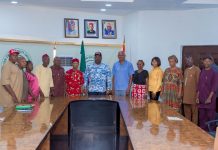



FIC Report (Jigawa State) – President Bola Ahmed Tinubu has reaffirmed the Federal Government’s commitment to strengthening collaboration with traditional institutions to foster peace, security, national cohesion and sustainable development across Nigeria.
The President’s position was conveyed on Monday in Dutse, Jigawa State, by the Minister of Information and National Orientation, Mohammed Idris, during the 8th Executive Committee Meeting of the Northern Traditional Rulers’ Council (NTRC).
According to Idris, the Tinubu administration recognises the strategic role of traditional rulers in nation-building and remains committed to deepening engagement with them in promoting peace, unity and development.
“The administration of President Bola Ahmed Tinubu fully recognises the strategic role of traditional institutions and remains committed to deepening engagement with traditional rulers in advancing peace, security, national cohesion and development,” the minister stated.
He commended the Northern Traditional Rulers’ Council, under the leadership of the Sultan of Sokoto, Muhammad Sa’ad Abubakar, for its sustained contributions to peacebuilding, security and regional development.
Speaking on the theme, “Peace, Unity and Development of the North,” Idris described peace as the foundation of prosperity, stressing that sustainable development can only flourish in an atmosphere of stability and unity.
He noted that traditional rulers remain indispensable partners in governance due to their close relationship with grassroots communities and their ability to mobilise citizens towards national objectives.
“Across generations, our traditional rulers have served as custodians of culture and values, mediators in times of conflict and trusted bridges between government and the people,” he said.
On security, Idris said the Federal Government had strengthened coordination among the Armed Forces, intelligence agencies and other security institutions, leading to significant gains against criminal and terrorist groups across the country.
He, however, maintained that military operations alone could not guarantee lasting peace, stressing the need to tackle poverty, unemployment, social exclusion and limited economic opportunities.
The minister highlighted key interventions under the Renewed Hope Agenda, including investments in agriculture, livestock development, solid minerals, infrastructure, education financing, consumer credit and support for Micro, Small and Medium Enterprises (MSMEs).
He described the establishment of the Federal Ministry of Livestock Development as a landmark initiative aimed at modernising livestock production, improving food security and reducing farmer-herder conflicts.
Idris also spotlighted the Federal Government’s Legacy Highway Projects, including the Lagos-Calabar Coastal Highway, the Sokoto-Badagry Super Highway, the Calabar-Abuja Super Highway and the Akwanga-Jos-Bauchi-Gombe Road Corridor, describing them as transformative investments capable of boosting national integration and economic growth.
According to him, the projects will improve connectivity, reduce transportation costs, expand access to markets and create employment opportunities across the country.
The minister urged traditional rulers to sustain support for government programmes through public enlightenment, dialogue, tolerance and the promotion of responsible citizenship.
He expressed confidence that the meeting would generate practical recommendations to strengthen peace, deepen unity and accelerate development in Northern Nigeria.
Idris also conveyed the Federal Government’s condolences to the government and people of Katsina State over the death of Rabe Abubakar, describing the loss as painful and significant.
Meanwhile, Chairman of the Northern States Governors’ Forum and Governor of Gombe State, Muhammadu Inuwa Yahaya, warned that worsening insecurity across Northern Nigeria had reached a critical stage where “silence, hesitation and routine responses are no longer acceptable.”
“The old methods are clearly not working. We cannot continue to confront rapidly changing security threats with outdated strategies and fragmented responses,” he said.
Yahaya identified banditry, insurgency, farmer-herder clashes and communal conflicts as major threats confronting the region, lamenting that persistent violence had displaced communities, destroyed markets, forced the abandonment of farmlands and disrupted education.
In his remarks, Governor Umar Namadi called on traditional rulers to intensify efforts towards promoting peace, unity and sustainable development, stressing that security remains the bedrock of prosperity.
He listed insecurity, poverty, youth unemployment, climate change, drug abuse and the rising number of out-of-school children as key challenges facing Northern Nigeria.
Namadi advocated stronger collaboration among governments, traditional institutions and local communities to address the region’s socio-economic and security concerns.
“Security is the foundation of peace, peace is the condition for unity, and unity is the pathway to sustainable development,” he said.
The governor highlighted initiatives introduced by his administration, including community-based peace and security committees and programmes designed to strengthen social cohesion, civic responsibility and the campaign against drug abuse.
He also commended President Tinubu’s efforts to tackle insecurity through intensified military operations, improved intelligence gathering and stronger cooperation between federal and state authorities.
Signed:
Bashir Dahiru Galadanchi
Head, FIC