


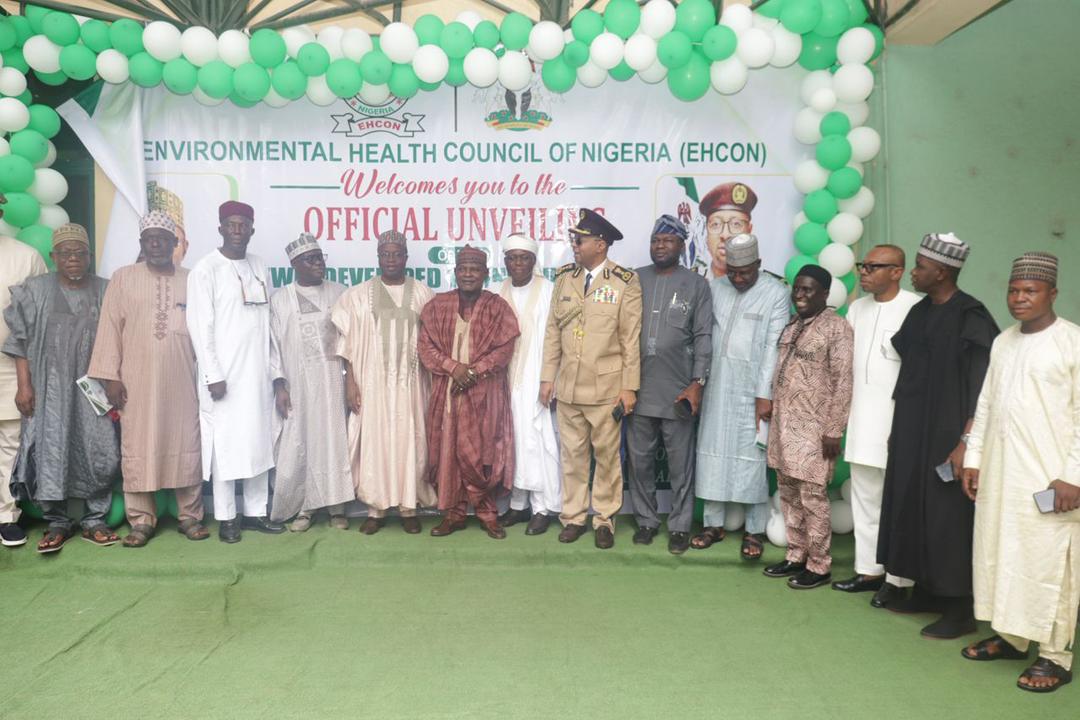
The Federal Government has unveiled fourteen new curricula for Environmental Health and Public Health programmes in Nigerian polytechnics and monotechnics as part of efforts to strengthen environmental health education and equip professionals to tackle emerging public health challenges across the country.
Speaking at the unveiling ceremony held at the Federal Ministry of Environment, Green Building Conference Hall, Maitama, Abuja, the Honourable Minister of Environment, Honorable Balarabe Abbas Lawal represented by Conservator General, National Park Services, Ibrahim Goni, described the initiative as a major step towards building the skilled workforce needed to improve sanitation, food safety, pollution control, disease prevention and environmental sustainability.
The Minister said the curricula, developed through collaboration between the Environmental Health Council of Nigeria and the National Board for Technical Education (NBTE), will provide a nationally coordinated framework for producing competent professionals with the knowledge, practical skills and ethical standards required to protect public health.
He noted that Nigeria continues to face challenges associated with poor sanitation, unsafe food, environmental pollution, inadequate waste management, climate change and environmentally related diseases, stressing that addressing these issues requires well-trained environmental health professionals.
The Minister urged training institutions to ensure effective implementation of the curricula by providing qualified lecturers, functional laboratories, practical training opportunities and modern learning facilities. He also called on governments, development partners and the private sector to support the initiative through sustained investment in environmental health education and professional development.
Commending the leadership of the Environmental Health Council of Nigeria, the Minister described the new curricula as an important investment in disease prevention, healthier communities and national development before officially unveiling the fourteen programmes.
Earlier, the Registrar of the (EHCON) Environmental Health Council of Nigeria, Dr. Yakubu Mohammed Baba, described the unveiling as a historic milestone in the advancement of environmental health education, professional specialisation and public health development in Nigeria.
“The new curricula represent a transition from broad-based training to specialised, competency-driven professional education. They provide clear benchmarks for equipping students with scientific knowledge, practical competencies, modern techniques, professional ethics and technological capabilities required to address emerging environmental and public health challenges,” he said.
“The programmes are designed to produce highly skilled professionals capable of improving sanitation, food safety and security, waste management, pollution prevention and control, disease surveillance, occupational health and safety, climate change adaptation, and the protection of communities from environmental health risks” he enthused.
He commended the Federal Ministry of Environment, the Federal Ministry of Education, the National Board for Technical Education, technical experts, academics, professional associations, development partners and other stakeholders whose contributions made the development and validation of the curricula possible, describing the collaboration as a significant milestone for environmental health education.
The Registrar disclosed that the Environmental Health Council of Nigeria would work closely with the National Board for Technical Education and participating institutions to support implementation through capacity building, accreditation, quality assurance, curriculum review and the integration of digital innovation, entrepreneurship and applied research into programme delivery.
He further appealed to the Federal Government, state governments, educational institutions, development partners and the organised private sector to support the implementation of the curricula through the provision of laboratories, equipment, digital learning facilities, research grants, scholarships and practical training opportunities, noting that investment in environmental health education is essential to preventing disease and building healthier communities.
The Registrar reaffirmed the Council’s commitment to strengthening professional standards and producing competent environmental health practitioners capable of addressing Nigeria’s evolving public health challenges, while calling on all stakeholders to work together to ensure the successful implementation of the new curricula for the benefit of present and future generations.
Bala Hauwa Jummai
Head, Information and Public Relations Division