


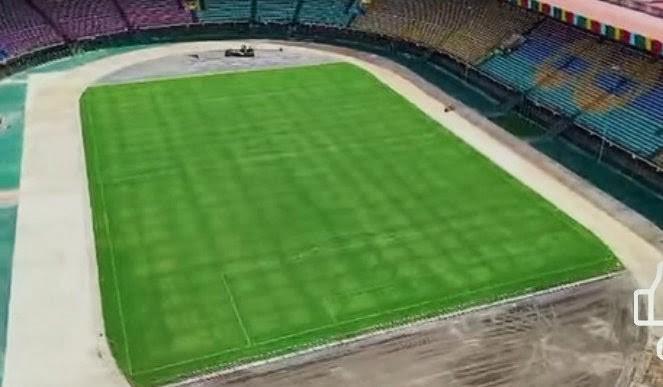
FIC REPORT (LAGOS STATE) – The Teslim Balogun Stadium in Surulere has torn out its artificial turf for a new natural grass pitch built to international standard, the latest in a string of facility upgrades that Lagos State officials are pitching as central to Governor Babajide Sanwo-Olu’s drive to use sports as an engine of economic and social development.
The replacement pitch, now a lush green expanse where the old turf once sat, is engineered with four sub-surface drainage layers designed to keep the field clear of flooding, topped by a fifth layer of surface drainage spaced at 1.5-metre intervals. The stadium is being lined up to host the maiden National Intermediate Games in the first quarter of 2027, alongside whatever other major events come its way in the meantime.
Speaking at the pitch’s unveiling, Mr Deji Aladegbemi, Director of Sports Facilities at the Lagos State Sports Commission, situated the project within a much wider push — one he said is unfolding simultaneously across other sporting centres statewide as evidence of the governor’s commitment to driving growth through sport. “One good thing about Lagos is our ability to take sporting events to every corner of the state. Lagos is ready, we are prepared, and the government will not stop with these eight stadia; we will continue to build more. Badagry, for instance, is a key location where sports and facilities will drive tourism and entertainment to that axis,” he said.
On how the upgraded stadium will actually be run, Aladegbemi described a hybrid model built around government and private-sector collaboration. “The management of the stadium will be a mixed model, a collaboration between the government and the private sector. While we build internal capacity within our workforce, we will simultaneously seek external support and investment to generate income. The private sector wants to align its brand with something that works and stands the test of time,” he said.
He was equally firm on how the new pitch will be protected, insisting the venue would be shielded from unauthorised, non-sporting use in order to preserve it. “We must move away from the facility management practices of past decades and adapt to current realities. The State has other centres available for social engagements,” Aladegbemi said.
Engr Adeleke Olanrewaju, Managing Director of Peculiar Concerns Limited, the firm that handled the project, praised the state government’s vision in commissioning a world-class pitch as part of a wider rollout spanning eight stadia. He argued the upgrades put the venue in a strong position for FIFA accreditation, noting that pitch quality is the area certifying authorities scrutinise most closely — and the area where many Nigerian stadiums have historically fallen short. “Many stadiums in Nigeria have failed to secure FIFA accreditation due to poor pitch quality. Attention is often given to other departments at the expense of the pitch, which is what certifying authorities evaluate most strictly. Prioritising pitch quality is essential for certification,” he explained.
Olanrewaju noted that full FIFA accreditation requires four training pitches to complement a main stadium — a threshold Lagos State has cleared with room to spare, having built eight standard pitches across various locations to serve as practice facilities.
He also spoke to the new pitch’s resilience, saying it is built to hold up against shifting weather conditions provided it receives specialised care beyond basic watering, and advised that its use be restricted strictly to football to get the most out of its lifespan.
Sourced and Reported from Lagos by:
IYEDEH Onowouzou David
ACIO&PRO
25/09/2026