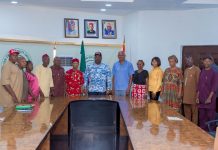



FIC Report (Ondo State) – The Cocoa and Coffee Farmers Alliance Association of Africa (COCEFAAA) has urged the Federal Government to urgently finalise and implement a National Coffee Strategy designed to revitalise coffee production, strengthen smallholder farmers’ livelihoods, and reposition Nigeria in the global coffee market.
The call was made by the Association’s President, Comrade Adeola Adegoke, during a two-day stakeholders’ meeting and flag-off ceremony for the establishment of 1,000 hectares of coffee plantations, organised by Lingzhi Global Nigeria Limited and the Ondo State chapter of the National Coffee and Tea Association of Nigeria (NACOFTAN), in Akure, Ondo State.
Adegoke urged the Federal Government to situate coffee firmly within the agricultural policy framework, while ensuring that farmers benefit from subsidised inputs, effective extension services, and export-oriented incentives that would enhance both productivity and competitiveness.
“We urge the Federal Government to finalise and implement a National Coffee Strategy—one that places coffee squarely within the agricultural policy domain and ensures that smallholder farmers have access to subsidised inputs, extension support, and export incentives,” he said.
He further appealed to the Ondo State Government to establish a dedicated coffee development fund and prioritise post-harvest infrastructure, including processing mills, roasting and storage facilities, and export certification centres.
Highlighting the economic significance of coffee, Adegoke noted that two billion cups of coffee are consumed daily, underscoring its status as one of the world’s most actively traded agricultural commodities. He cited that the global coffee market, valued at USD 284.8 billion in 2025, is projected to reach USD 486.2 billion by 2035.
“Minimum of 25 million farming families worldwide depend on coffee for their livelihood, representing more than 100 million people. These figures confirm that coffee is not a marginal commodity. It is a strategic product with substantial economic, social, and geopolitical relevance,” he said.
According to him, Nigeria’s coffee sector has continued to decline despite rising global demand and favourable climatic conditions for cultivation. He noted that while the country produced approximately 95,000 bags of coffee in the 1960s, output has since deteriorated, leaving Nigeria among the world’s lowest coffee exporting nations.
Adegoke said the 1,000-hectare coffee initiative in Ondo State represents a deliberate and strategic effort to restore Nigeria’s standing in the international coffee market and to reinforce the nation’s agricultural diversification agenda.
He disclosed that, when fully mature, the project is expected to generate over $2.9 million annually, while creating employment opportunities for more than 5,000 farmers and workers across the coffee value chain.
Also speaking at the event, Ondo State Governor, Lucky Aiyedatiwa, described the initiative as a landmark development that will revive coffee production in the state and deepen economic diversification through agriculture.
Represented by the Commissioner for Agriculture and Forestry, Engr. Leye Akinola, the governor stated that the project would directly engage over 2,000 farmers and generate thousands of additional jobs across processing, packaging, transportation, and export activities.
He assured stakeholders of continued government support through extension services, secure land access, rural road development, and reliable off-take arrangements for participating farmers.
The governor added that the state, in partnership with Lingzhi Global Nigeria Limited, would also drive value addition through roasting, branding, and packaging—positioning “Made-in-Ondo” coffee for favourable competition in global markets.
In his remarks, the representative of the Honourable Minister of Agriculture and Food Security, Senator Abubakar Kyari, commended the initiative and assured that the Federal Government remains committed to supporting initiatives that expand agricultural production, enhance value chains, and promote smallholder farmers.
Compiled by
Lawrence Blessing Ojooyi
Information officer 1