

The Federal Government has reaffirmed its commitment to strengthening teacher education, accelerating digital transformation, promoting school safety, and expanding inclusive access to quality education through the handover of Information and Communication Technology (ICT) equipment and instructional materials to 15 Federal and State Colleges of Education across Nigeria.
The intervention is being implemented through a partnership between the Federal Ministry of Education, the Government of Japan, the UNESCO International Institute for Capacity Building in Africa (UNESCO-IICBA), and the African Union under the project titled “Capacity-Building of Teachers to Promote Continuous and Inclusive Access to Safe and Quality Education for Girls in West Africa.” The project, launched in 2024, is being implemented in six African countries: Burkina Faso, Cameroon, Chad, Mali, Mauritania, and Nigeria.
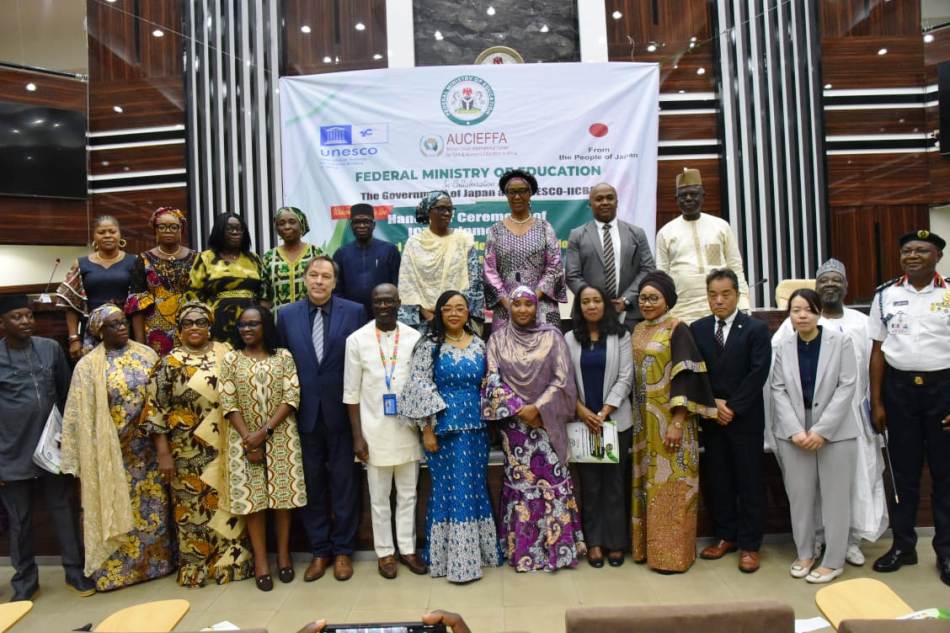
Speaking at the handover ceremony in Abuja, the Honourable Minister of State for Education, Prof. Suwaiba Sa’id Ahmad, described the initiative as a strategic investment in strengthening Nigeria’s education system and advancing the Renewed Hope Agenda.
She noted that the project aligns with national priorities, including Technical and Vocational Education and Training (TVET), STEM Education, Girl-Child Education, Quality Assurance, Data and Digitalisation, and efforts to reduce the number of out-of-school children.
According to the Minister, the ICT equipment comprises 65 laptops, 71 tablets, 23 desktop computers, 5 interactive smart boards, 14 projectors, 15 printers, and 15 backup hard drives. She explained that the facilities will strengthen pre-service and in-service teacher training, expand access to digital learning resources, and promote innovative, inclusive, and learner-centred teaching methods across beneficiary institutions..
Prof. Ahmad emphasized that teachers remain the foundation of every effective education system and stressed that no meaningful reform can succeed without well-trained, motivated, and digitally empowered educators. She further noted that the intervention will be complemented by training on ICT integration, school safety, infrastructure security, and inclusive teaching practices to ensure safe and supportive learning environments, particularly for girls and vulnerable learners.
She commended the Government of Japan, UNESCO-IICBA, the African Union, and other development partners for their continued support in strengthening teacher education and expanding equitable access to quality education across West Africa.
Earlier, the Director of the Colleges of Education Department, Federal Ministry of Education, Dr. Uche.Cecilla. Uba, described the intervention as a milestone in improving teacher preparation and institutional capacity. She explained that the equipment was procured following extensive consultations and needs assessments aimed at addressing gaps in digital literacy and teacher development.
She noted that the initiative goes beyond equipment provision to include capacity-building on ICT integration, gender-responsive pedagogy, school safety guidelines, the Safe Schools Declaration, and infrastructure security.
Delivering the keynote address, the Director of UNESCO-IICBA, Dr. Quentin Wodon, highlighted the importance of girls’ education as a transformative investment for national development. He commended Nigeria’s progress in implementing education programmes and encouraged stronger support for female leadership in schools, as well as participation in UNESCO-IICBA’s professional learning communities and knowledge-sharing platforms.
In her remarks, the Executive Secretary of the National Commission for Colleges of Education (NCCE), Dr. Angela Ladi Adela Jiya, described the intervention as a strategic investment in human capital development. She noted that the facilities would enable Colleges of Education to produce digitally skilled, innovative, and gender-responsive teachers capable of meeting the demands of modern classrooms.
In a goodwill message, the Head of the Education Sector, UNESCO Abuja Office, Mr. Oladeji Adeyemi, reaffirmed UNESCO’s commitment to strengthening teacher education, advancing digital transformation, and promoting safe and inclusive learning environments. He noted that teachers remain central to sustainable education reform and improved learning outcomes.
Representing the Government of Japan, the Chargé d’Affaires of the Embassy of Japan in Nigeria, Mr. Hitoshi Kozaki, described the intervention as a demonstration of commitments under the Tokyo International Conference on African Development (TICAD) framework. He reaffirmed Japan’s support for quality education, human security, skills development, and the empowerment of women and girls across Africa.
Speaking on behalf of beneficiary institutions, the Provost of the Federal College of Education (Technical), Asaba, Dr. James Azuka Olisa, described the intervention as timely and impactful. He assured stakeholders that beneficiary institutions would ensure effective utilization and maintenance of the equipment to maximize its long-term benefits.
The beneficiary institutions include Federal Colleges of Education in Kontagora, Zaria, Yola, Oyo, Umunze, Gombe, and Asaba; College of Education, Zuba; Isaac Jasper Boro College of Education; Enugu State College of Education (Technical); Sa’adatu Rimi College of Education, Kano; Adamu Augie College of Education, Argungu; Shehu Shagari College of Education, Sokoto; Adamawa State College of Education, Hong; and Taraba State College of Education, Zing.
The Federal Ministry of Education expressed appreciation to the Government of Japan, UNESCO-IICBA, the African Union, and all development partners for their continued support. Beneficiary institutions were urged to ensure effective utilization and maintenance of the facilities to strengthen teacher preparation, enhance digital literacy, and improve learning outcomes nationwide.
Boriowo Folasade
Director, Press and Public Relations