

The Federal Government has intensified its nationwide education sector reforms with the rollout of full Computer-Based Examinations (CBE) for the National Examinations Council (NECO), recording a nearly 90 percent reduction in examination malpractice as it targets the total elimination of examination fraud by 2027.
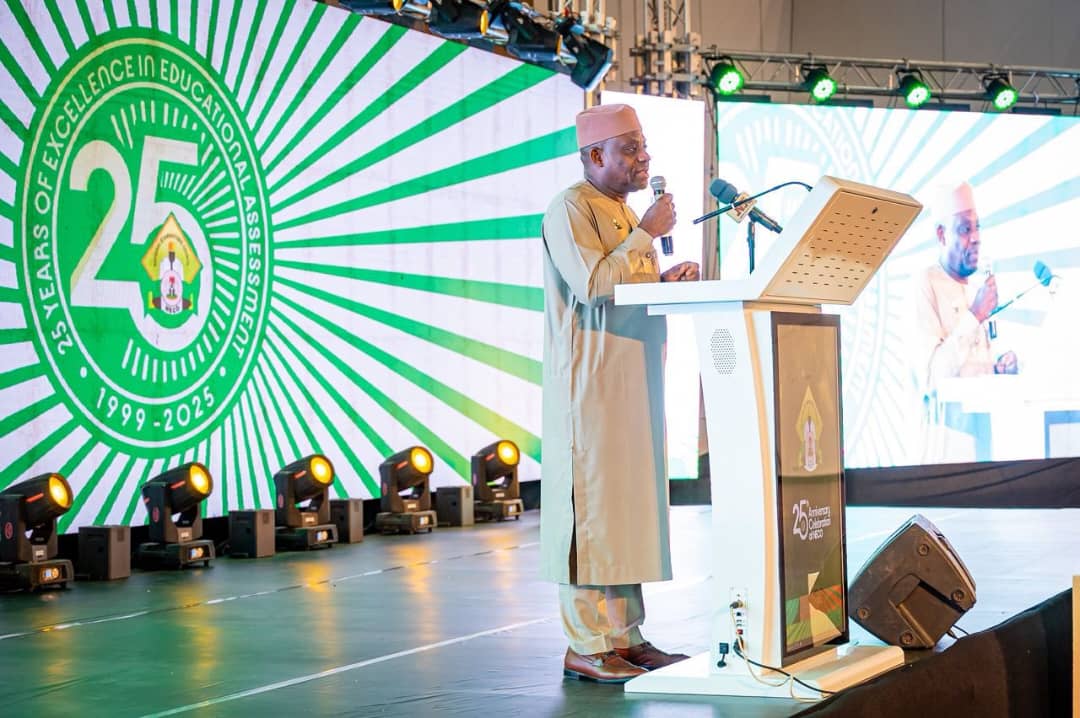
The renewed commitment was reaffirmed during NECO’s Silver Jubilee celebration in Abuja, where the Federal Government highlighted ongoing reforms aimed at strengthening transparency, credibility, affordability, accessibility, and global competitiveness in Nigeria’s examination system.
Vice President Kashim Shettima, represented by his Senior Special Assistant on Legal and Compliance Matters, Barrister Bashir Maidugu, described credible examinations as fundamental to national development, human capital growth, and educational advancement. He stressed that NECO must continue to provide affordable and accessible examination services to Nigerians across all social and economic backgrounds while sustaining international standards and transparency in examination administration.
The Vice President commended NECO’s embrace of digital innovation to improve examination security, result processing, and operational efficiency, noting that technology-driven reforms are critical to safeguarding the future of Nigerian learners in an increasingly digital and artificial intelligence-driven world. He further called for stronger examination security mechanisms, timely release of results, and expanded capacity-building opportunities for teachers and examiners nationwide.
Speaking at the event, the Honourable Minister of Education, Dr. Maruf Tunji Alausa, described NECO as one of the critical pillars supporting Nigeria’s educational system through credible, standardised, and inclusive national assessments. He disclosed that the Federal Government’s digital reforms have already reduced examination malpractice significantly and announced that NECO would commence full Computer-Based Examinations this year as part of broader efforts to modernise assessment systems nationwide.
According to the Minister, the deployment of Computer-Based Examinations will enable real-time monitoring of candidates, rapid detection of suspicious activities, and improved examination administration capable of guaranteeing fairness, accountability, and integrity across public examinations. He added that the reforms are aligned with global best practices and designed to promote critical thinking, digital literacy, innovation, and problem-solving skills among Nigerian learners.
Dr. Alausa noted that the Federal Government remains committed to restoring public confidence in national examinations through strengthened quality assurance systems, enhanced data management processes, and technology-driven monitoring frameworks that protect the integrity of certification in Nigeria.

Delivering his address, the Registrar and Chief Executive of NECO, Professor Dantani Ibrahim Wushishi, described the Silver Jubilee celebration as an opportunity to reflect on the Council’s remarkable growth, institutional reforms, and contributions to educational assessment over the past twenty-five years. He stated that NECO overcame its early operational challenges through professionalism, transparency, and continuous technological innovation.
Professor Wushishi highlighted major reforms introduced by the Council, including online registration systems, internet-based result access, e-certificates, digital verification platforms, and advanced data analytics systems aimed at strengthening examination administration and service delivery. He further disclosed that NECO now conducts examinations in eight countries and continues to collaborate with regional and international assessment bodies to improve educational mobility and harmonise assessment standards.
He also announced that the Council is intensifying anti-malpractice measures through Computer-Based Examinations and unveiled a commemorative publication titled “25 Years of NECO: Evolution, Challenges and Contributions to Nigeria’s Educational Assessment System.”
Earlier in her remarks, Chairperson of the NECO Governing Board, Professor Modupe Adeola Adelabu, described the anniversary as a celebration of resilience, institutional dedication, and sustained reforms in examination administration. She commended the leadership of the Federal Ministry of Education, particularly the Honourable Minister of Education, Dr. Maruf Tunji Alausa, and the Honourable Minister of State for Education, Professor Suwaiba Sa’id Ahmad, for driving reforms that continue to strengthen public trust in Nigeria’s education sector.
Professor Adelabu reaffirmed NECO’s commitment to integrity, inclusiveness, accountability, and examination credibility while appreciating stakeholders whose contributions continue to support educational assessment and national development.
Also speaking at the event, the representative of former Head of State, General Abdulsalami Abubakar, described NECO as a symbol of educational excellence and national progress. He commended the Council for sustaining transparency, fairness, and efficiency through technology-driven reforms and capacity-building initiatives that have strengthened examination processes and enhanced public confidence over the past twenty-five years.
The Federal Ministry of Education reaffirmed that ongoing reforms under the Renewed Hope Agenda of President Bola Ahmed Tinubu remain focused on restoring integrity, expanding access, modernising educational systems, and positioning Nigeria’s education sector to meet global standards. The Ministry assured Nigerians of its continued commitment to policies and innovations that guarantee credible examinations, protect the future of learners, and strengthen confidence in the nation’s educational institutions.
Mrs. Boriowo Folasade
Director, Press and Public Relations