

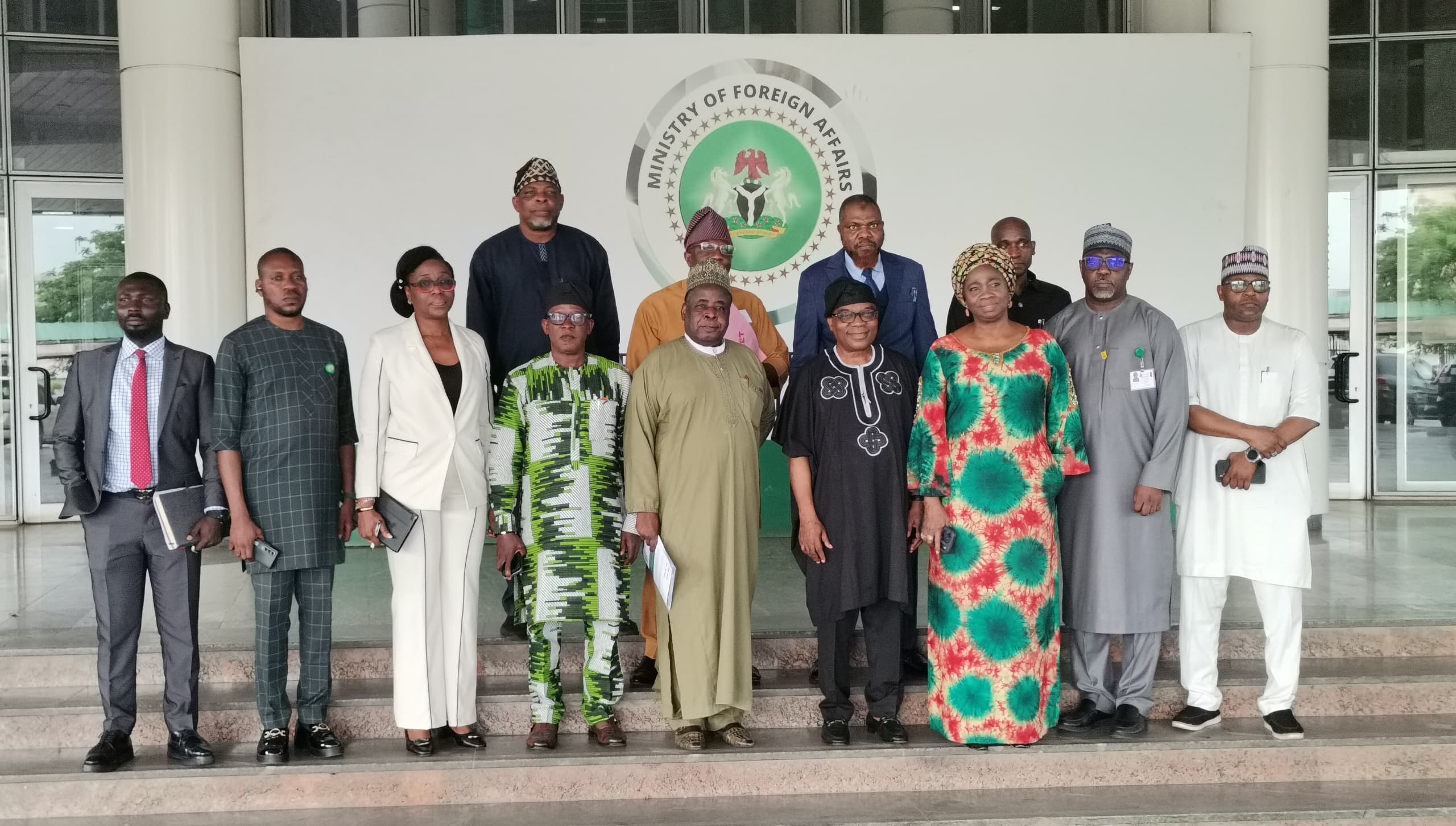
Her Excellency, the Honourable Minister of Foreign Affairs of the Federal Republic of Nigeria, Ambassador Bianca Odumegwu-Ojukwu, on Wednesday, 22 July 2026, received the Federal Minister for Foreign Affairs of the Federal Republic of Germany, His Excellency Dr. Johann David Wadephul, at the Ministry of Foreign Affairs, Abuja, where both countries reaffirmed their commitment to deepening bilateral cooperation and strengthening their longstanding strategic partnership.
Welcoming Dr. Wadephul on his first official visit to Nigeria, Ambassador Odumegwu-Ojukwu described the visit as a reflection of the enduring friendship between both countries, built over more than six decades on mutual respect, shared values and productive cooperation. She commended Germany’s continued support for Nigeria’s development priorities, peacebuilding efforts and regional integration in West Africa.
During the bilateral talks, both Ministers reviewed the excellent state of relations between Nigeria and Germany and reaffirmed their commitment to enhancing political dialogue, expanding trade and investment, promoting sustainable development, and strengthening cooperation in renewable energy, critical minerals, digital innovation, artificial intelligence, agriculture, manufacturing, healthcare, infrastructure development and the green economy.
Ambassador Odumegwu-Ojukwu reaffirmed Nigeria’s commitment to implementing the outcomes of the Fifth Session of the Nigeria-Germany Binational Commission, the principal framework for bilateral cooperation. She welcomed Germany’s continued support for the Presidential Power Initiative, renewable energy transition, agricultural transformation and sustainable economic development, while encouraging increased German investment in Nigeria’s priority sectors in line with the Federal Government’s economic reform agenda.
Both Ministers also exchanged views on regional and global developments, noting that emerging challenges such as terrorism, violent extremism, climate change, irregular migration, food insecurity and economic uncertainty require stronger international partnerships founded on dialogue, solidarity and shared responsibility. In this regard, Ambassador Odumegwu-Ojukwu commended Germany’s longstanding support for ECOWAS in promoting regional integration, democratic governance, peacebuilding, conflict prevention, humanitarian assistance and institutional capacity development.
On regional security, the German Foreign Minister acknowledged Nigeria’s leadership role in combating terrorism and violent extremism, particularly within the Lake Chad Basin and the wider West African sub-region. He reaffirmed Germany’s commitment to supporting humanitarian assistance, stabilisation efforts, post-conflict recovery and development programmes, while expressing confidence that both countries would continue to deepen cooperation in addressing common security challenges.
Dr. Wadephul described Nigeria as Germany’s foremost strategic partner in West Africa and one of its most important partners on the African continent. He noted that Nigeria remains Germany’s second-largest trading partner in Sub-Saharan Africa, with over one hundred German companies operating in the country, and expressed optimism that his visit, accompanied by a business delegation, would stimulate greater investment and unlock new opportunities for economic collaboration.
The German Foreign Minister further highlighted the progress achieved under the Nigeria-Germany Binational Commission, particularly in the areas of renewable energy, critical minerals, pharmaceuticals and biometric technology. He reaffirmed Germany’s commitment to supporting Nigeria’s energy transition through the Presidential Power Initiative and other climate and energy partnerships aimed at expanding access to reliable and affordable electricity.
The meeting also provided an opportunity for discussions on migration and mobility. Ambassador Odumegwu-Ojukwu acknowledged Germany’s efforts to promote legal migration pathways but expressed concern over the persistent backlog in the processing of student visa applications and the difficulties experienced by Nigerians seeking medical visas. She appealed for improved coordination and greater flexibility in addressing genuine humanitarian and consular cases, including an urgent request to facilitate a visa for the mother of a deceased Nigerian student who recently died in Germany following injuries sustained during the conflict in Ukraine.
Responding, Dr. Wadephul acknowledged the concerns raised and assured the Nigerian Government that the German authorities would review the outstanding visa issues, including the humanitarian case presented during the meeting. He reiterated Germany’s commitment to expanding legal migration opportunities while combating irregular migration and human trafficking, and assured that efforts were underway to improve visa processing in Nigeria.
The meeting concluded with both Ministers expressing satisfaction with the strength of Nigeria-Germany relations and reaffirming their determination to deepen cooperation in areas of mutual interest. They expressed confidence that the outcomes of the discussions would further consolidate the strategic partnership between both countries and contribute to regional peace, economic prosperity and sustainable development.
Signed:
Kimiebi Imomotimi Ebienfa, anipr
Spokesperson
Ministry of Foreign Affairs, Abuja
Wednesday 22, July 2026