


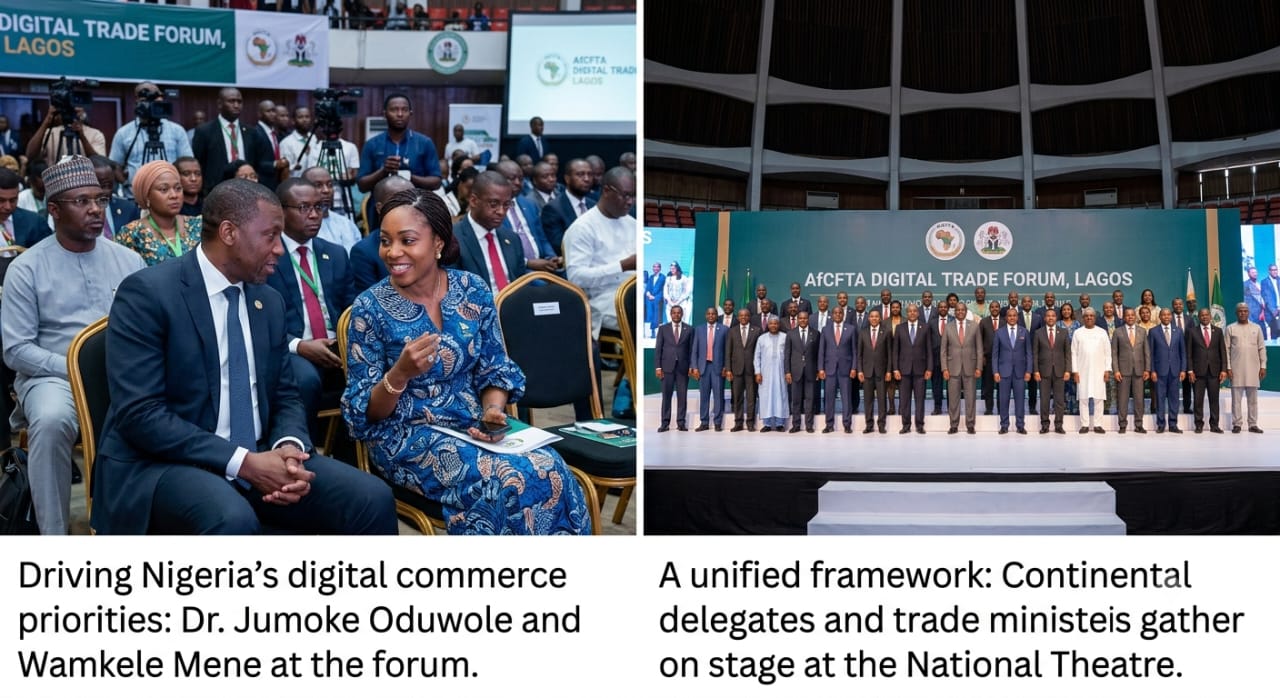
?FIC Report (Lagos State) – The energy in the room was undeniably Lagos—fast-paced, ambitious, and slightly impatient. Inside the packed convention hall, the heavy, bureaucratic language usually found in continental trade treaties was stripped away, replaced by the hum of digital data and the sharp click of smartphones. For two days, Nigeria’s commercial capital became the operational headquarters for the future of African commerce as the African Continental Free Trade Area (AfCFTA) Digital Trade Forum pulled into town. The goal was straightforward but massive: turn Africa’s fragmented digital landscapes into a unified powerhouse, shifting the focus from slow-moving paperwork to lightning-fast execution.
?It is a transition that arrives not a moment too soon. President Bola Ahmed Tinubu framed the high-stakes summit by reminding continental delegates that the era of theoretical agreements is over. Africa, he urged, must move decisively from aspirations on paper to tangible prosperity in the everyday lives of its people. To prove the point, federal officials showcased Nigeria’s new National Single Window, a digital initiative specifically designed to cut through bureaucratic red tape and lower the crushing overhead costs that have long crippled cross-border entrepreneurs.
?The spotlight remained firmly on the host nation when AfCFTA Secretary-General Wamkele Mene took the podium to deliver a major announcement. Nigeria has officially become the very first State Party to complete full parliamentary ratification of the AfCFTA Protocol on Digital Trade. It is a strategic first-mover advantage that puts Nigerian tech at the wheel of a continental digital market currently valued at `$180 billion, a figure projected to skyrocket to a staggering $712 billion by 2050. Driven by mobile money expansion and a hyper-connected youth population, the potential is boundless, even if immediate hurdles like high internet costs and fragmented local laws still linger.
?Nigeria’s Minister of Industry, Trade and Investment, Dr. Jumoke Oduwole, made it clear that Lagos is the perfect launchpad for this digital evolution. She outlined a aggressive suite of domestic reforms already working behind the scenes, including intellectual property protections woven into the Tax Reform Act to shield young innovators. More impressively, the ministry has just completed Africa’s first comprehensive mapping of a national digital services ecosystem, creating a practical roadmap to help homegrown startups seamlessly scale into lucrative markets like Kenya, Egypt, and Ghana. By actively dismantling cross-border licensing friction, the government is betting big on its local talent.
?As the forum drew to a close with a unified eight-point call to action, the ultimate takeaway was clear to everyone in attendance. While the legal and regulatory foundations of this historic protocol are finally secure, the real test of the AfCFTA will not be measured by the signatures of politicians. Instead, the true victory will belong to the small business owners, the tech builders, and the young entrepreneurs who, from the tech hubs of Lagos to the markets of Nairobi, can finally sell their ideas across an entire continent with a single tap of a screen.
Gloria Dawodu
CI&PRO
8th July 2026