

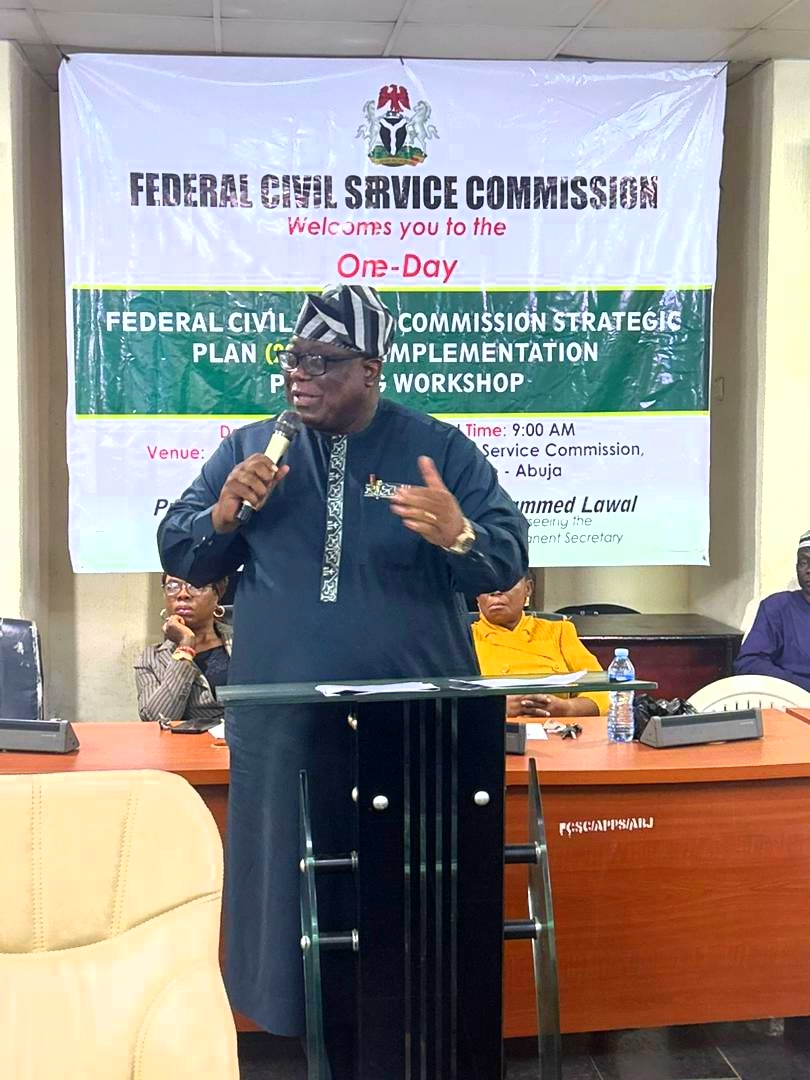
The Chairman of the Federal Civil Service Commission (FCSC), Professor Tunji Olaopa, has emphasized the urgency of repositioning the Commission as the central gatekeeper of professional public administration, as Nigeria embarks on implementing its 2026–2030 Strategic Plan.
Speaking at the Strategic
Plan Implementation Planning Workshop on Monday, in Abuja. Professor Olaopa described the session as a critical step toward deepening stakeholders’ understanding of the reform agenda ahead of its presentation to the Federal Executive Council.
He noted that while the workshop could not exhaustively address the granular details of the plan, it was essential for aligning internal stakeholders with the strategic vision.
“It would be a disservice if, upon national rollout, internal actors are still engaging the plan at a superficial level,” he stated.
The Chairman underscored that the Strategic Plan signals a renewed recognition by the Federal Government of the Commission’s pivotal role in Nigeria’s national transformation journey. He explained that the reform agenda is aligned with the administration’s broader governance priorities and aims to restore the Commission’s historic mandate as the custodian of merit, standards, and professionalism in the Federal Civil Service.
Central to the reform is the re-establishment of competency-based human resource management across Ministries, Departments, and Agencies (MDAs). According to Professor Olaopa, this shift is vital for rebuilding institutional capacity, enhancing organizational intelligence, and reducing over-reliance on external consultants.
He further highlighted the need for a multi-dimensional cultural transformation within the civil service—one that fosters policy intelligence, managerial excellence, and a strong ethos of patriotism among public servants. This cultural reset, he noted, will form the foundation for nurturing a new generation of public sector leaders capable of driving sustainable national development.
Reflecting on historical benchmarks, Professor Olaopa recalled the legacy of the pre-1970s Public Service Commission, which upheld meritocracy and safeguarded the professional integrity of the civil service. He explained that the current reform draws inspiration from that era, particularly its disciplined gatekeeping role and commitment to values-driven administration, while adapting to contemporary realities such as federal character considerations.
“The theory of change guiding this Strategic Plan is clear,” he stated. “The Commission must undergo introspection and institutional renewal to effectively reclaim its leadership role in shaping a competent, accountable, and performance-driven civil service.”
The workshop marks the beginning of a phased implementation process, with detailed execution frameworks and stakeholder engagements expected to follow.
Ibraheem Zakariyya,
Head, Press & Public Relations
4th May, 2026