


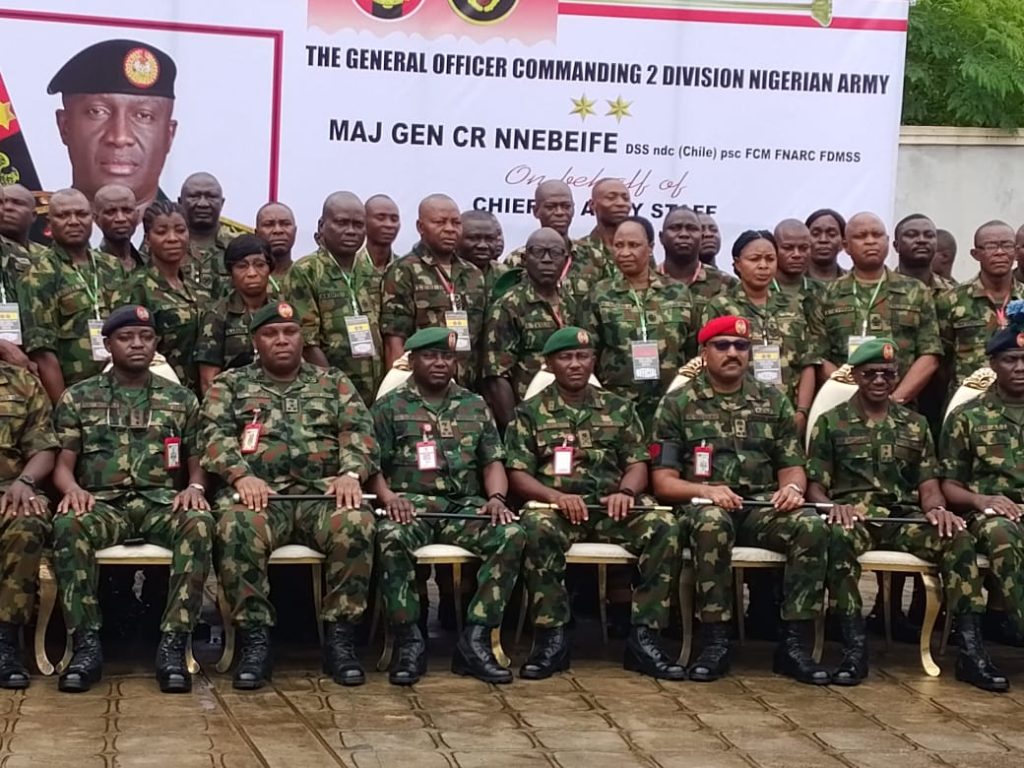
FIC Report (Oyo State) – The Nigerian Army, on Monday, began a historic Convention for its Chief Clerks to enhance the Army’s decision-making processes across all its formations.
While opening the convention, the Chief of Army Staff (COAS), Lieutenant General Waidi Shaibu, called for stronger joint military operations, improved administrative efficiency, and faster decision-making systems as part of ongoing reforms aimed at repositioning the Nigerian Army to tackle the emerging security threats.
The opening ceremony of the maiden Nigerian Army Chief Clerks’ Convention 2026 was held at Eledua Event Hall, Moniya, Ibadan.
According to the organisers, the four-day convention, which brought together Chief Clerks from the Army formations across the country, was aimed at strengthening administrative professionalism, enhancing record management systems, and improving decision-support structures within the Army.
The Chief of Army Staff, who was represented by the General Officer Commanding (GOC) 2 Division, Major General Chinedu Nnebeife, said that the contemporary security challenges facing the country require a more coordinated, technologically driven military structure capable of responding swiftly to emerging threats.
According to him, modern warfare is increasingly being shaped by asymmetric and hybrid threats, such as terrorism, insurgency, cyber-attacks, disinformation, and transnational organised crime, all of which demand rapid and accurate decision-making across command structures.
“These challenges demand a flexible and coordinated response across the defence and security architecture. Within this environment, administrative precision, real-time information flow, and personnel accountability have become as critical to mission success as firepower and manoeuvre,” he said.
General Shaibu stressed that joint operations and timely command decisions remain were central to operational success, noting that no single security agency can effectively address today’s complex threats in isolation.
The COAS explained that the convention was organised to assess and strengthen the role of Chief Clerks in supporting command decisions through efficient information management and administrative coordination.
The Army Chief noted that the clerical cadre plays a strategic role in ensuring accurate records, timely communication, and effective administrative support, all of which directly influence operational effectiveness in the field.
He further outlined five key pillars of the Nigerian Army’s transformation agenda, including strengthening professionalism and discipline, enhancing administrative efficiency, improving training and operational readiness, deepening technological integration, and advancing personnel welfare.
General Shaibu disclosed that ongoing reforms within the Army included the digitisation of service records, automation of pay and allowances, and deployment of an integrated human resource management system across formations.
“These reforms are designed to improve transparency, speed, accountability, and ensure that commanders have access to accurate manpower data for planning and execution,” he said.
He also reaffirmed the military’s commitment to capacity development, stating that institutions such as the Nigerian Army School of Finance and Administration would be strengthened to equip personnel with modern skills in digital administration, leadership, and operational documentation.
The COAS emphasised that Chief Clerks must evolve beyond traditional administrative duties to become operational enablers capable of supporting commanders in complex and fast-changing security environments.
On personnel welfare, Shaibu reiterated the Army’s commitment to improving accommodation, healthcare, and morale under the “Soldier First” philosophy of the present administration of the President Bola Ahmed Tinubu.
“A soldier who is well motivated and properly managed administratively will give his best in service to the nation,” he added.
He commended the GOC 2 Division, Major General Chinedu Nnebeife, the Local Organising Committee, and the Department of Personnel Management for successfully hosting the convention.
Shaibu expressed appreciation to President Bola Ahmed Tinubu for his continued support for the Armed Forces, reaffirming the Army’s loyalty to the Commander-in-Chief and the Constitution of the Federal Republic of Nigeria.
Earlier in his welcome address, the GOC 2 Division, Major General Chinedu Nnebeife, whose remarks were delivered by the Commander, 2 Provost Group, Brigadier General Uche Charles Nnabuihe, described the convention as a timely platform for strengthening administrative capacity within the Army’s clerical cadre.
The GOC said that the Chief Clerks remain the “engine room” of military administration, noting that their efficiency in handling records and correspondence directly impacts command decisions and operational outcomes across formations involved in counter-insurgency and other security operations. Nnebeife, therefore, urged participants to maximise the lectures and interactive sessions lined up for the convention, stressing that continuous learning and adaptability remain essential in today’s volatile security environment.
The event was attended by senior military officers, including the Commander, 2 Military Intelligence Brigade, Brigadier General Hasaf Hassan, and the Director of Records, Army Headquarters, Department of Personnel Management, Brigadier General Gabriel Olufemi Olorunyomi, who represented the Chief of Personnel Management, Major General Adewale Adekeye, among others.
It would be recalled that bandits, who were reported to have come from Kwara State, on Friday 15th, May 2026, attacked Ahoro-Esinele and Yewota in the Oriire Local Government Area of the Oyo State, where they killed some of the teachers and kidnapped scores of students and other teachers from three schools in the two communities.
This incident had prompted the Inspector-General of Police, Tunji Disu, whom President Tinubu had ordered to lead the rescue operation, to undertake an operational visit to the scenes of the attacks.
Report by Moses Oyelade, AD(I&PR). FIC, Ibadan.