

FIC Report (Enugu State) – The Enugu State Ministry of Agriculture and Agro-Industrialization has begun a statewide capacity-building programme to equip farmers with climate-change knowledge.
According to the the Commissioner for Agriculture, Dr Patrick Ubru, the initiative is designed to help farmers understand weather patterns and improve productivity across rural communities.
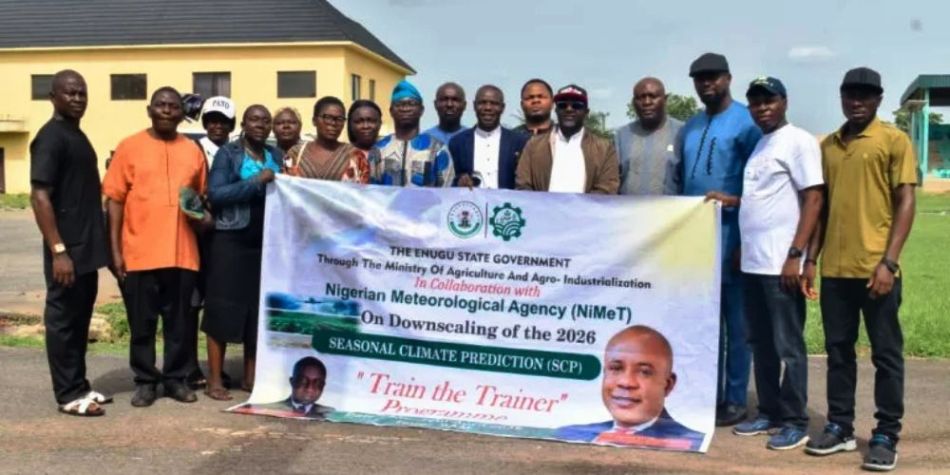
Speaking during the three-day “train-the-trainer” workshop on the downscaling of the 2026 Seasonal Climate Prediction (SCP) in Enugu, organised in collaboration with the Nigerian Meteorological Agency, Ubru said the programme reflects Governor Peter Ndubuisi Mbah’s commitment to agricultural transformation.
“This is a form of capacity building initiated by His Excellency to educate our farmers and give them the right knowledge they deserve,” Ubru said.
“We are here to downscale the 2026 NiMet prediction so farmers can apply it directly to their farming practices.”
He recalled that a similar exercise conducted in 2025 yielded positive results.
“We saw the impact, farmers were able to monitor weather and apply it. Some even understood that the first rain is not always the best time to plant,” he added.
“From the success of last year, His Excellency said we should expand it. Every rural community must be developed. This will help not only farmers but other sectors understand weather patterns”, he said.
On monitoring, the Commissioner said, “We are collecting their data and will keep communication. They will submit reports, videos, and names of those they train. We also have demonstration farms where they will practically experience how weather affects farming.”
In his presentation, Professor Ifeanyi Enete of Nnamdi Azikiwe University said the training was prompted by increasing climate variability.
“Rainfall and temperature patterns have changed significantly. Farmers are the most vulnerable,” he said.
“We need to inform them what the weather will look like so they can plan.”
He explained that onset is “when is the rain going to start” and “cessation is when is it going to end”, while planting period is between the onset and cessation.
According to him, “Only when farmers know these variables, they can be able to plan and develop crop or livestock calendars.”
Enete who is also the Director of Maritime Institute, warned of the economic and health impacts of climate change.
“Floods can destroy farms, forcing farmers to start afresh. Some lose crops, livestock, and even suffer depression,” he said.
On solutions, he advocated smart agriculture, saying “Capacity building and climate information will help farmers avoid weather-related losses. Diversification is key, don’t rely on one crop or livestock.”
He also emphasised soil, water, and agroforestry management. “Too much rain causes flooding; too little leads to drought. Proper soil and water management are essential for resilience,” he added.
The NiMet Zonal Manager South-East zone, Osuyomi Oluwaseyi, explained that the prediction focuses on rainfall onset, length of season, and cessation.
“The predictions vary depending on location. Southern areas experience earlier onset than northern areas,” he said.
Providing details, he noted: “We predicted onset in the southern parts around March 30, while northern areas begin in early April. Some far northern locations may start around April 11.”
On cessation, he said, “Northern areas will experience cessation around November 22, and it cascades downward.”
He added that the length of the season is projected at about 227 days. “These are the key variables farmers need to plan effectively,” he added.
Bonaventure Ngwu, HOC, FIC ENUGU
(13/04/2026).